
JOURNAL
Buckwheat Noodles and Weight Management: Why Buckwheat Alone Is Not Enough
Ingredients, refining, and meal order when considering buckwheat noodles in a balanced diet.
This is educational health information based on publicly available academic material, not an advertisement guaranteeing or recommending a particular treatment or procedure. Appropriate diets vary with individual health; consult a professional for personal application.
“I really want noodles. Buckwheat noodles are healthy, so they should be fine, right?”
You may have considered them a less guilt-inducing option while managing your weight, or searched after hearing that buckwheat is good for you. Conflicting information can make food choices tiring.
This article explains how buckwheat noodles fit into weight management.

Specialist in plastic surgery (Ministry of Health and Welfare registration No. 2190), with 16 years of clinical experience as described in the original post.
Author of a Korean-language book on the fundamentals of slow-aging diets, described in the source as a No. 1 Kyobo bestseller.
Official advisor to Merz Aesthetics Korea.
Publications in international journals, including Frontiers in Ophthalmology in 2026.
During dietary consultations, certain foods repeatedly come up as foods people believed were healthy despite limited weight-loss progress. Buckwheat noodles are one example.
Buckwheat can be a beneficial grain, but processing it into noodles changes the picture. The question is not simply whether to avoid carbohydrates, but which carbohydrates to choose.
In three minutes, this article offers a framework for choosing noodles and other grain-based foods.

Where does the “diet food” reputation come from?
The benefits associated with buckwheat generally refer to whole buckwheat, with the outer layers and germ retained.
Fine milling and refining remove fiber and outer layers, leaving starch that is absorbed more quickly. Commercial buckwheat noodles or soba are finely milled and often mixed with wheat flour. Many are therefore closer to refined noodles with some buckwheat included.
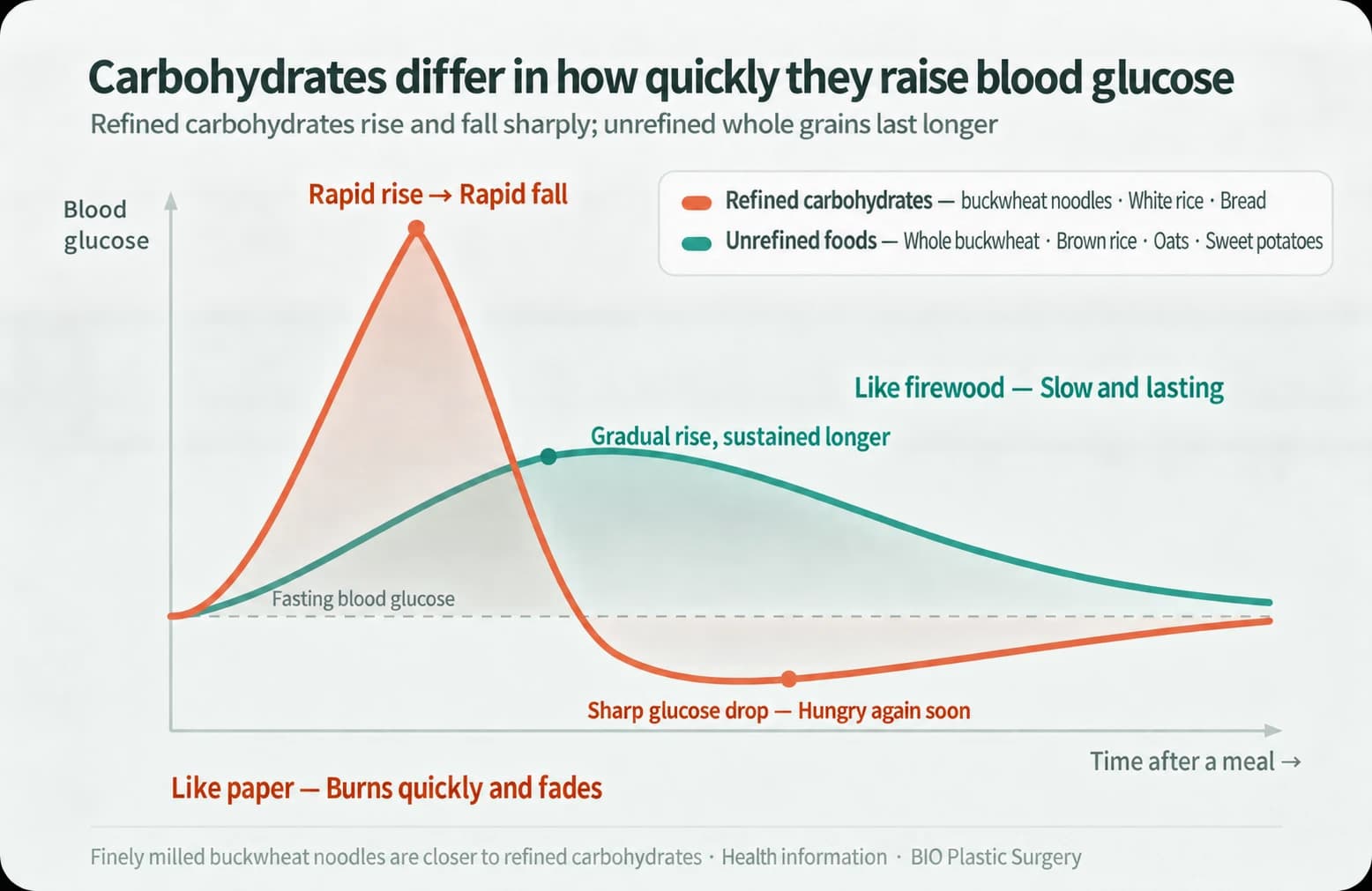
Think of whole grains as firewood that burns slowly, and refined noodles as paper that flares up and fades quickly. Blood glucose can similarly rise and fall more quickly, with hunger returning sooner.
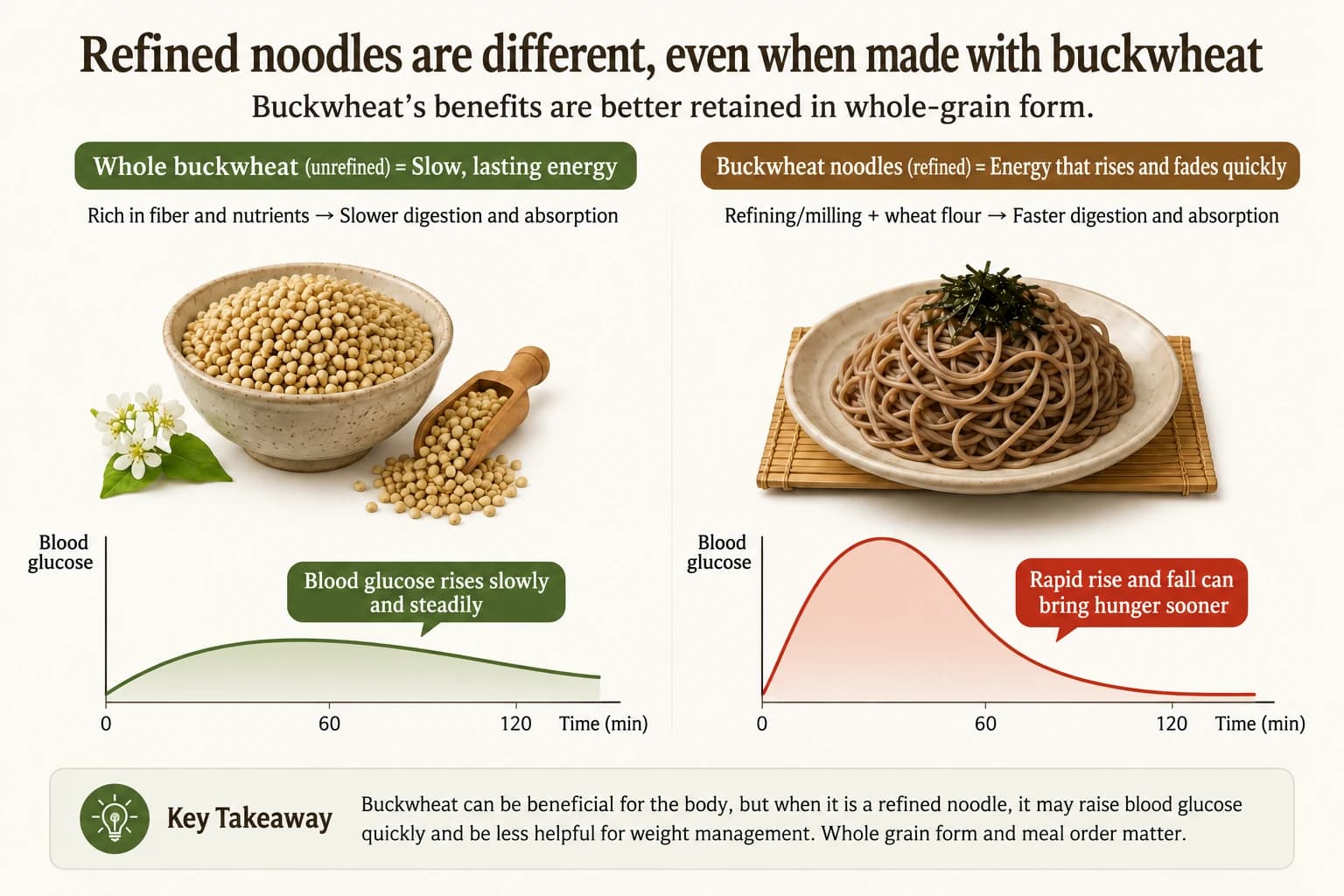
Whole grains generally contain more fiber, B vitamins, iron, zinc, and magnesium than refined grains (Pol et al., 2021, PMC).
Reduce refining rather than eliminating all carbohydrates
I do not generally recommend removing carbohydrates altogether. They are involved in the body’s water balance and provide fuel for immune cells and energy for the brain. Eliminating them completely affects these functions.
The focus is to shift the balance:
- Reduce refined carbohydrates such as white rice, bread, instant noodles, snacks, sugar, and finely milled noodles, including buckwheat noodles.
- Retain less-refined foods such as brown rice, oats, sweet potatoes, winter squash, and whole buckwheat groats.
The form matters even when the grain is the same. Buckwheat contains reported components such as rutin, D-chiro-inositol, and resistant starch. Their potential advantages are better retained in whole-grain form and become less prominent with fine refining and wheat-flour mixtures.
A meta-analysis of nine clinical studies associated buckwheat-supplemented diets with significantly lower blood-glucose concentrations and discussed resistant starch as a contributor to a lower glycemic index (Huda et al., 2018, PMC).
Research has also examined how rutin and fatty acids in buckwheat flour may slow starch digestion and reduce glycemic index (Ikeda et al., 2010, PubMed).
Studies directly comparing whole and refined grains point in a similar direction.
In a crossover trial of people at risk of metabolic syndrome, a whole-grain diet reportedly reduced body weight and inflammatory markers compared with a refined-grain diet (Roager et al., 2019, Gut/PubMed).
The criterion is therefore not simply “it contains buckwheat,” but how much of the grain’s less-refined form remains.
If you still want noodles, consider the order of your meal
You do not always have to give up the satisfaction of noodles. One approach described in the literature is changing meal order:
Vegetables → Protein → Carbohydrates.
Fiber eaten first can slow absorption of foods eaten afterward. Protein can support satiety, so noodles arrive after these moderating elements are already in place. The original article describes a more gradual glucose rise and less fat accumulation with this approach.
A continuous glucose monitoring crossover study reported lower post-meal glucose variability when vegetables were eaten before carbohydrates (Imai et al., 2013, PMC).
For a buckwheat-noodle meal:
- Start with vegetables or salad rather than noodles alone.
- Follow with protein such as eggs, lean meat, or tofu.
- Eat the noodles last, and dip rather than pour the sauce. Tsuyu can contain more sodium and sugar than expected.
Changing the sequence can be simpler than relying on willpower alone.
The key questions are how refined the noodles are and how you combine and sequence the meal, rather than whether the label says buckwheat. The same framework can guide other noodles and grain foods.
If you are interested in dietary and weight-management approaches that fit your health and routine, including maintaining facial tissue, skin, and muscle during weight loss, the author’s Korean-language book provides further discussion.
View the book on Kyobo Book Centre
This is general health information based on public academic sources. It does not guarantee diagnosis, treatment, or procedure outcomes for any individual. Some cited research involves animal studies or clinical findings under specific conditions and may not apply equally to everyone.
Source: Original post on Dr. Hyemi Yu’s Naver blog (Korean)
The original publication date and the website revision date are shown separately.