
JOURNAL
Calcium phosphates and bone regeneration
A historical source account: Calcium phosphates and bone regeneration. Context and outstanding review are distinguished.
This is a historical personal account, notice or shared post. Past dates, affiliations, events and promotional descriptions are distinct from current operating information. Hospital and republication-rights review remain pending.
How does bone regenerate?
The original post included this English passage; bracketed numbers refer to the cited review, rather than to a new reference list on this page:
First, calcium ions affect cells and living systems in several ways. Calcium is one of the ions that form the bone matrix, and it exists mostly in the form of calcium phosphates in bone tissues [28]. These calcium ions cause bone formation and maturation through calcification. In addition, calcium ions affect bone regeneration through cellular signaling. Calcium stimulates mature bone cells through the formation of nitric oxide and induces bone growth precursor cells for bone tissue regeneration [29, 30]. Calcium ions also stimulate the osteoblastic bone synthesis pathway by activating ERK1/2 [31] and increase the life span of osteoblasts by activating the PI3K/Akt pathways [32]. Furthermore, calcium ions regulate the formation and the resorptive functions of osteoclasts [33, 34].
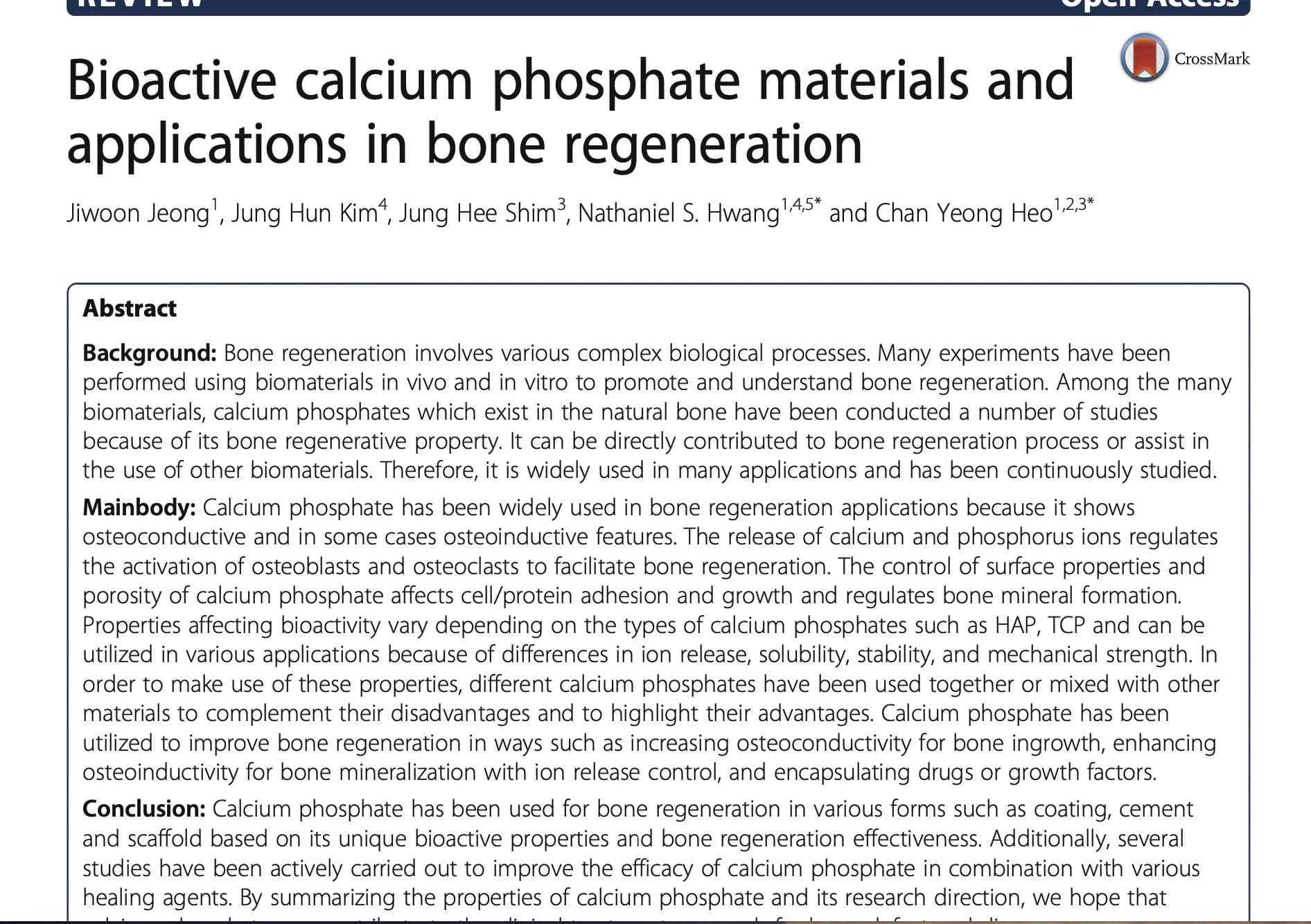
The author then introduced bone repair after fracture, trauma or surgery as a biological process involving cell communication, material compatibility and ions. The post discussed the review Bioactive calcium phosphate materials and applications in bone regeneration by Jiwoon Jeong and colleagues. The original called it a 2023 review; the publisher records publication on January 14, 2019. The source year is retained as a historical discrepancy, not as the corrected bibliographic date.
Calcium phosphate materials
The source discussed hydroxyapatite (HAP), beta-tricalcium phosphate (β-TCP) and whitlockite through their relationship with bone mineral. It distinguished osteoconduction—a framework along which cells can attach and bone can form—from osteoinduction under particular conditions.
It also discussed calcium (Ca²⁺) and phosphate (Pi) release in relation to osteoblast activity and the balance with osteoclasts. The role depends on the specific material and setting; this is a materials-research discussion rather than an outcome promise.
Applications described in the review
The author listed coatings on metal implants to support bone–implant integration; cements used to fill defects and potentially be replaced as remodeling proceeds; three-dimensional scaffolds for cell growth and vascularization; and delivery systems for factors or medicines, including BMP and VEGF.
The source compared the approach with providing soil in which new tissue may grow, rather than simply gluing a fracture together.
Design variables
The source identified particle size and shape, surface roughness, porosity, ion-release rates and combinations with other materials such as polymers or nanoparticles as important variables. It noted that overly rapid dissolution could be associated with inflammatory reactions, whereas an overly stable material might persist instead of being replaced. An appropriate balance therefore depends on design and context.
Supporting a biological repair system
The essay described calcium phosphates as part of a broader platform for studying and influencing repair, from bone grafting to three-dimensional, patient-specific implant research. Its concluding theme was that better design and continuing research may offer more precise ways of supporting bone formation.
Reference and publication-date correction
Jeong J, Kim JH, Shim JH, Hwang NS, Heo CY. Bioactive calcium phosphate materials and applications in bone regeneration. Biomaterials Research. 2019;23:4. Published January 14, 2019. The original blog gave 2023; that year has been corrected against the publisher record.
Source: Original post on Dr. Hyemi Yu’s Naver blog (Korean)
The original publication date and the website revision date are shown separately.