
JOURNAL
Tissue changes after energy treatments: limits of an analogy
Tissue changes after energy treatments: limits of an analogy. Source observations, research context and limitations.
This article discusses the source author’s earlier literature, cases and experiences. Research populations and limitations matter; individual diagnosis and treatment require clinical assessment.
The source asks why some people notice limited improvement after repeated energy-based treatments, particularly after earlier facial surgery or multiple injectable procedures.
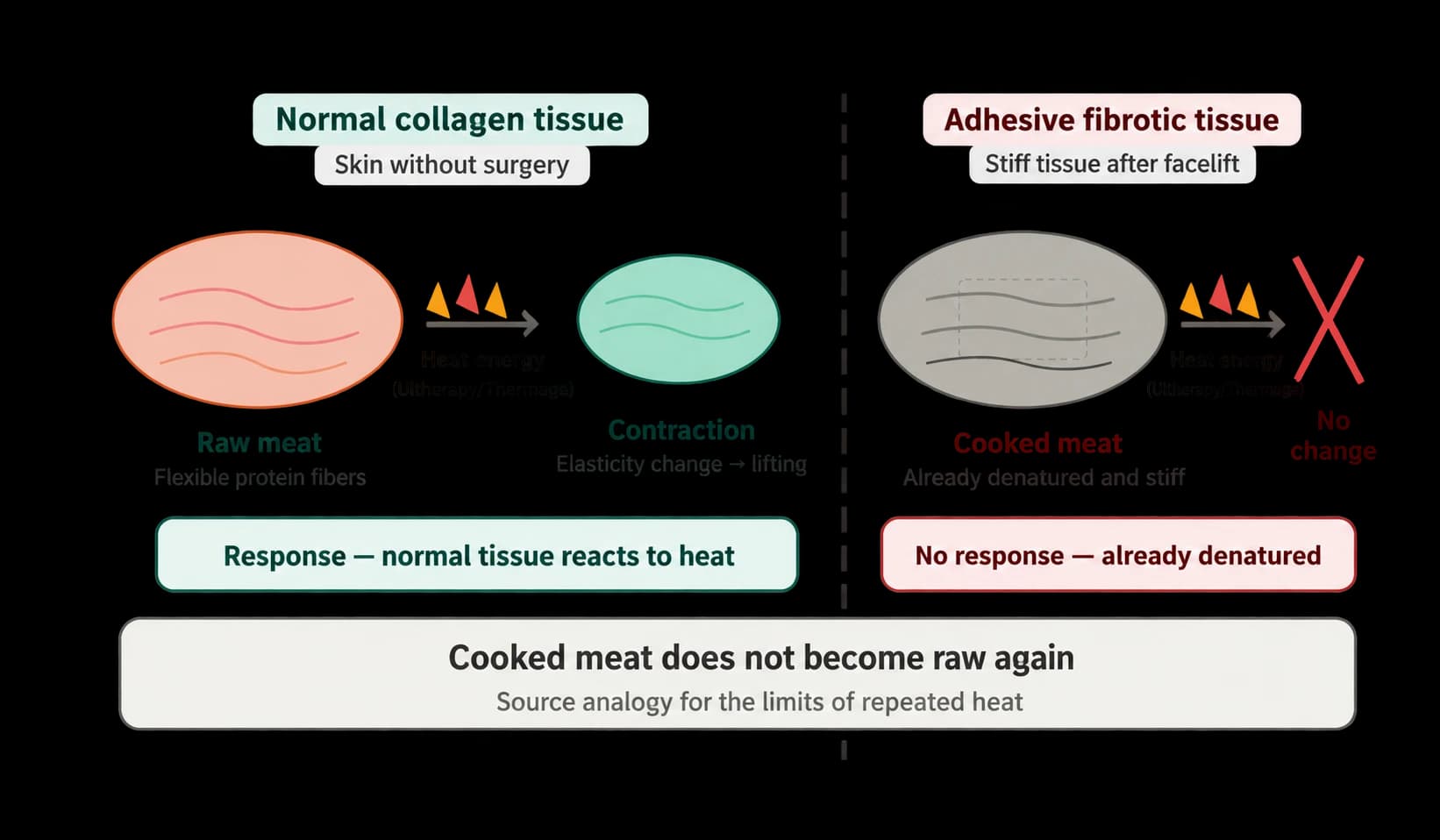
It addresses people with recurrent folds or laxity who have tried nonsurgical treatment after surgery. A lack of response cannot be attributed to one cause without examination.

The author recalls consultations after Ultherapy, Thermage, facial contour surgery, fat grafting or repeated biostimulator treatments. Adhesions were considered as one explanation for altered movement and limited response. The discussion draws on literature from several conditions rather than a direct comparative trial in every facial situation.

Adhesions after surgery
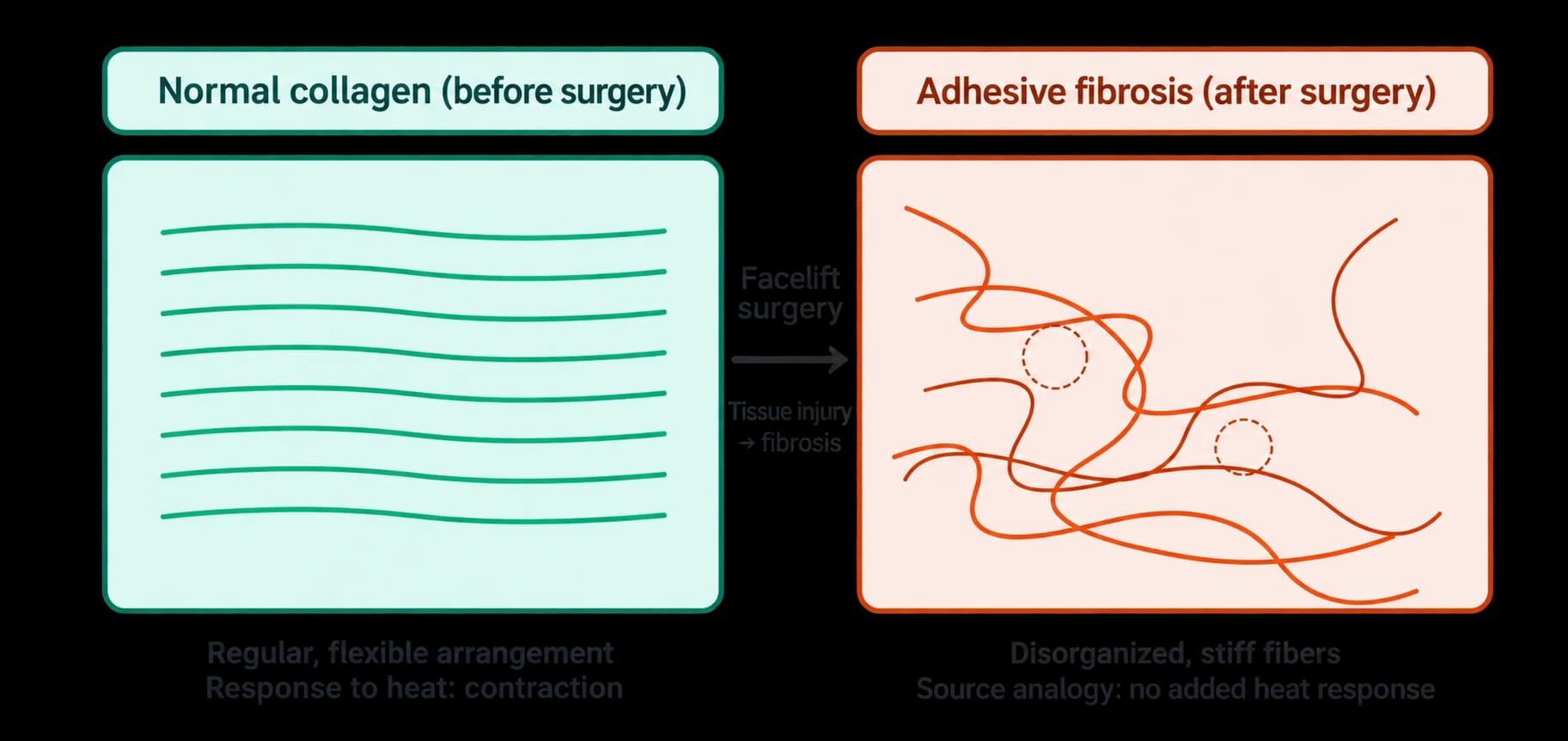
Surgical tissue injury can be followed by collagen deposition and fibrosis. Myofibroblasts, extracellular-matrix turnover and fiber organization are discussed as possible contributors to scar contracture. Wound healing is not identical in every patient.
Source reference: Current progress in understanding the molecular pathogenesis of burn scar contracture. 2017. PMC5441009.
Energy treatment and the limits of a cooking analogy
Ultrasound- and radiofrequency-based devices use thermal effects. The source compares previously altered collagen to cooked meat. This analogy does not prove that living tissue cannot respond to another treatment; device settings, indication and tissue condition matter.
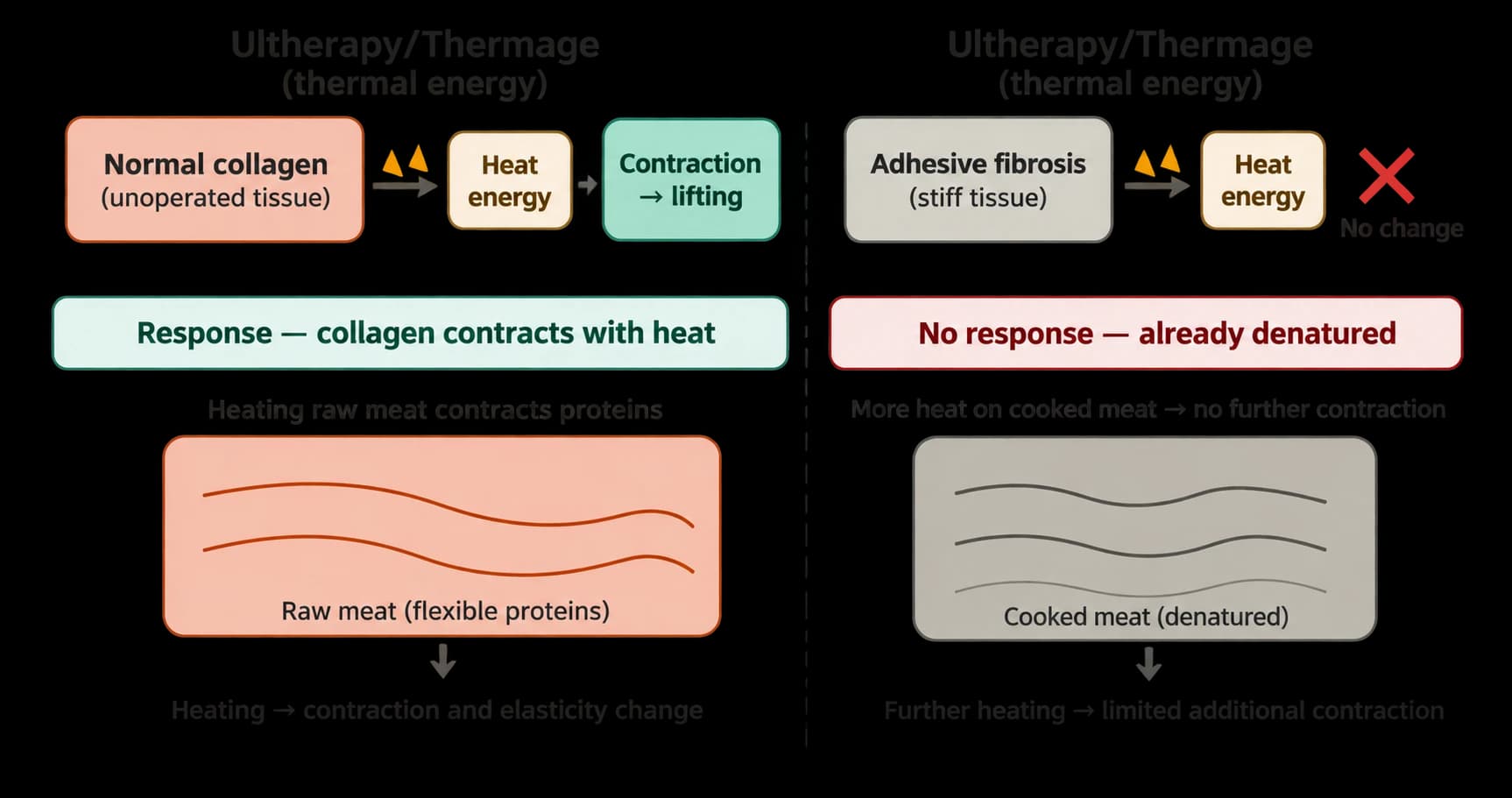
The source’s comparison is an illustration rather than a biological equivalence. It also raises concern about injury after inappropriate settings or repeated HIFU, which must be evaluated using the cited literature.
Source reference: Complications and Risks of High-Intensity Focused Ultrasound (HIFU) in Esthetic Procedures: A Review. Applied Sciences. 2025;15(9):4958. https://www.mdpi.com/2076-3417/15/9/4958
Approaches investigated for contracture
Burn-scar literature discusses release of contracture bands. Needle- or incision-based release is minimally invasive rather than noninvasive. A burn-contracture intervention is not automatically applicable to postoperative facial adhesions.
Source reference: Minimally Invasive Contracture Release Improves Function in Patients with Burn Contractures. Journal of Burn Care & Research. 2023. PMC10185065.
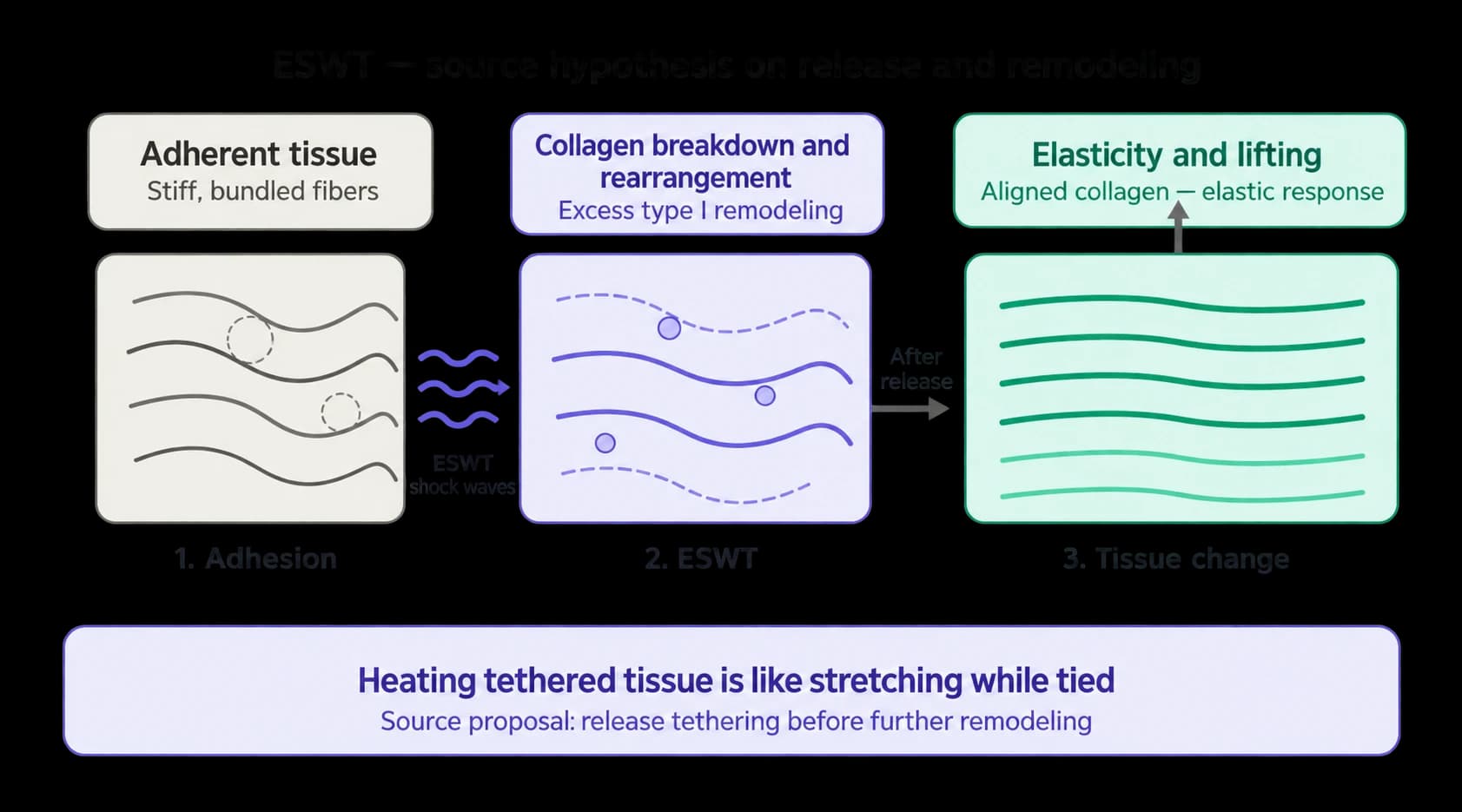
The source discusses mechanical stimulation and collagen remodeling with ESWT. Burn-scar findings must be distinguished from clinical evidence in postoperative facial adhesions. TGF-β1 and α-SMA changes are proposed mechanistic observations rather than guarantees for an individual.
Source reference: Mechanisms of extracorporeal shock wave therapy in burn scar repair: Advances in immunoactivation-based scar remodeling research. Regenerative Therapy. 2025. PMC12205553.
Source reference as listed: The effectiveness of extracorporeal shockwave therapy on hypertrophic scar appearance and hand mobility in a severe burn patient. Burns & Trauma. 2020. Full bibliographic details require confirmation.
The source also mentions hyaluronan-related extracellular-matrix mechanisms. Their relationship to patient outcomes needs separate evaluation.
Source reference: Burn scar pain: from mechanisms to treatments. Frontiers in Physiology. 2025. PMC12504270.
Putting the discussion in context
Fibrosis and adhesions may influence the tissue response after surgery. The source proposes considering release and remodeling rather than repeating heat alone. This is a clinical perspective drawn partly from burn literature, not proof of a universal sequence or an established ESWT effect in all facial adhesions.
This literature discussion does not replace a diagnosis or individual treatment assessment.

Source: Original post on Dr. Hyemi Yu’s Naver blog (Korean)
The original publication date and the website revision date are shown separately.