
JOURNAL
ESWT research for biostimulator nodules
ESWT research for biostimulator nodules. Source observations, research context and limitations.
This article discusses the source author’s earlier literature, cases and experiences. Research populations and limitations matter; individual diagnosis and treatment require clinical assessment.
Nodules after biostimulators
The source discusses persistent lumps and the combination of deposits, inflammation and fibrosis. Juvelook is PDLLA, Sculptra is PLLA and Radiesse is CaHA; these materials must not be merged under PDLLA. ESWT is discussed as an investigated adjunct, not a standard cure.
A mechanical-wave analogy
The source compares ESWT with working hard ground. Mechanical stimulation is a different concept from focused ultrasound and does not mean that a device simply breaks or removes every deposit.
What does the cited study examine?
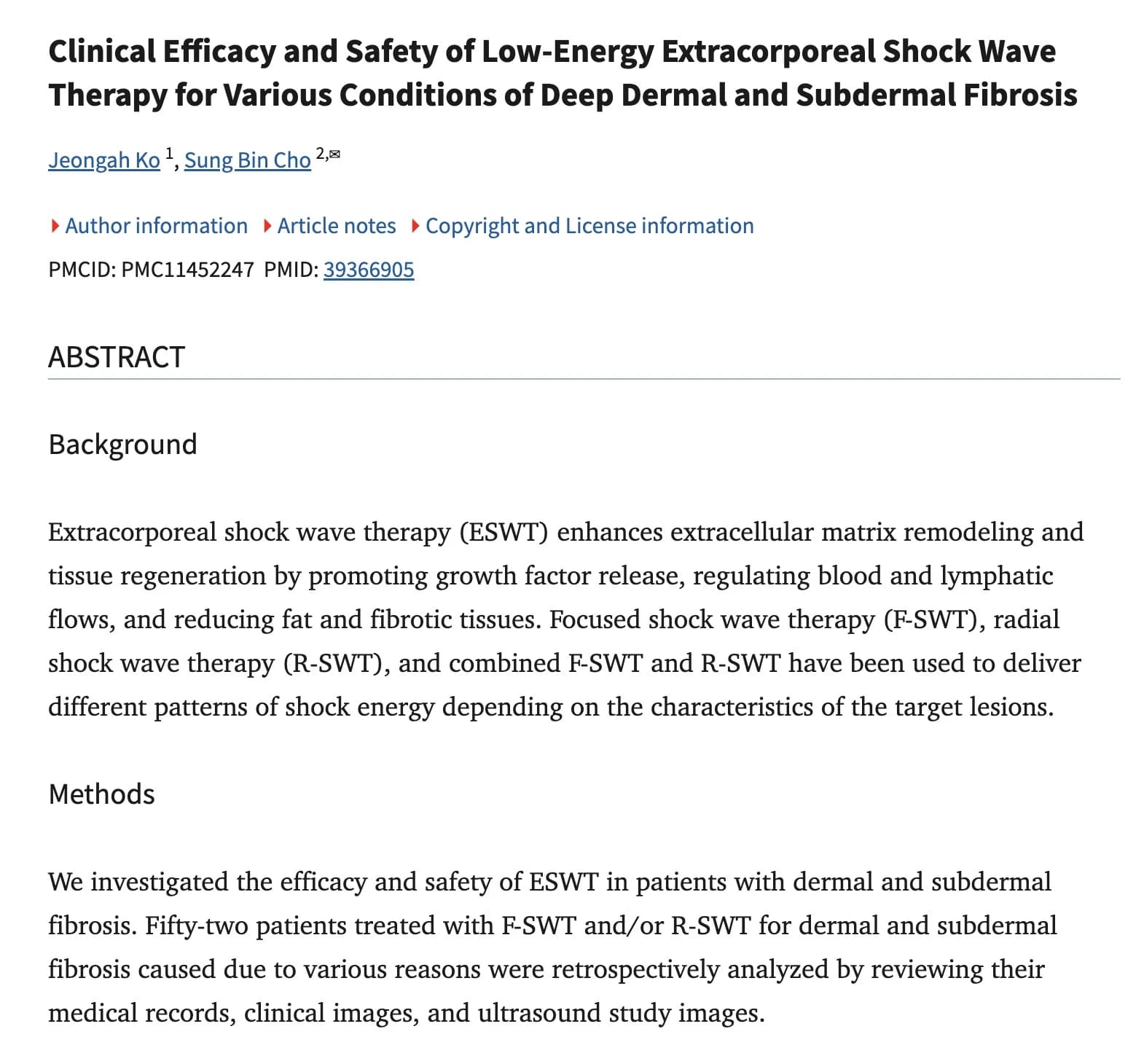
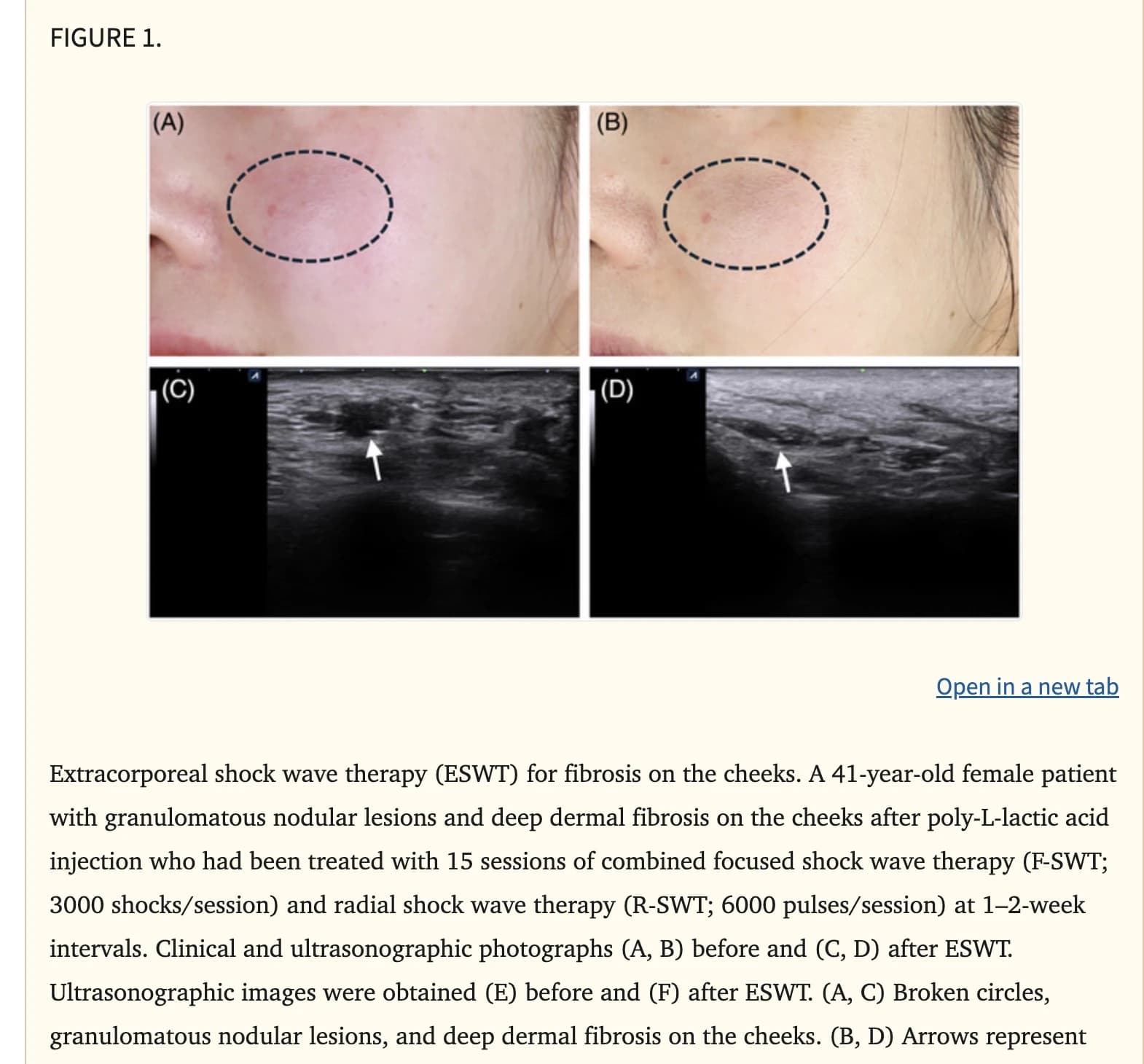
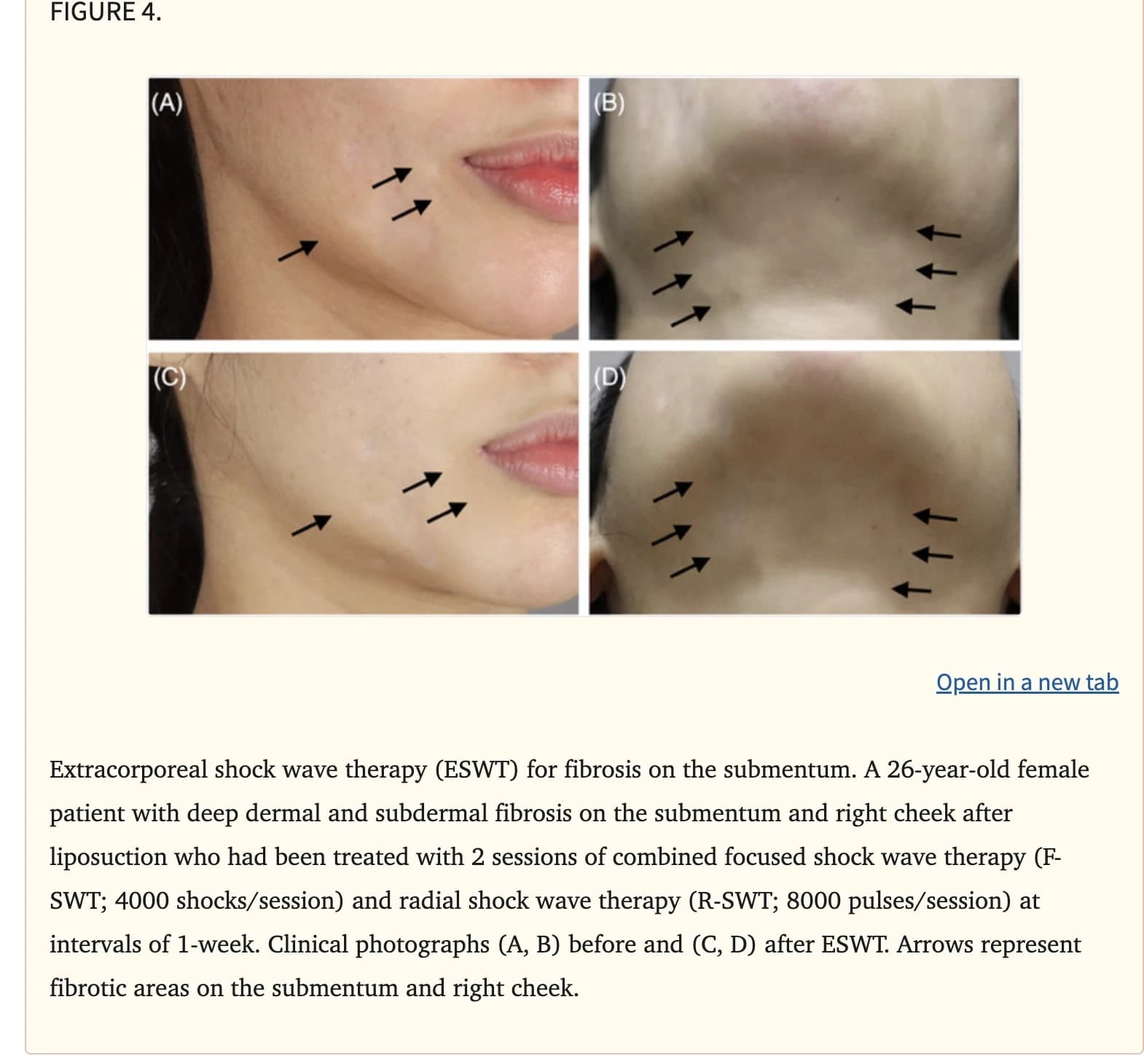
The paper Clinical Efficacy and Safety of Low-Energy Extracorporeal Shock Wave Therapy for Various Conditions of Deep Dermal and Subdermal Fibrosis is available at https://pmc.ncbi.nlm.nih.gov/articles/PMC11452247/. It is a single-center retrospective observational study of 52 patients with different causes of fibrosis, not a controlled trial confined to PDLLA or CaHA nodules. The source quotes improvement in appearance and movement and discusses transient swelling or redness. Optimal protocols and material-specific effectiveness remain unresolved.
Proposed mechanisms
The source discusses mechanical effects, cavitation and shear stress, eNOS/NO and VEGF, matrix metalloproteinases and collagen balance, NF-κB and macrophage polarization, and Substance P/CGRP-related pain pathways. These findings arise from different experimental and clinical settings. They cannot all be assumed to occur or determine improvement in a particular nodule. ESWT is discussed as affecting surrounding tissue rather than directly removing particles.
Questions raised in the source
Can a nodule disappear completely? The source describes an adjunctive remodeling approach rather than guaranteed removal.
Is it painful? Tolerance varies; study reports do not establish a painless treatment.
Does greater hardness predict a better response? Fibrosis, inflammation and calcification differ and require assessment.
Does it replace injection or surgery? These have different roles; superiority is not established here.
Related source posts
Recurrent nodules: https://blog.naver.com/myangel315/223837832369
Ultrasound assessment: https://blog.naver.com/myangel315/223968028026
Inflammation after threads: https://blog.naver.com/myangel315/223997007730
The source regards ESWT as a possible adjunct and calls for more clinical data. The author also describes satisfaction in caring for people with distressing nodules and a personal practice of prayer. Personal belief and clinical observation are distinct from evidence of a mechanism or general efficacy.
This article discusses research and experience; it does not replace individual medical care.
Materials linked by the source
Source: Original post on Dr. Hyemi Yu’s Naver blog (Korean)
The original publication date and the website revision date are shown separately.