
JOURNAL
Reading outcome claims about ESWT for nodules
Reading outcome claims about ESWT for nodules. An edited account of source experience, research context and limitations.
This edited account distinguishes personal experience, laboratory research and clinical studies. Individual suitability requires clinical assessment.
This article focuses on interpreting outcome figures for ESWT after nodules or adhesions. The source cites Ko and Cho’s 2024 report and describes follow-up in 52 people with dermal or subdermal fibrosis.
Participants had fibrosis associated with surgery, fat grafting, fillers, threads, trauma and other causes. It was not a randomized controlled trial limited to one product’s nodules, so results cannot be generalized to every CaHA or PDLLA nodule.
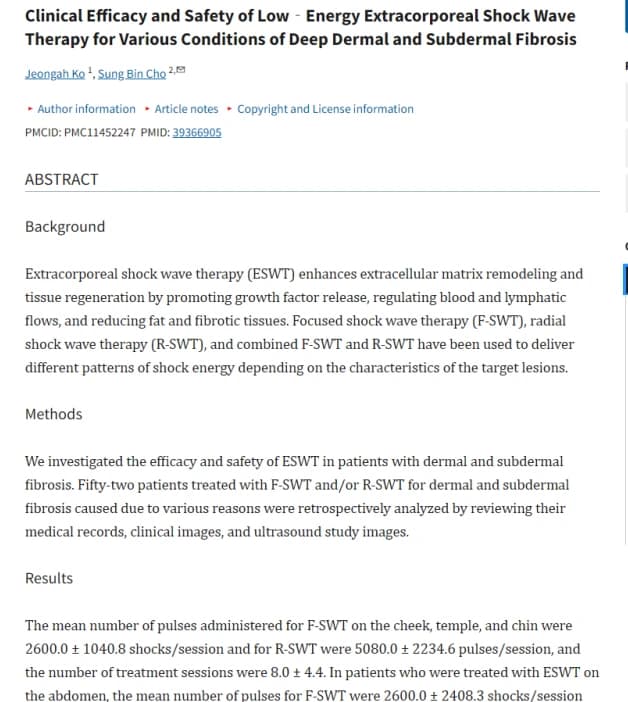
The source’s average of eight sessions, 80% figure and focused-then-radial sequence require confirmation of the population, endpoint and original data. They are not presented as standard session counts or order. One patient’s expression change also cannot establish nerve recovery in everyone.
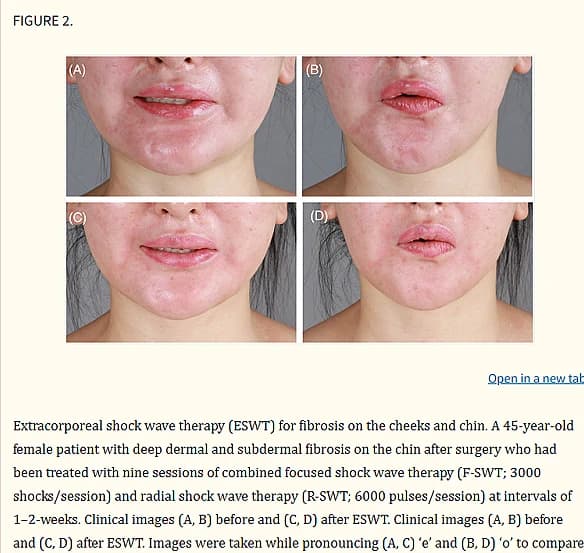
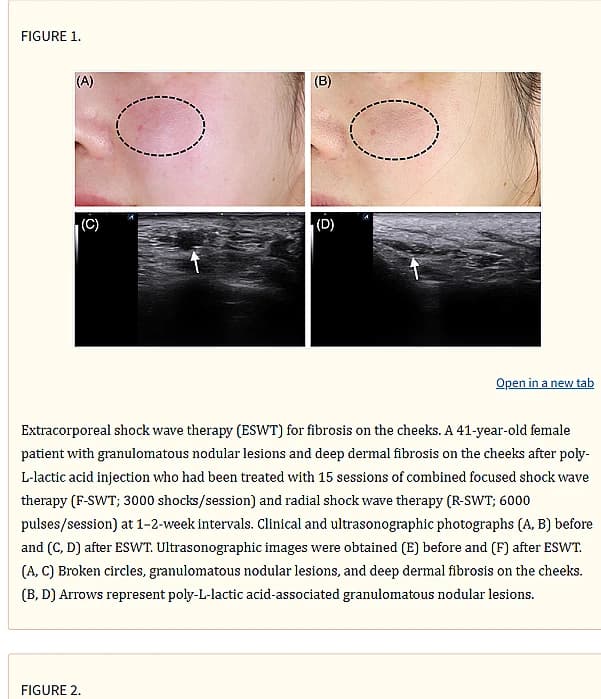
Growth factors, immune cells and extracellular-matrix explanations should be separated into mechanistic research and clinical observations. Changing the skin’s memory is a metaphor, rather than an established effect. Suitability, adverse effects and alternatives depend on diagnosis.
Source: Original post on Dr. Hyemi Yu’s Naver blog (Korean)
The original publication date and the website revision date are shown separately.