
JOURNAL
Eyelid ptosis after botulinum toxin: causes and prevention research
A discussion of eyelid ptosis after botulinum toxin, hyperconcentration research and limits of historical rates.
The rates below come from historical sources cited by the original post and do not rank product safety across different trials. Current labeling and the original studies require review; hyperconcentrated injections are not a universal recommendation.
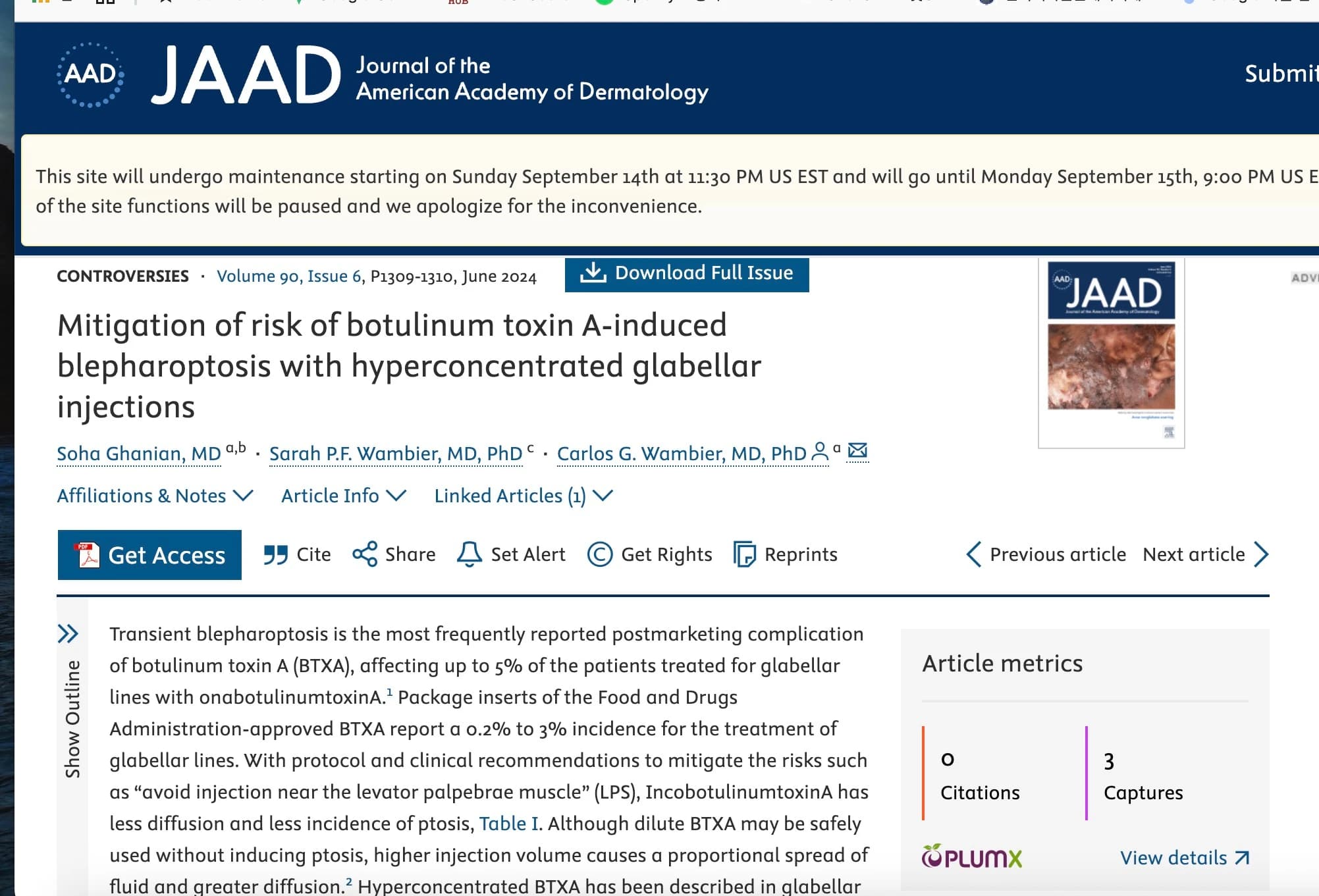
Botulinum toxin is widely used to treat wrinkles, but unintended effects can occur. One recognized complication is blepharoptosis, or upper-eyelid drooping. The source discusses a 2024 Journal of the American Academy of Dermatology report by Ghanian and colleagues on hyperconcentrated glabellar injections as a possible way of reducing this risk.
1. Frequency and causes of eyelid ptosis
The original post cites historical FDA-related data reporting approximately 0.2–3% eyelid ptosis after treatment of glabellar lines, including about 3% for onabotulinumtoxinA and 0.2% for incobotulinumtoxinA. These figures come from different trials and must not be read as a direct safety ranking.
A relevant mechanism is unintended spread toward the levator palpebrae superioris (LPS), weakening the muscle that raises the upper eyelid.
2. Injection volume and spread
Botulinum toxin products are prepared with diluent. The source discusses how injection volume may affect the area of spread even when the total dose is unchanged.
- Lower concentration and larger volume may produce a wider distribution.
- Higher concentration and smaller volume may limit unwanted spread under some conditions.
Preparation, product, dose, location and anatomy all matter. Dilution alone does not determine safety.
3. A clinical report of hyperconcentrated injections
According to the original post, the authors changed their glabellar injection protocol in 2022 after experiencing an approximately 2% ptosis rate in the preceding year. The reported change reduced diluent volume while keeping the total dose unchanged, and the authors described fewer cases afterward.
This is a report of a particular clinical approach, not proof that spread always matters more than total dose or that the same protocol is appropriate for everyone.
4. Historical product-specific figures in the source
- OnabotulinumtoxinA: 3%
- AbobotulinumtoxinA: 2%
- IncobotulinumtoxinA: 0.2%
- PrabotulinumtoxinA: 2%
- DaxibotulinumtoxinA: 2%
These figures are reproduced as historical claims in the original post. They require verification against the relevant trials and current labeling; differing trial conditions prevent a simple comparison of product safety. Product properties, dilution and technique can all contribute to outcomes.
5. Clinical considerations
The report raises the possibility that concentration and volume may help reduce unwanted spread, but concentration alone is not the solution.
- Anatomy: clinicians must consider the LPS and individual variation in the brow-depressor complex.
- Location: the source gives a technical example of at least 1 cm above the midpupillary reference and above the supraorbital ridge. Its precise meaning and applicability require specialist review; it is not a self-injection instruction.
- Angle and depth: technique must be appropriate to the product and anatomical context.
These details require professional judgment rather than a universal recipe.
Conclusion
Eyelid ptosis is a recognized complication of botulinum toxin. Hyperconcentrated injections are one approach discussed in the literature, but product selection, preparation, anatomy and injection technique must be considered together. No approach can guarantee safety or satisfaction, and suitability is individual.
References cited in the source
- Ghanian S, Wambier SP, Wambier CG. Mitigation of risk of botulinum toxin A–induced blepharoptosis with hyperconcentrated glabellar injections. J Am Acad Dermatol. 2024;90(6).
- FDA. BOTOX Cosmetic (onabotulinumtoxinA) for injection – Highlights of prescribing information. 2011. This is a historical reference, not current labeling.
- Nestor MS, Han H, Gade A. Botulinum toxin–induced blepharoptosis: anatomy, etiology, prevention, and therapeutic options. J Cosmet Dermatol. 2021;20:3133–3146.
This article shares medical information and is not intended to promote a particular procedure or product or to encourage treatment.
Source: Original post on Dr. Hyemi Yu’s Naver blog (Korean)
The original publication date and the website revision date are shown separately.