
JOURNAL
Facial aging and first impressions: New York lecture notes
Facial aging and first impressions: New York lecture notes. Source observations, research context and limitations.
This article discusses the source author’s earlier literature, cases and experiences. Research populations and limitations matter; individual diagnosis and treatment require clinical assessment.
Facial aging and how an observer reads a face
This is the author’s account of a lecture by Dr. Daria Voropai at the Merz Global Longevity Summit in New York in October 2026. It revisits a familiar question: why does someone look tired when they do not feel tired?
The lecture discussed rapid first impressions, infant looking preferences and adults’ responses to faces judged attractive. Such observations do not mean that appearance reliably identifies personality, health or trustworthiness. A rapid judgment and an accurate judgment are different things.
Age-related changes in skin, fat compartments and soft-tissue support can create shadows or expression-like signals. The source recalls a sleep-deprivation study in which observers rated willingness to socialize differently. An observer’s rating is not evidence that a cosmetic treatment improves health or social outcomes.
The author reflects that some people want their appearance to match how they feel rather than simply look younger. Their goals and preferences should guide the discussion.

Weight change and facial shape
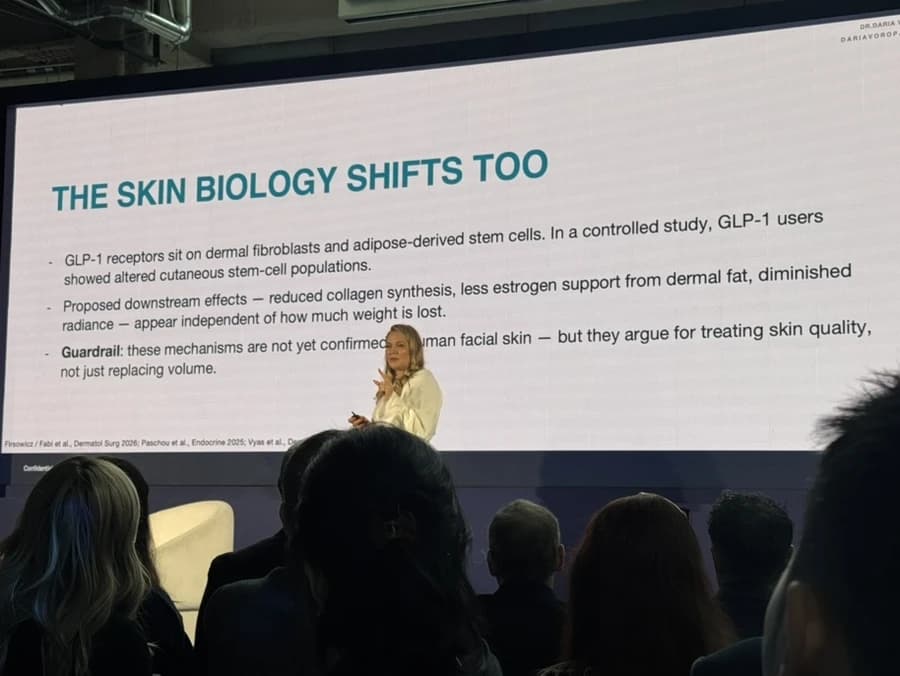
The lecture reportedly cited an MRI observation connecting 10kg of weight loss with about 10% facial-volume loss. The population and methods need checking; it is not a formula for every patient. Fat volume, upper-lip proportions and cellular function are separate questions. Direct drug effects, weight loss, age and prior tissue condition must be distinguished. This article focuses on perception and research limits rather than recommending a procedure after weight loss.
Support, stimulate and integrate
The source records these three concepts: consider structural support, biological tissue responses and the harmony of the face as a whole. Replacing every lost unit of volume is not automatically the person’s desired goal.
CaHA was discussed in relation to collagen I/III, elastin and vascular findings. A tissue change does not prove complete restoration of skin function or reversal of biological aging. Claims about normalizing cells after GLP-1 treatment need separate clinical evidence.
The author asks whether the patient wants a wrinkle changed, volume restored or an appearance that better reflects their own sense of energy. No single facial impression is superior or necessarily needs correction. The closing reflection treats a face as a form of communication and calls for respect for natural expression.
Hyemi Yu, plastic surgeon. Historical lecture account by the director of 1PM Clinic.
Source: Original post on Dr. Hyemi Yu’s Naver blog (Korean)
The original publication date and the website revision date are shown separately.