
JOURNAL
Facial volume and skin changes after weight loss
A New York lecture account on weight loss, facial fat, skin support and the limits of clinical observations.
Weight-loss effects and medication-specific effects must be distinguished. Conference cases and treatment intervals are not universal protocols; source lecture and media publication permissions require review.
One memorable lecture in New York concerned GLP-1-related medicines and facial aging. These medicines play important roles in obesity and diabetes treatment, with evidence for additional benefits in some cardiovascular and kidney conditions.
For an aesthetic physician, another question arises: “I lost weight for my health, so why does my face look older?” Some patients notice hollow cheeks or looser skin after substantial weight loss. The lecture considered facial fat, supporting structures, collagen, elastin and cellular function rather than volume alone. Here are the ideas I found useful.
1. Facial fat is more than weight to lose
Fat is often thought of as something to reduce. In the face it also contributes to three-dimensional shape and tissue support. Deep cheek fat and temporal fat influence facial contours, and substantial weight loss can reduce these compartments.
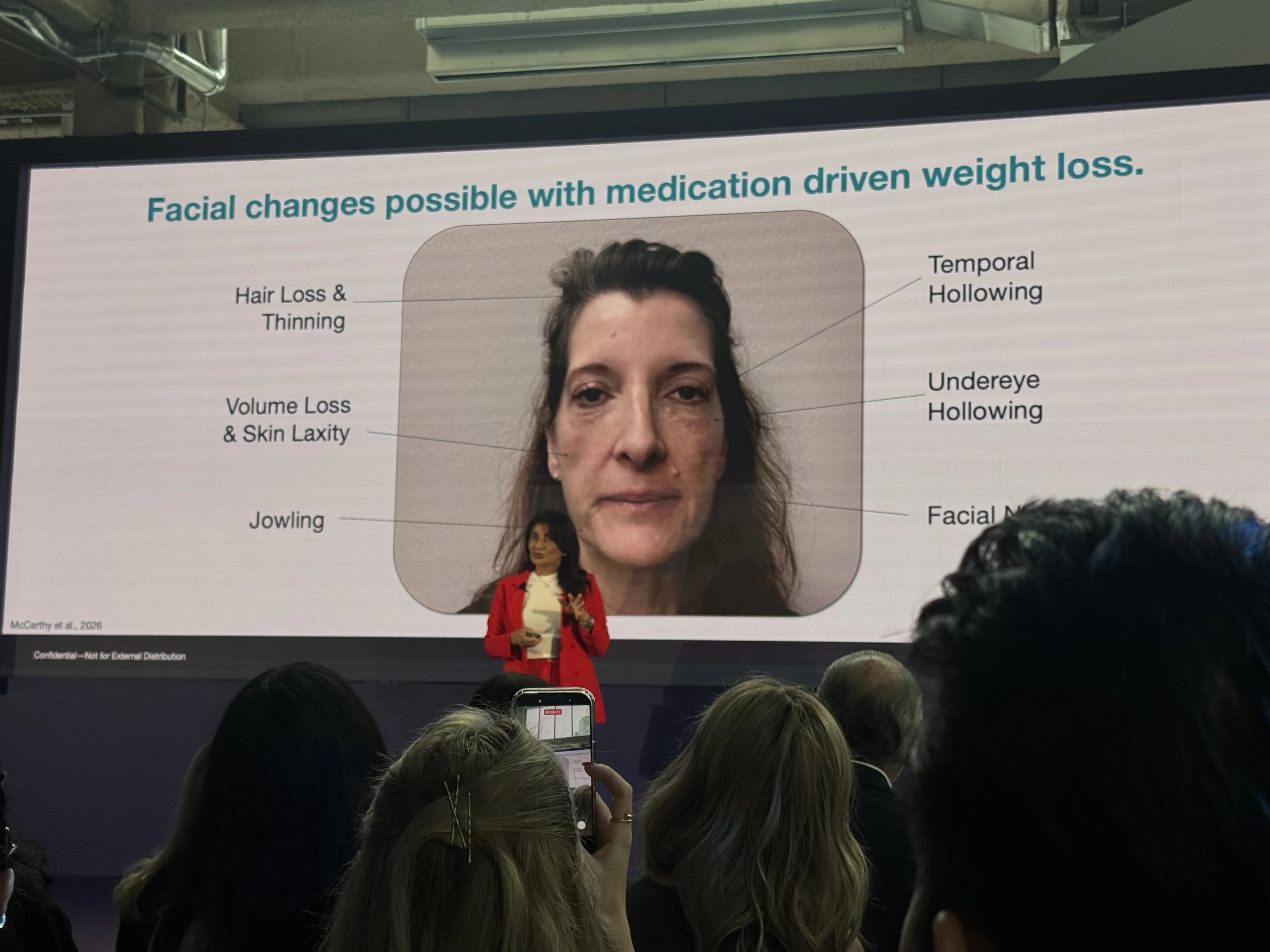
Cheeks and temples may look hollower, and existing laxity may become more noticeable. This does not establish that GLP-1 medicines selectively remove facial fat. Much of the change may reflect weight loss rather than a unique drug effect.
Facial changes should not negate a medicine’s health benefits. Instead, we need to assess which structures have changed.
2. The face as a tent
The speaker compared the face to a tent. Internal poles support it, while ropes hold the fabric taut. Smaller supports and looser ropes allow the fabric to sag.
Facial fat is like the internal support, dermal collagen like strong ropes, and elastin like elastic bands that stretch and recoil. Weight loss changes the support beneath the skin; limited elasticity may make laxity more apparent. Real facial shape also depends on retaining ligaments, muscle, bone and skin. The analogy nevertheless helps explain why changes extend beyond the surface.
3. Is more collagen enough?
The lecture emphasized elastin and proteoglycans alongside collagen. Collagen supplies tensile support; elastin contributes recoil; proteoglycans retain water and help regulate the cellular environment. Together these form part of the extracellular matrix, or ECM.
A house needs pillars, walls and the materials connecting them. Likewise, collagen quantity alone cannot explain skin function if its organization or balance with other components is altered. Fiber arrangement, elastin, ECM composition and remodeling also matter.
4. Skin cells have different roles
Fibroblasts produce collagen and other ECM components, but they are not all identical. Cells in superficial and deeper dermis may have different characteristics: some contribute to the local and perivascular environment, others to thicker collagen fibers and support.
Like workers repairing walls, building pillars or managing plumbing, different cells contribute different functions. Assessment should distinguish loss of volume from loss of the skin’s elasticity rather than treat every complaint of sagging as the same problem.
5. Why Radiesse was discussed
Radiesse is an injectable based on calcium hydroxylapatite, or CaHA. It can provide volume support, and research examines collagen and ECM responses after injection.
The speaker emphasized dilution and tissue distribution. An undiluted formulation may use its elastic properties for structural support; diluted approaches may distribute material differently for different goals. Reinforcing a pillar and repairing a broad wall are different tasks.
Dilution does not make every tissue layer appropriate for injection. Site, depth, anatomy and material properties matter, and complications including inflammatory nodules can occur.
The speaker showed cases after substantial weight loss during GLP-1 treatment, describing changes in texture, elasticity, radiance and support. Before-and-after photographs and personal experience do not establish the same benefit for everyone. Radiesse has not been shown by these cases to regrow fat lost through weight reduction. Volume support and actual adipose-tissue regeneration are different concepts.
6. Natural appearance and individual assessment
Cases included people who had lost approximately 10–20 kg. The speaker asked how to assess a returning patient who had lost 15 kg and whose face looked different.
The stated aim was to assess needed volume and support rather than overfill or create an overly tight appearance. A personal protocol of two treatments about a month apart was described; it is not a universal standard.
Some patients primarily lose deep cheek volume; others mainly notice laxity. Others are satisfied without aesthetic treatment. Not everyone needs an injectable procedure. I believe the task is to identify which tissue changes actually concern the patient.
7. Nutrition belongs in the discussion
GLP-1-related medicines affect appetite and food intake. Some people may not obtain enough protein or micronutrients. Fibroblasts also need an appropriate nutritional environment—workers cannot repair a house without materials.
The speaker discussed vitamin D and fibroblast function. The frequency of particular deficiencies varies across populations and studies; identical tests are not required for everyone. Markedly reduced intake or rapid weight loss may justify nutritional assessment. Skin recovery is connected with broader health.
8. Aging is more than wrinkles
The lecture also considered cellular senescence. When treating wrinkles with lasers, microneedling or injections, are we considering only a visible outcome or the cellular changes beneath it?
Senescent cells can stop dividing while releasing substances that affect surrounding tissue, inflammation and ECM. Wrinkles also reflect UV exposure, facial movement, elasticity and changes in fat and bone. They cannot all be attributed to senescence.
The lecture does not provide sufficient evidence that Radiesse directly removes senescent cells or reverses cellular aging. It does broaden the research questions beyond visible lines.
9. Three messages from New York
First, preserve metabolic-health benefits. Facial changes alone are not a reason to dismiss the role of appropriate GLP-1-related treatment in obesity and diabetes.
Second, consider the whole ECM: collagen, elastin, proteoglycans, fibroblasts and surrounding tissue interact.
Third, recognize changes early by considering weight-loss rate, facial fat, elasticity and nutrition together. Future research into senescence and regeneration may change aesthetic practice, but that remains a prospect rather than a present promise.
Losing weight for health and maintaining a natural-looking face need not be opposing goals. Both can matter. Aesthetic assessment should consider skin, fat and ECM as an interacting structure rather than simply something to fill or tighten. At 1PM Clinic Cheongdam, I intend to keep reviewing research and considering each patient’s skin and facial structure individually.
Source: Original post on Dr. Hyemi Yu’s Naver blog (Korean)
The original publication date and the website revision date are shown separately.