
JOURNAL
Fat and CaHA: limits of laboratory combination research
Fat and CaHA: limits of laboratory combination research. Source observations, research context and limitations.
This article discusses the source author’s earlier literature, cases and experiences. Research populations and limitations matter; individual diagnosis and treatment require clinical assessment.
The source introduces laboratory research into combining autologous fat and CaHA. Interest in clinical combinations is distinct from evidence that the materials are safe and effective together in people.
A laboratory question about compatibility
The source describes adipose-derived mesenchymal stromal/stem cells obtained from SEFFI-prepared fat, comparing fat alone with fat plus CaHA. Outcomes included viability, proliferation, MSC markers and adipogenic, chondrogenic and osteogenic differentiation.
Cell survival under the tested conditions
Trypan-blue findings and doubling time were described as similar between groups. This laboratory observation does not establish absence of toxicity or clinical complications in all uses.
Marker expression
The source reports CD73, CD90 and CD105 expression in both groups. Marker preservation supports a specific laboratory observation, not complete proof of unchanged function.
Differentiation and calcium staining
Adipogenic and chondrogenic differentiation were reported in both groups. Stronger Alizarin Red staining in the CaHA group may reflect calcium in the material itself; it does not independently prove enhanced bone formation.
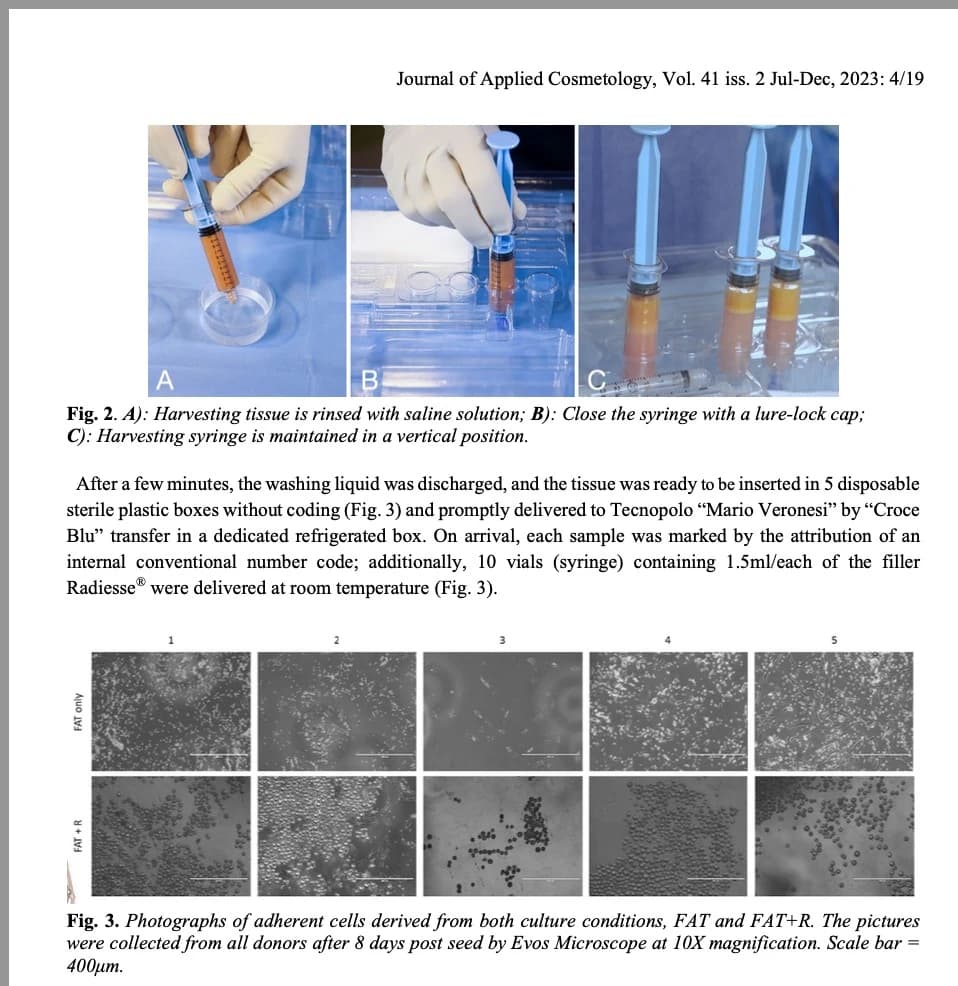
Fewer attached cells
The source considers whether CaHA occupied part of the culture surface rather than reducing viable cells. A Transwell or other follow-up design was proposed to distinguish these possibilities.
Laboratory results and clinical safety are different
The study offers observations under specified culture conditions, not a demonstration of safety or efficacy of facial fat–CaHA combinations. The source also recalls a MAX symposium presentation concerning PRP and CaHA. PRP, PRF and laboratory fat experiments are different materials and evidence streams.
The author closes with a reflection on continuing study. Exact paper details, clinical scope and current service availability still require confirmation.
Materials linked by the source
Source: Original post on Dr. Hyemi Yu’s Naver blog (Korean)
The original publication date and the website revision date are shown separately.