
JOURNAL
Semaglutide and kidney disease in the FLOW trial
Semaglutide and kidney disease in the FLOW trial. An edited account of source experience, research context and limitations.
This edited account distinguishes personal experience, laboratory research and clinical studies. Individual suitability requires clinical assessment.
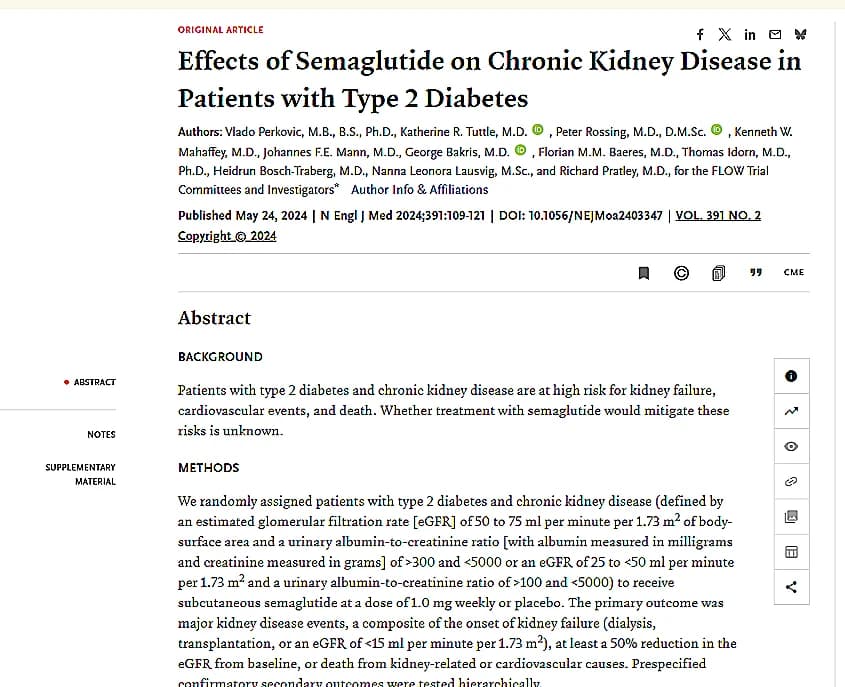
FLOW was a randomized, placebo-controlled trial of semaglutide in people with both type 2 diabetes and chronic kidney disease. The source gives 2025, but the original paper was published in 2024 (DOI: 10.1056/NEJMoa2403347).
It enrolled 3,533 participants with a median follow-up of 3.4 years. The study used semaglutide 1 mg once weekly; this describes the trial, rather than individual dosing advice. Results should not be assumed identical in general weight-management populations or with other doses and products.
The primary composite included kidney events and kidney-related or cardiovascular death. The reported HR of 0.76 describes a relative reduction in that composite, rather than a 24% restoration of each person’s kidney. A difference in eGFR decline also does not mean filtration was reversed or dialysis postponed by a fixed interval.
Adverse events and discontinuations must be distinguished accurately by group. Lower serious-adverse-event rates do not make nausea or vomiting a harmless adaptation process.

The purpose is to understand study populations and endpoints. This does not replace kidney diagnosis or treatment, or establish Korean product indications. Metaphors about turning back the kidney’s clock have not been retained as clinical conclusions.
Materials linked by the source
Source: Original post on Dr. Hyemi Yu’s Naver blog (Korean)
The original publication date and the website revision date are shown separately.