
JOURNAL
Flu-like reactions after cell treatment
A historical source account: Flu-like reactions after cell treatment. Context and outstanding review are distinguished.
This is a historical account of the original author’s experiences and interpretations. Research claims, numerical results, mechanisms and legal descriptions remain pending comparison with primary sources and hospital medical review. They do not establish a treatment benefit or current applicability.
Editorial note: flu-like symptoms or insomnia do not prove recovery or successful cell activity. New symptoms after a procedure require clinical assessment; severe symptoms such as shortness of breath or chest pain need urgent medical attention.
The original author introduced a question about feeling flu-like after cell treatment and proposed that such symptoms might accompany a recovery process. It described homing to injured tissue and IL-6 and TNF-α signaling as a possible explanation for low-grade fever, chills and muscle pain. This remains the source's interpretation; symptoms alone cannot establish homing or successful recovery.
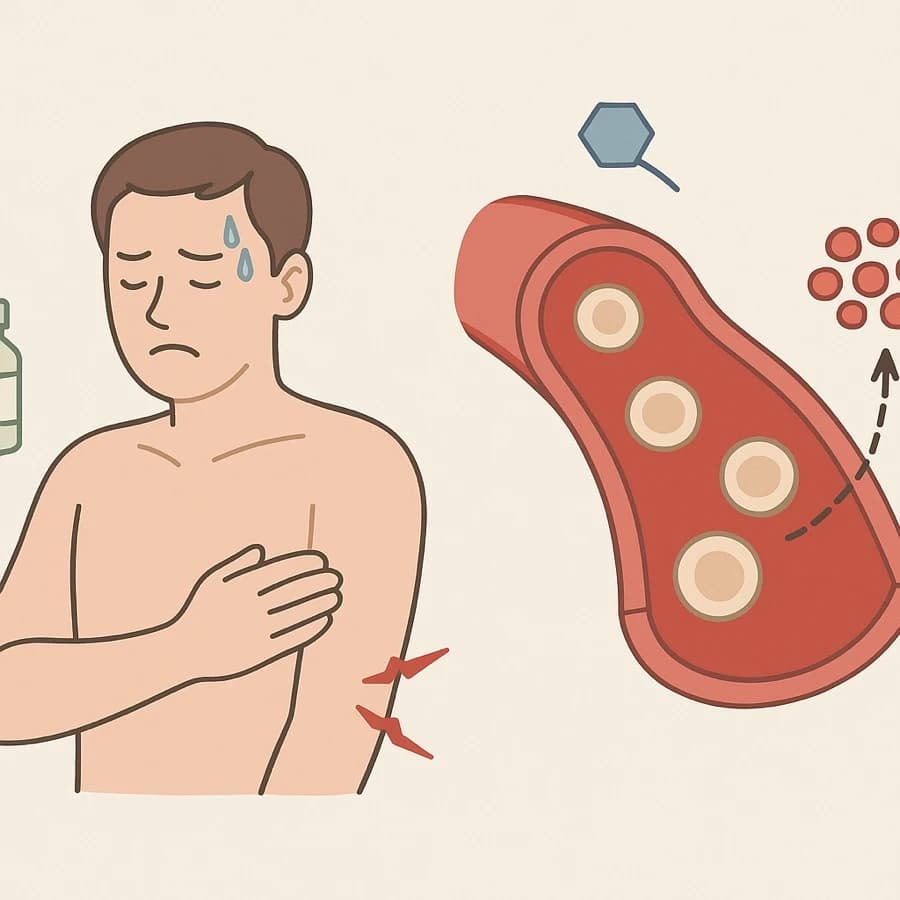
The source attributed a description of the SDF-1α/CXCR4 axis, MSC homing and inflammatory cytokines to a 2014 Nature Biotechnology study. Its exact quotation and the claimed connection with flu-like reactions have not been verified against the cited paper.
The author's interpretation of homing
The original post interpreted flu-like symptoms as an indirect indication of cells traveling to sites of injury and described SDF-1α as an SOS signal. That interpretation is not a diagnostic test for cellular movement or treatment benefit.
Reactions described as transient in the source
The post attributed low-grade fever and muscle pain in the first 24–48 hours after infusion to a 2014 Stem Cells report. It characterized temperatures below 38°C, one or two days of mild aches and slight fatigue as potentially transient. The quotation and attribution require verification, and those thresholds do not exclude an important adverse event.
Warning signs retained from the source
The source urged medical assessment for persistent temperature of 38.5°C or above; severe swelling or pain in the groin or legs; shortness of breath; chest pain; or severe chills. It raised infection, thrombosis and hypersensitivity as possible concerns. New or worsening symptoms should not be dismissed as beneficial homing.
Original conclusion and references
The author's closing interpretation was that mild flu-like symptoms might accompany cellular activity, while severe or persistent symptoms needed review. That interpretation has not been established as evidence of treatment success.
- Ankrum J, Ong JF, Karp JM. Mesenchymal stem cells: immune evasive, not immune privileged. Nature Biotechnology. 2014;32(3):252–260.
- Moll G, et al. Do cryopreserved mesenchymal stromal cells display impaired immunomodulatory and therapeutic properties? Stem Cells. The original post gave 2014;32(9):2430–2442; the bibliographic details and support for the quoted symptoms require verification.
The original disclaimer described the post as general academic information rather than promotion of a procedure or clinic, noting that individual reactions vary and require a clinician's assessment.
Editorial reference check: the two cited papers exist in PubMed. Their existence does not verify the original quotations or the claim that flu-like symptoms prove recovery.
Source: Original post on Dr. Hyemi Yu’s Naver blog (Korean)
The original publication date and the website revision date are shown separately.