
JOURNAL
Why glycerol is discussed in skin boosters
The source review’s discussion of HA, glycerol and AQP3, with context for interpreting evidence.
Animal findings and AQP3 mechanisms must be distinguished from human clinical outcomes. Nonimmunogenicity does not mean no allergy risk; product-specific evidence and labeling require review.
A topic I came across while reviewing the literature: glycerol.
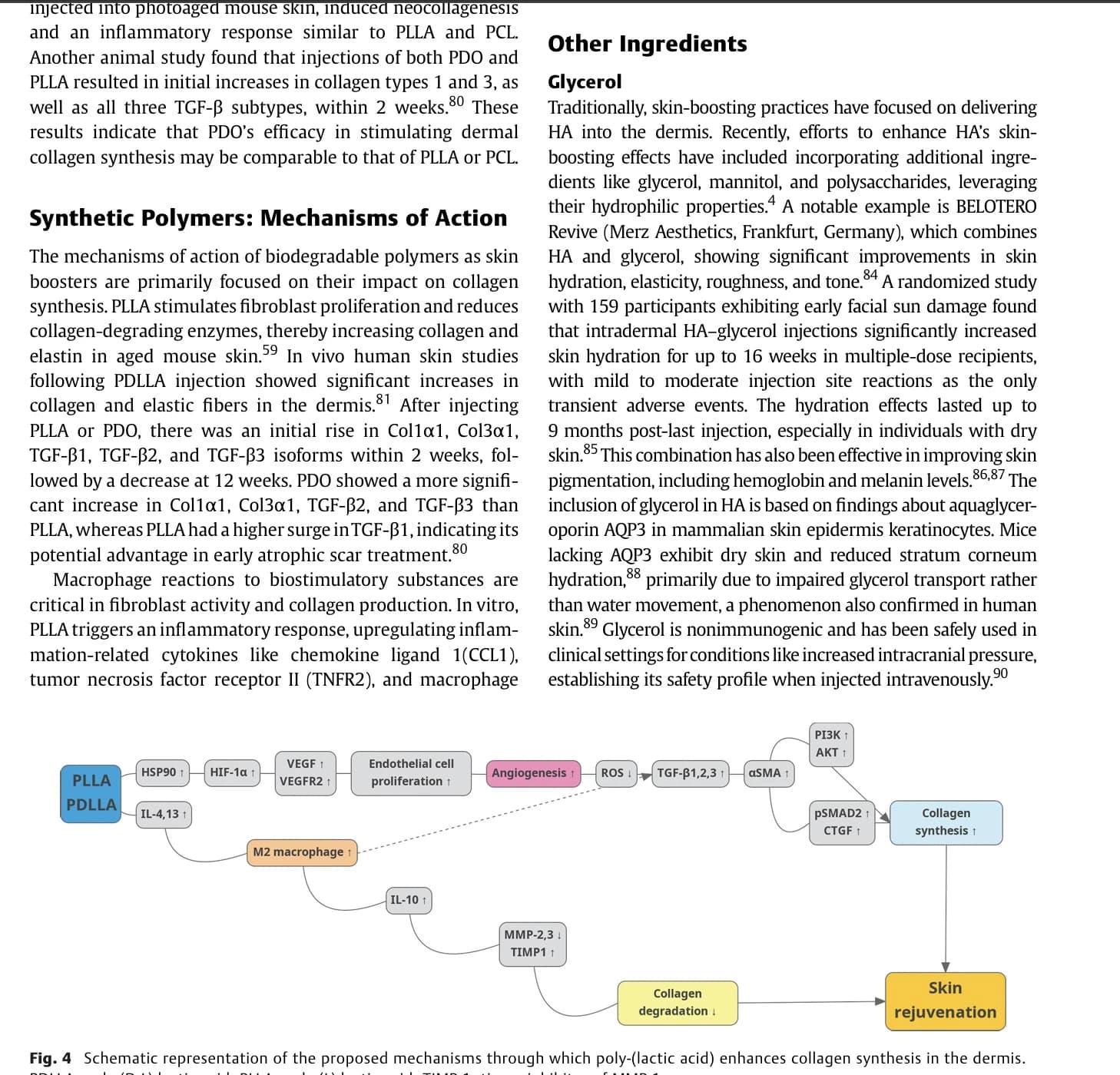
The following discussion comes from the paper shown here.
Why add glycerol?
HA skin boosters have long been discussed as injectable hydration treatments. The source describes interest in combining HA with hydrophilic ingredients such as glycerol, mannitol or polysaccharides to examine effects beyond HA alone.
HA and glycerol: hydration findings in the source
The post discusses BELOTERO Revive (Merz Aesthetics), combining HA and glycerol. It cites a randomized study of 159 participants with early facial photodamage, describing significant hydration findings over up to 16 weeks after repeated injections and some effects reported as lasting up to nine months after the final treatment, particularly in drier skin.
The source describes mostly mild or moderate transient injection-site reactions. Study design, time points and outcomes require verification; those observations do not guarantee durability or safety for a particular patient.
Other reported skin measures
The source discusses reports concerning elasticity, roughness, evenness of tone and hemoglobin- or melanin-related measures. These outcomes and their clinical meaning require checking against the specific studies rather than assuming every product has all these effects.
AQP3 and glycerol transport
AQP3, or aquaglyceroporin-3, is discussed as a channel in epidermal keratinocytes that transports glycerol as well as water. The source cites observations in AQP3-deficient mice linking reduced skin hydration with altered glycerol transport.
Animal mechanisms, human physiology and the clinical effects of an injectable product are different levels of evidence. The source’s broad statement that glycerol rather than water is the key to hydration requires qualification, not a universal conclusion.
Interpreting safety statements
The original post describes glycerol as nonimmunogenic and refers to its use in other medical settings, including intravenous treatment for raised intracranial pressure. A material’s use by one route does not establish the safety of every product or route, and nonimmunogenic does not mean no allergy or adverse-event risk.
Closing perspective
The source sees HA–glycerol combinations as part of a move toward formulations informed by skin physiology. It discusses hydration, elasticity and tone in that context. This is not proof of a new universal standard or a guarantee that all claimed effects occur.
The article shares research-related information rather than advertise a product or encourage attendance. Individual treatment choices require specialist consultation. Exact bibliographic details and product-specific labeling still need review.
Source: Original post on Dr. Hyemi Yu’s Naver blog (Korean)
The original publication date and the website revision date are shown separately.