
JOURNAL
Considering hair loss after aging, stress or immunosuppressant use
The source’s discussion of possible hair changes during immunosuppressant use and an individual case.
Changes to immunosuppressant or transplant-related treatment require the prescribing team. Case images and conference protocols do not guarantee results or provide self-treatment instructions; patient consent and publication approval require review.
The original post presents this as medical information, refers to Korean medical-advertising rules and states that the original author consulted a specialist lawyer. Those statements concern the original publication; they do not certify the legal or medical approval of this migration.
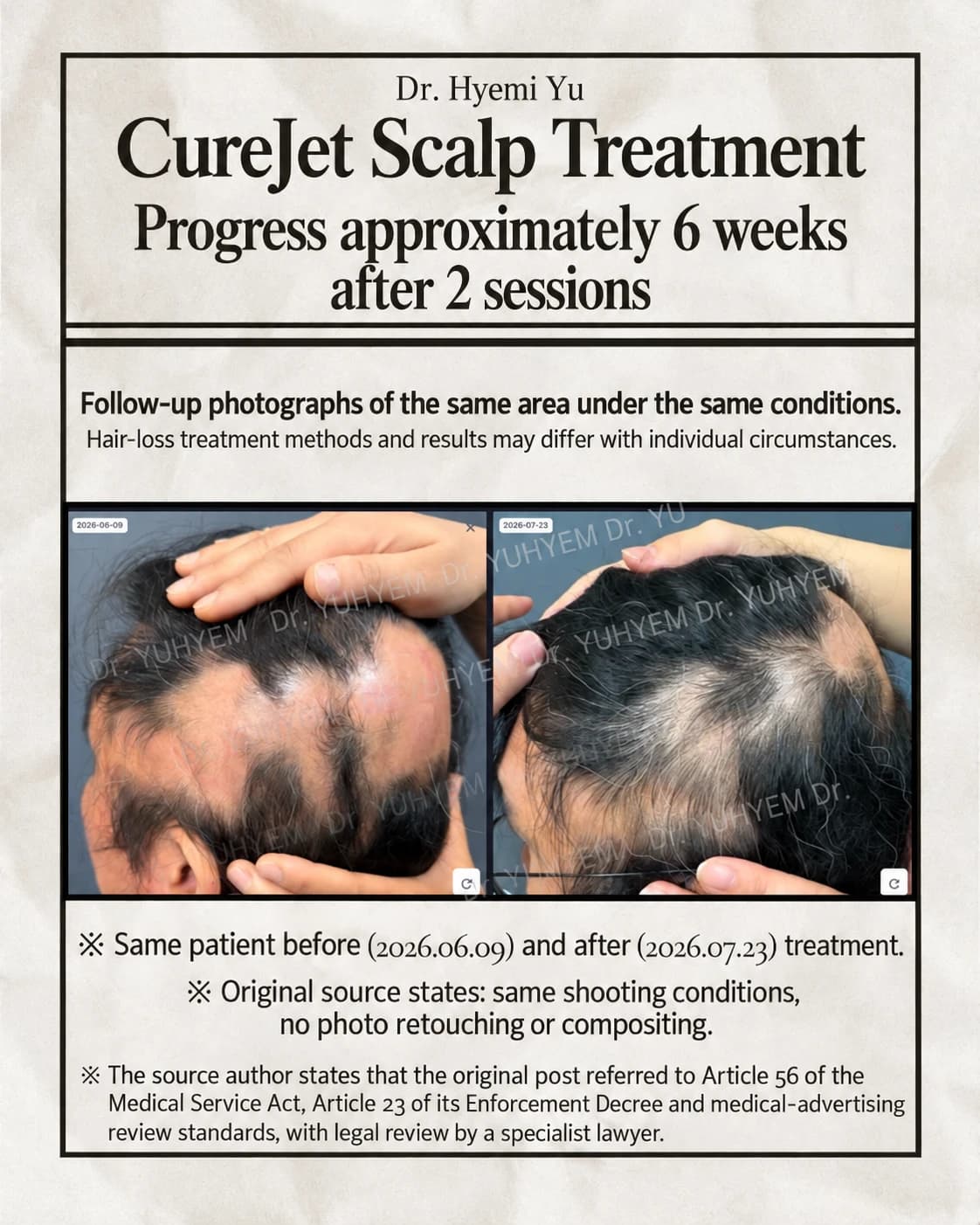
The source describes a patient who noticed substantial shedding, especially around the crown, after beginning immunosuppressant treatment for an underlying condition. Uncertainty about the medicine, the illness or stress made the experience more worrying. The author recalls the patient trying to conceal the thinning by growing the remaining hair longer.
This article discusses possible relationships between immunosuppressant use and hair loss. The original introduction was written by Dr. Hyemi Yu while practicing at BIO Plastic Surgery near Sinsa Station; that is a historical affiliation.

Historical author introduction
The source introduces Dr. Hyemi Yu as a plastic surgeon at BIO Plastic Surgery, with broadcast appearances, scalp/hair clinical experience and authorship of a Korean book on slow-aging weight management. Those credentials and publication details remain subject to clinic confirmation.
Patients sometimes describe shedding after starting a medicine even when their hair seemed fine before. The purpose here is to consider the medication, timing and pattern without assume one cause from timing alone.

Why can responses differ between medicines?
The source discusses several categories, which require checking against the actual drug and individual clinical setting.
1. Telogen effluvium
The post describes early transition from growth (anagen) to resting (telogen), followed by diffuse shedding approximately 2–4 months after a trigger. It mentions drugs including methotrexate and oral steroids. Drug-specific mechanisms and frequency require review rather than treating this as the pattern for every immunosuppressant.
2. Effects on actively growing follicles
Some cytotoxic medicines, including cyclophosphamide, are discussed in relation to acute, diffuse anagen shedding. The source contrasts this with delayed telogen patterns.
3. Autoimmune-associated changes
The post refers to reports of alopecia areata appearing or worsening with some biologic medicines. Proposed immune mechanisms do not establish the cause in an individual case.
4. Increased hair growth instead
Cyclosporine can be associated with hypertrichosis. Medicines within the broad label “immunosuppressants” can therefore have different hair effects.
The source considers some diffuse crown presentations alongside telogen effluvium. Location alone is not diagnostic; the exact drug, start date and examination matter.
What the source recommends considering
Do not stop a prescribed immunosuppressant independently because of shedding. Underlying disease can be affected; the prescribing specialist should be involved.
Record the drug name and timing for assessment. Distinguishing patterns and other possible causes is more useful than assume a drug effect from appearance alone.
The source also discusses supportive scalp care alongside management of the underlying condition. Such care cannot replace the prescribing team’s plan.
CureJet in the case described
CureJet is described as an electromagnetic, needle-free delivery device. The following photographs document an individual case during immunosuppressant use, not a demonstration of benefit for all such patients.
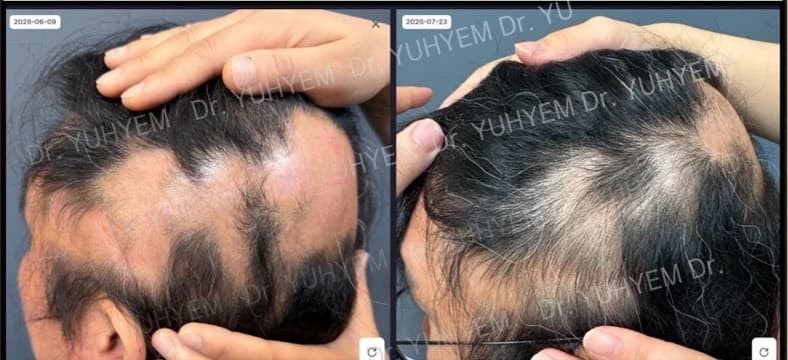
Source dates: June 9, 2026, and July 23, 2026.
The original post states that these are photographs of the same patient before and after two CureJet sessions, taken under the same conditions without retouching or compositing. Those are statements about the source photographs. English lettering on a localized graphic must be distinguished from the original images, and the clinical claim and consent require review.
The source describes approximately six weeks of observation after two sessions. This is an individual case; causes, severity, treatment plans and responses differ.
Adverse effects and considerations
The original post lists possible temporary pain, redness, swelling, tenderness, folliculitis and inflammation. Responses may vary with the cause of shedding, health, progression and habits.
People taking immunosuppressants should disclose their medicine and general health before a procedure because infection risk and suitability require assessment. The underlying disease remains under the prescribing specialist’s care; scalp treatment is discussed as supportive.
Hair loss during immunosuppressant use can have several explanations. The source encourages assessment rather than self-diagnosis and does not guarantee the same outcome as the case shown.
The original post repeats its medical-advertising and legal-review statements. They are historical claims by the original author, not verification of this translated publication’s compliance or approval.
Source: Original post on Dr. Hyemi Yu’s Naver blog (Korean)
The original publication date and the website revision date are shown separately.