
JOURNAL
Nasolabial fillers and upper-lip proportions
Nasolabial fillers and upper-lip proportions. Source observations, research context and limitations.
This article discusses the source author’s earlier literature, cases and experiences. Research populations and limitations matter; individual diagnosis and treatment require clinical assessment.
If repeated filling leaves the cheeks feeling heavier or the upper lip looking longer, adding more material without reassessing the cause may not address the concern.
The source describes people who initially liked filler, Sculptra, Juvelook or fat grafting but later felt that the nasolabial folds looked deeper or the face heavier. The question is why added volume does not always produce the intended appearance.

Patients in the source’s clinical accounts ask why their folds look deeper after volume treatment.
“I had volume added, so why do the folds look deeper?” “My face looks heavier after treatment.” These are reported concerns rather than a diagnosis.
Support in the midface
The source discusses pseudoptosis and overfilling. Pseudoptosis describes an appearance of descent related to changes in support and volume distribution; previous injections alone do not establish the cause. Fat compartments and other supporting structures influence the contour between the cheek and upper lip.
Original illustration caption: comparison of a supported contour and pseudoptosis. The appearance should not be treated as a moral or personal judgment.
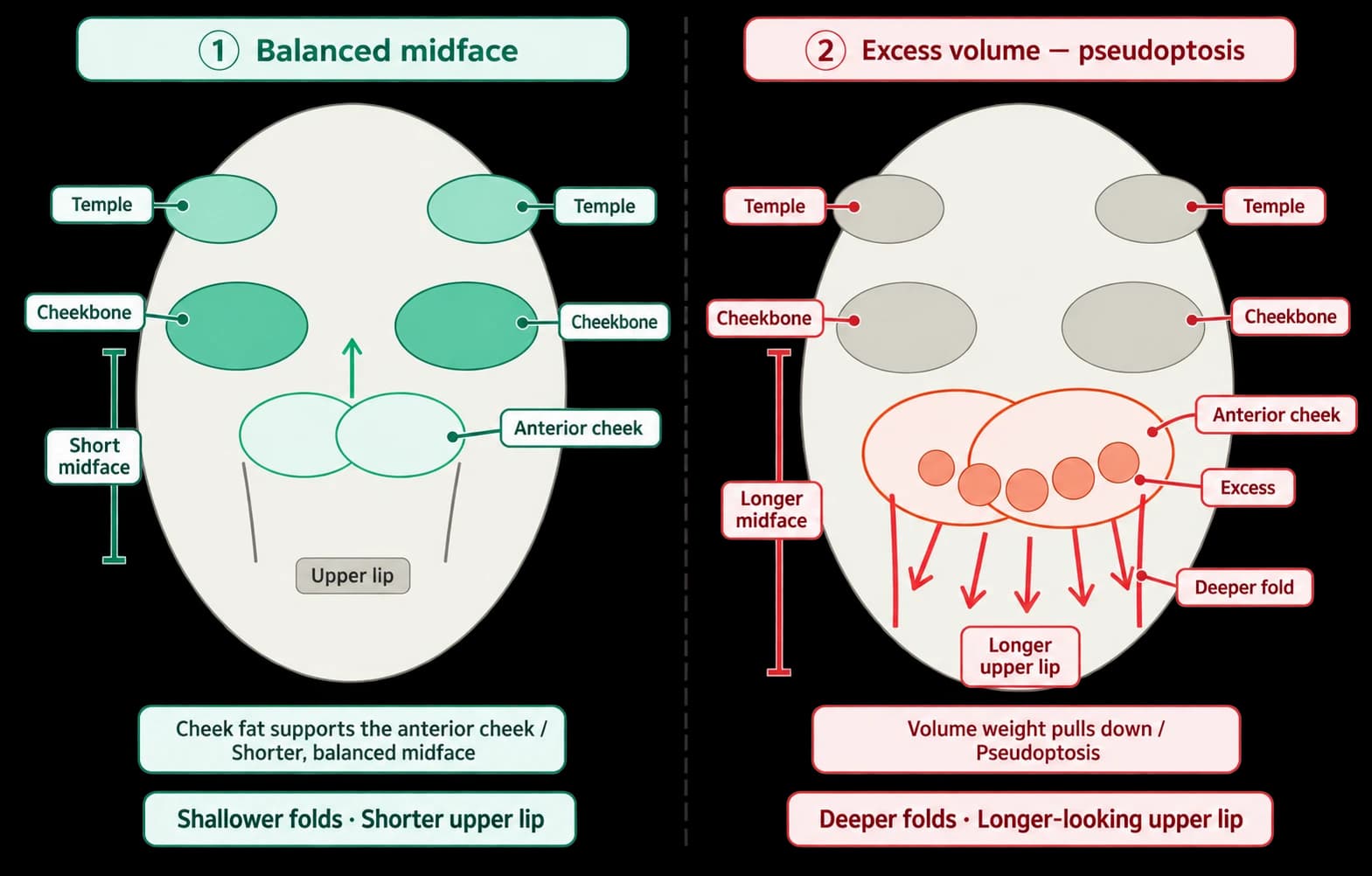
The source asks what happens when volume is repeatedly concentrated in the anterior cheek without considering support.
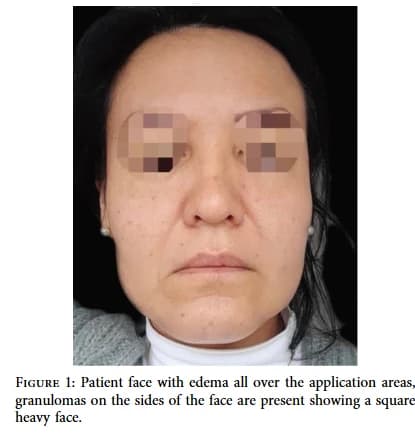
The source cites Treating Aging Changes of Facial Anatomical Layers with Hyaluronic Acid Fillers, 2021, PMC8405095, in discussing reduced deep-fat support and the appearance of pseudoptosis. The exact quotation and scope require source comparison.
Added volume and the impression of descent
Filler, PLLA-related tissue changes and grafted fat may persist to different degrees. The source proposes that excess anterior volume can influence facial proportions and the impression of heaviness. It does not establish that filler universally lengthens the upper lip.
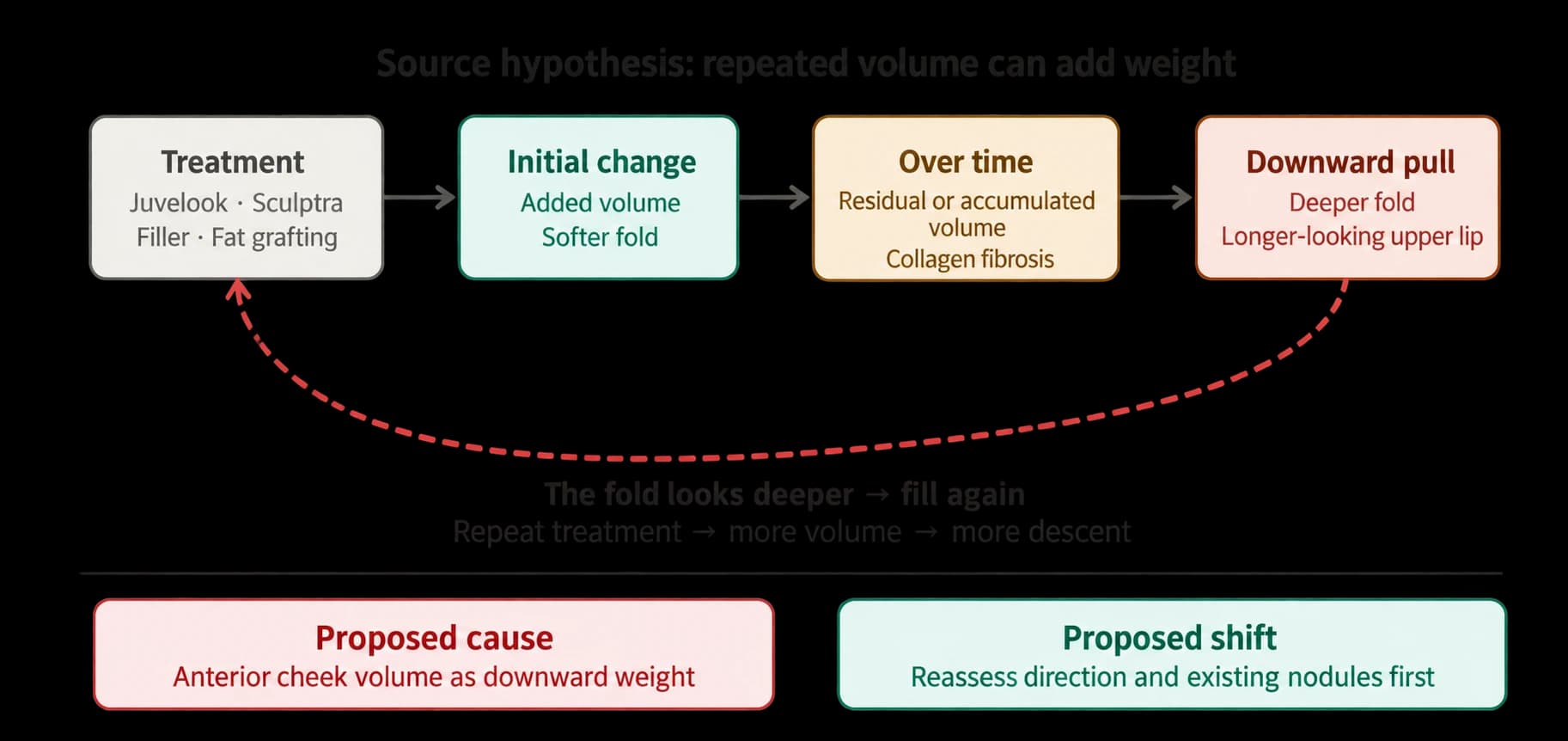
The source also discusses overfilled appearances in younger patients, sometimes most noticeable during facial movement. It does not provide a population incidence.
Reference cited by the source: Lim TS. Exploring facial overfilled syndrome from the perspective of anatomy and the mismatched delivery of fillers. Journal of Cosmetic Dermatology. 2024.
Reference cited by the source: Kapoor KM. Overfilled Face Syndrome: A Narrative Review and Proposal for a New Classification Framework. Aesthetic Surgery Journal Open Forum. 2025.
Assess distribution and support, as well as amount
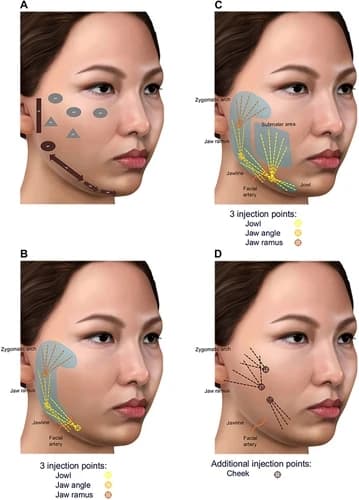
The source discusses the temple, lateral cheek and wider facial support. No particular site or vector is a universal injection instruction. Previous treatments, anatomy and the current concern need individual assessment.
Original illustration caption: comparison of injection direction and support vectors. It is a conceptual diagram, not a treatment plan.
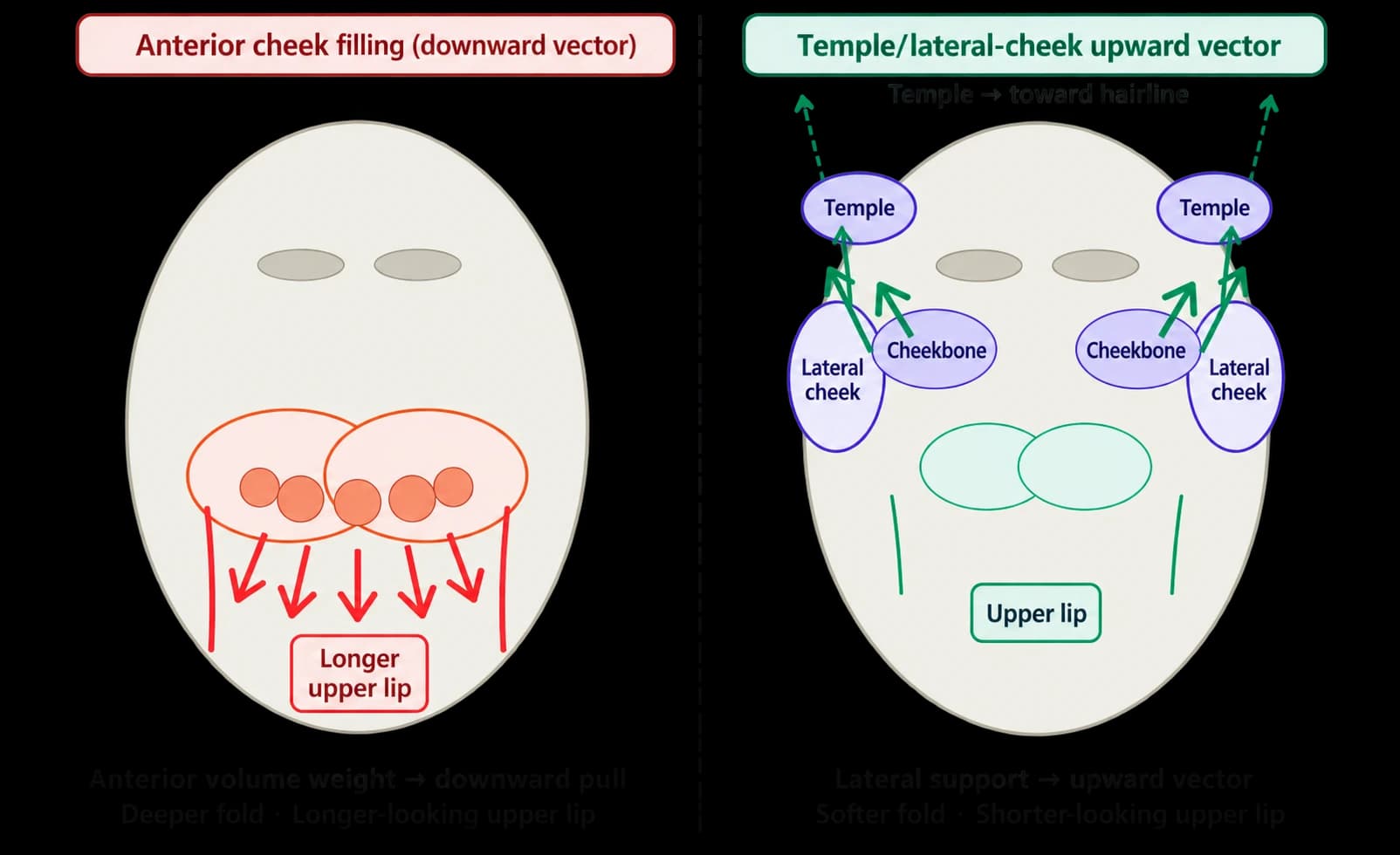
In some situations, the existing material or nodules may need evaluation before further volume is considered.
Reference cited by the source: Enzymatic Management of Facial Overfilled Syndrome: A Case Series and Narrative Review. Journal of Cosmetic Dermatology. 2025. PMC12334978.
The source links a discussion of facial design and lateral support: https://www.tandfonline.com/doi/full/10.2147/CCID.S506038#d1e386
Summary
Before adding more material to a heavy or descended appearance, assess distribution, support, nodules and other possible causes. Overfilling literature does not by itself establish a causal change in upper-lip length or a treatment sequence for every person.
This is a discussion of published literature. Assessment and treatment depend on the individual.
Materials linked by the source
Source: Original post on Dr. Hyemi Yu’s Naver blog (Korean)
The original publication date and the website revision date are shown separately.