
JOURNAL
Peripheral blood treatments: cases and mechanisms
A historical source account: Peripheral blood treatments: cases and mechanisms. Context and outstanding review are distinguished.
This is a historical account of the original author’s experiences and interpretations. Research claims, numerical results, mechanisms and legal descriptions remain pending comparison with primary sources and hospital medical review. They do not establish a treatment benefit or current applicability.
Chapter 1: Are blood stem cells really stem cells?
The author described people reporting that a previously restricted shoulder moved more comfortably and that morning erections had returned. The post asked whether such functional changes meant that stem cells had actually rebuilt tissue. These are reported observations, rather than proof of the mechanism.
Chapter 2: What is in peripheral blood?
The original author described small numbers of CD34+ hematopoietic stem cells and endothelial progenitor cells (EPCs) in peripheral blood, associated with blood formation and vascular repair. The post emphasized their low concentration in ordinary peripheral blood. It characterized most peripheral-blood-based approaches as modulation of inflammation, the vascular microenvironment and growth-factor signaling rather than transplantation of large numbers of stem cells.
Chapter 3
The shoulder observation
The author interpreted chronic inflammation and delayed healing, rather than the calcium deposit alone, as important in calcific tendinitis. The post proposed that VEGF, PDGF and TGF-β in autologous-blood approaches could affect angiogenesis and collagen remodeling, with reduced inflammation and improved circulation contributing to less pain and greater range of motion. It described a changed tissue environment rather than claiming that a calcium deposit had disappeared. The causal interpretation remains unverified for the reported case.

Chapter 4: The morning-erection observation
The original post described erection as a vascular response requiring adequate arterial inflow and venous closure. It proposed that improved endothelial function and nitric oxide (NO) signaling might explain the observation, and that peripheral-blood-derived progenitor cells could contribute repair signals. The author distinguished vascular function from recreating an organ and described morning erections as an indicator of microvascular health. The case does not establish that the treatment caused the reported change.

Chapter 5: Culturing cells in Korea
The original post asked whether a clinic cultures and expands the cells before administration. It stated that arbitrary in-house expansion and administration are tightly regulated and cited Korea's Act on the Safety of and Support for Advanced Regenerative Medicine and Advanced Biological Products. It listed approved facilities, GMP aseptic processing, genetic stability assessment and tumorigenicity assessment as relevant requirements, and said unrestricted in-clinic culture and injection were not generally permitted. This is the source author's legal account; its current scope and applicability have not been verified.
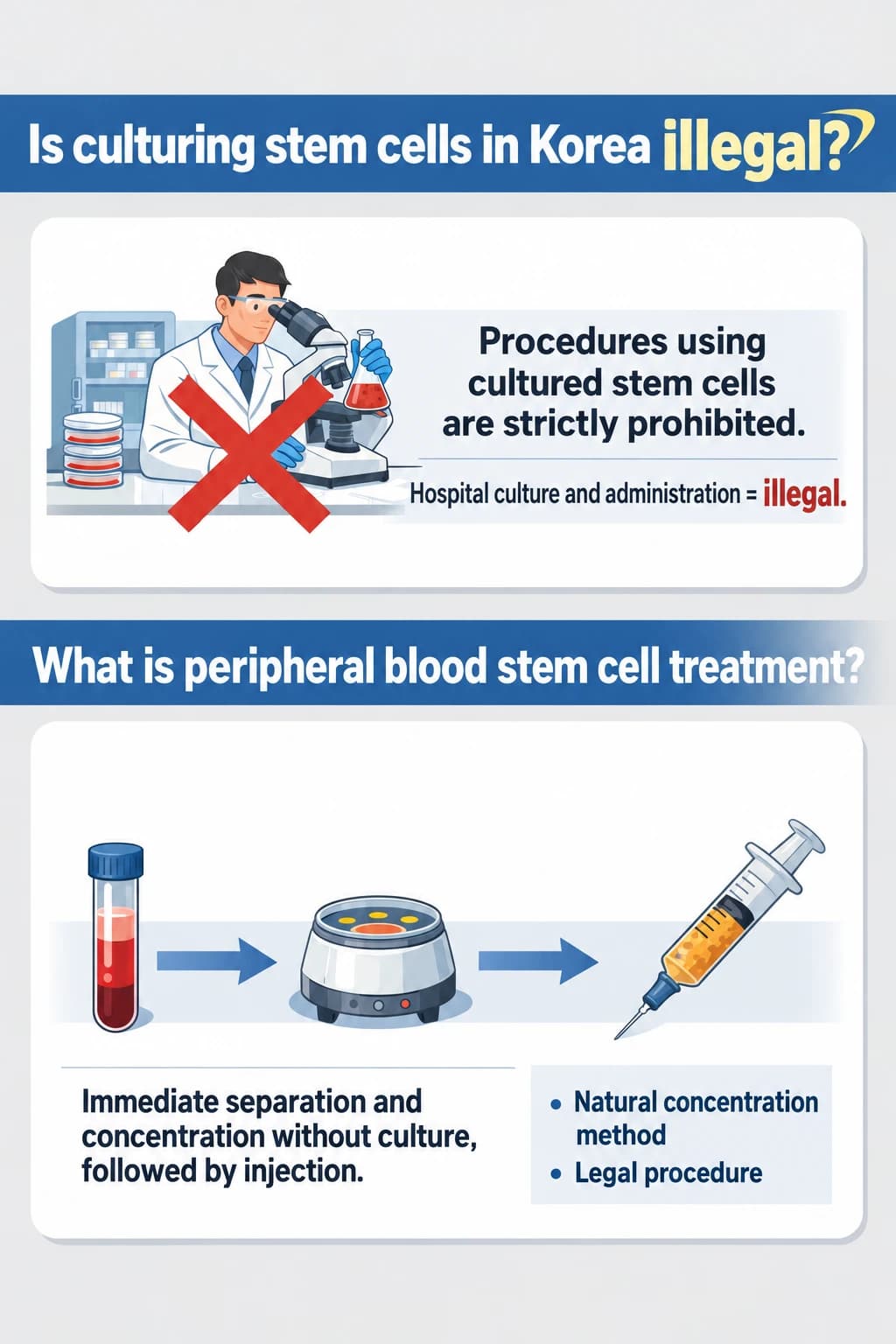
The author argued that culture is not simply increasing a cell count but a process associated with manufacturing a medicinal product. The applicable classification requires separate confirmation.
Chapter 6: The author's comparison with non-cultured approaches
The post listed an autologous tissue source, lower immune-rejection risk, a simpler process, immediate preparation and claimed legal stability as advantages. These are source claims, not an approval or safety determination for a particular product or procedure. The author also cautioned that expectations should concern stimulation of a recovery environment rather than regeneration by a large stem-cell dose.
Chapter 7: Possibility and process
The author regarded the shoulder and morning-erection reports as reasons to investigate, while cautioning against saying that stem cells had regenerated everything. The post placed more emphasis on microenvironmental regulation than on regeneration itself, and on transparent processing, understanding mechanisms, legal status and evidence rather than on a cell's name.
Source: Original post on Dr. Hyemi Yu’s Naver blog (Korean)
The original publication date and the website revision date are shown separately.