
JOURNAL
Rejuran PN and PDRN: understanding the differences
House and scaffold analogies for PN and PDRN, with distinctions between concepts and product-specific evidence.
The house and scaffold analogies are explanatory, not proof of a product’s mechanism, efficacy or safety. Product-specific PN/PDRN composition, approved uses and supporting references require medical review.
Words such as “regeneration,” “recovery” and “plumping” appear frequently in discussions about skin. They may sound similar while describing different situations.
PN (Rejuran) and PDRN are another example. Both are described as DNA-derived materials, but that does not make their roles interchangeable.
Think of the skin as a house
One house still has its walls and columns but has become less sturdy with age. Another has been hit by a storm: electricity and water are cut off, and its internal systems have stopped working. These houses do not necessarily need the same intervention. This is an analogy to help explain a concept, not an established model of a product’s clinical action.
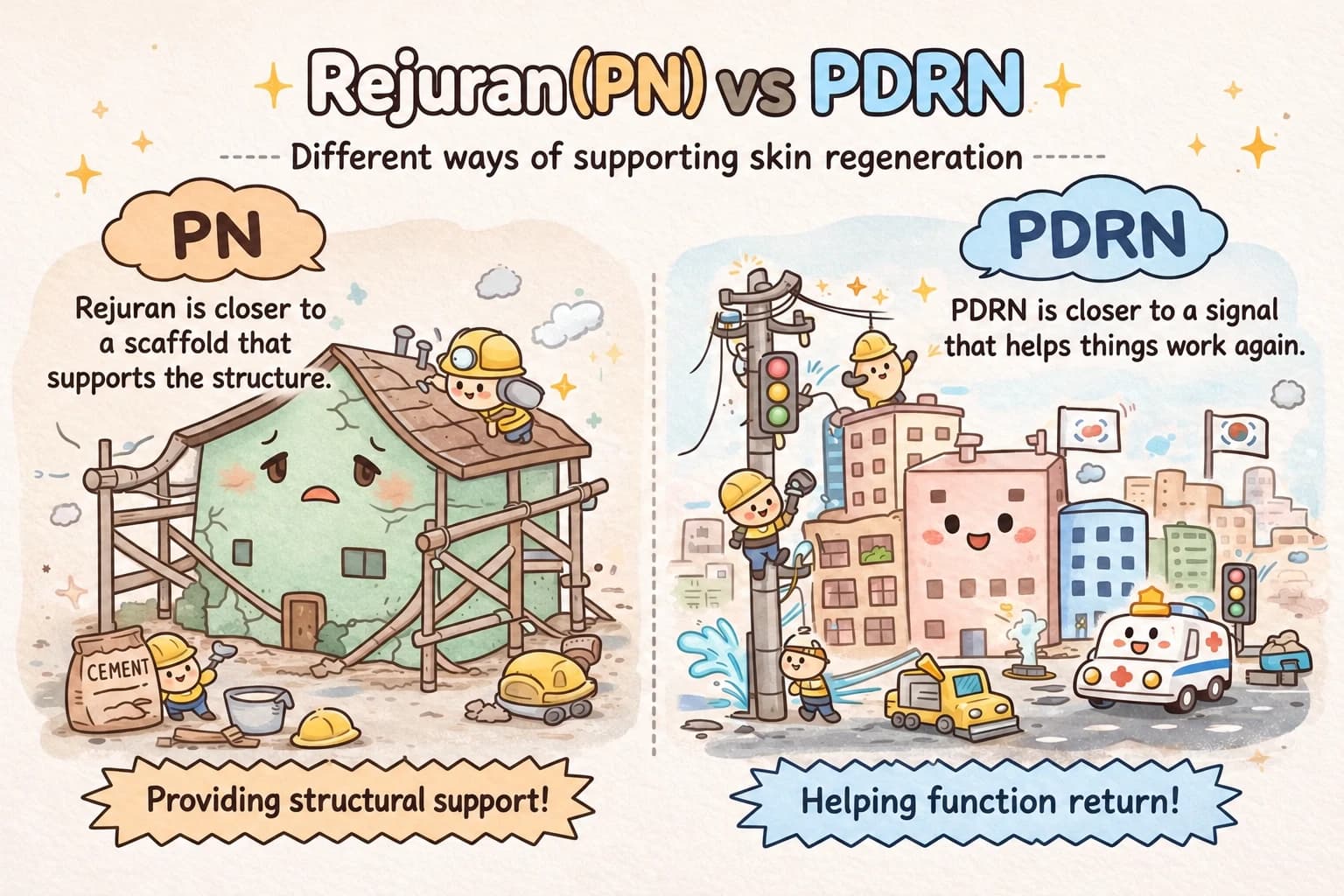
PDRN: a signal to help the house function again
The source uses PDRN as an analogy for restoring the signals that allow a house to work: bringing back electricity and water and making it habitable again.
PDRN has been studied in regenerative-medicine settings such as wound and tissue repair. Within this analogy, the focus is on supporting recovery of function rather than simply redecorating. The effect and approved use of any particular product must be assessed separately.
PN: a supporting framework for the house
Rejuran belongs to the PN category. The original post explains PN in a somewhat different way. It describes relatively long molecular structures and the concept of a supportive scaffold.
Imagine a house that still functions but has thinner walls and less overall support. PN is compared with adding a framework to support the surroundings. This is why discussions often mention skin texture and elasticity.
The source also raises the theoretical possibility of unexpected tissue responses depending on surrounding tissue and interactions with other materials. This is not evidence that a specific combination will cause a particular complication.
The question is not simply which is better
Comparing PN and PDRN as though one must be better is rather like asking whether a hammer or a screwdriver is the better tool.
In the source’s analogy, PDRN relates to recovery signals, while PN relates to structural support and the tissue environment. These are different contexts, not a proven head-to-head ranking or a rule for choosing treatment.
Reports of firmness or nodules
Online accounts sometimes describe firmness or nodules after PN is combined with other regenerative injections. The original post states that the literature it reviewed did not establish a high nodule risk from PN alone and that many reported nodules concerned other synthetic polymer biostimulators.
The scope of that literature search requires verification. Absence of a demonstrated high risk is not proof of no risk. Individual accounts and research findings need to be distinguished.
What does this skin need now?
Does it need recovery first, more structural support, or assessment of dryness and thinning? Understanding the terms PN and PDRN can provide a more precise language for discussing skin, without replacing a clinical assessment.
Bringing the distinction together
PN (Rejuran) and PDRN are both DNA-derived, but the source discusses different roles. PDRN is described in terms of a recovery environment, while PN is discussed in terms of structure and texture. Whether either is appropriate depends on the situation, product and evidence.
Taking time and using accurate terms can make conversations about skin more useful.
Source: Original post on Dr. Hyemi Yu’s Naver blog (Korean)
The original publication date and the website revision date are shown separately.