
JOURNAL
Radiesse distribution and nodule prevention in the literature
Source literature on CaHA distribution, local accumulation and dilution, with its limitations.
Local distribution is one factor in nodule assessment. Injection technique is not established as the cause of every nodule; dilution, depth, site-specific labeling and cited techniques require specialist review.
Radiesse distribution and nodule prevention: a literature discussion
The original post describes patients reporting lumps after material was placed mainly into nasolabial folds or under-eye hollows. It discusses repeated focal use of biostimulators and compares the approach with filling an isolated hollow with HA.
Radiesse is not HA. The source cites a 2024 Aesthetic Surgery Journal review discussing suboptimal spread and unintended bolus placement among possible contributors to CaHA nodules. Technique and distribution matter, but they cannot be assumed to explain every nodule or exclude material- and patient-related factors.
Microspheres and local accumulation
The source describes CaHA microspheres approximately 25–45 μm in diameter suspended in CMC gel. After gel absorption, particle-associated tissue responses may contribute to collagen formation.
It proposes the following simplified sequence for some noninflammatory findings: concentrated local placement → particle accumulation → persistence of a localized collection after gel absorption → a palpable nodule.
This does not classify every CaHA lump as physical rather than inflammatory, nor every HA nodule as immune-mediated. Individual findings require assessment.
McCarthy AD et al. Aesthet Surg J. 2024;44(8):869–879.
The source interprets the review as discussing placement, needle position, amount and superficial delivery as possible contributors to noninflammatory accumulation. Exact wording and the scope of the comparison with HA require verification.
Focal placement and broader distribution
Focal placement, as described by the source
The post lists concentrating material along a nasolabial line, a bolus in an under-eye hollow and a large amount at one site. It proposes that local accumulation may increase palpable-finding risk or create unwanted volume. These are planning considerations, not proof that every focal injection causes a nodule.
Broader distribution, as described by the source
The post discusses cannula retrograde threading, fanning and cross-pattern distribution to spread material over a larger area. It associates this with more even distribution. No technique eliminates risk, and this is not an instruction to inject every area or tissue plane.
de Almeida AT et al. Plast Reconstr Surg Glob Open. 2019.
The source cites consensus recommendations discussing retrograde, fanning or asterisk approaches and approximately 2–4 entry sites per facial side, with short linear threading when a needle is used. Such technical details require specialist review and product/site-specific labeling; they are not self-injection instructions.
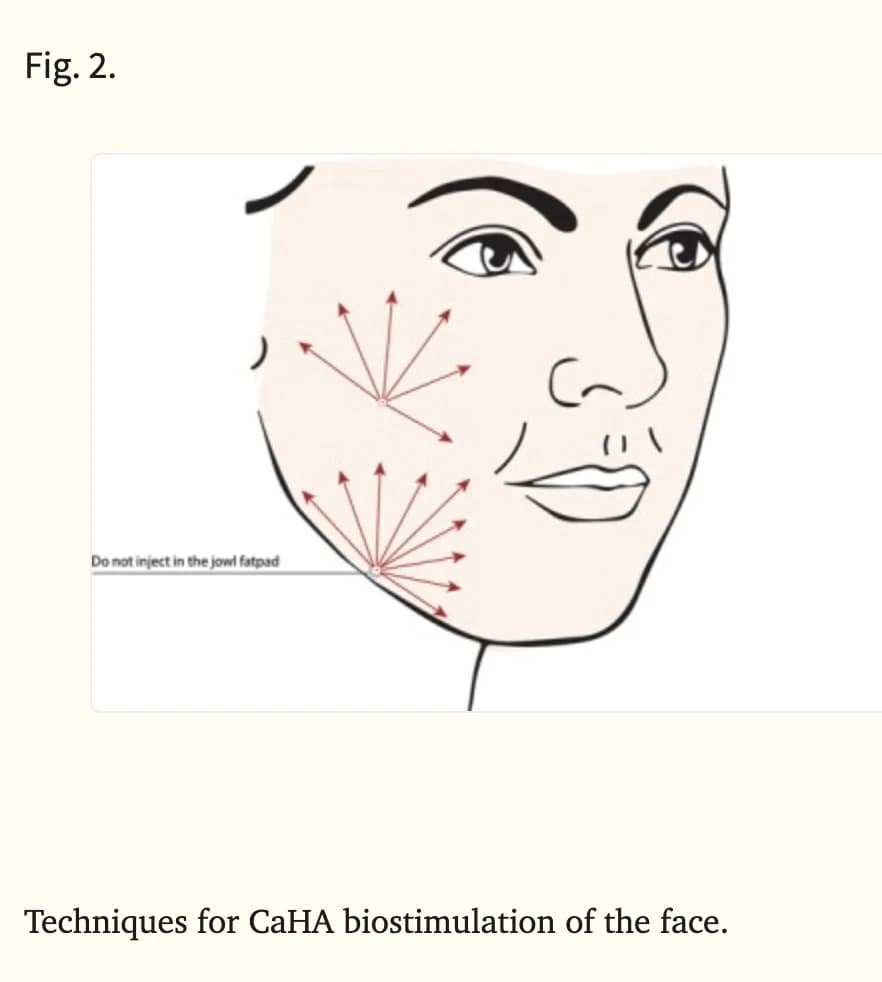
Dilution and distribution
The source relates dilution to viscosity and the distribution of particles per treated area:
- Undiluted: described as more viscous, with potential focal accumulation when placed as a bolus.
- 1:1 dilution: described as less viscous and capable of broader distribution.
- 1:2 or greater dilution: discussed for larger treated areas, including some body applications.
These descriptions do not establish appropriate use or an optimal ratio for every location. Product labeling, depth, anatomy and individual indication still matter.
Reference cited: PMC10693750, a 2023 case series.
The source interprets it as discussing easier lateral and deeper dispersion of diluted or hyperdiluted CaHA and less localized accumulation near an injection site. The exact findings and their applicability require original-paper review.
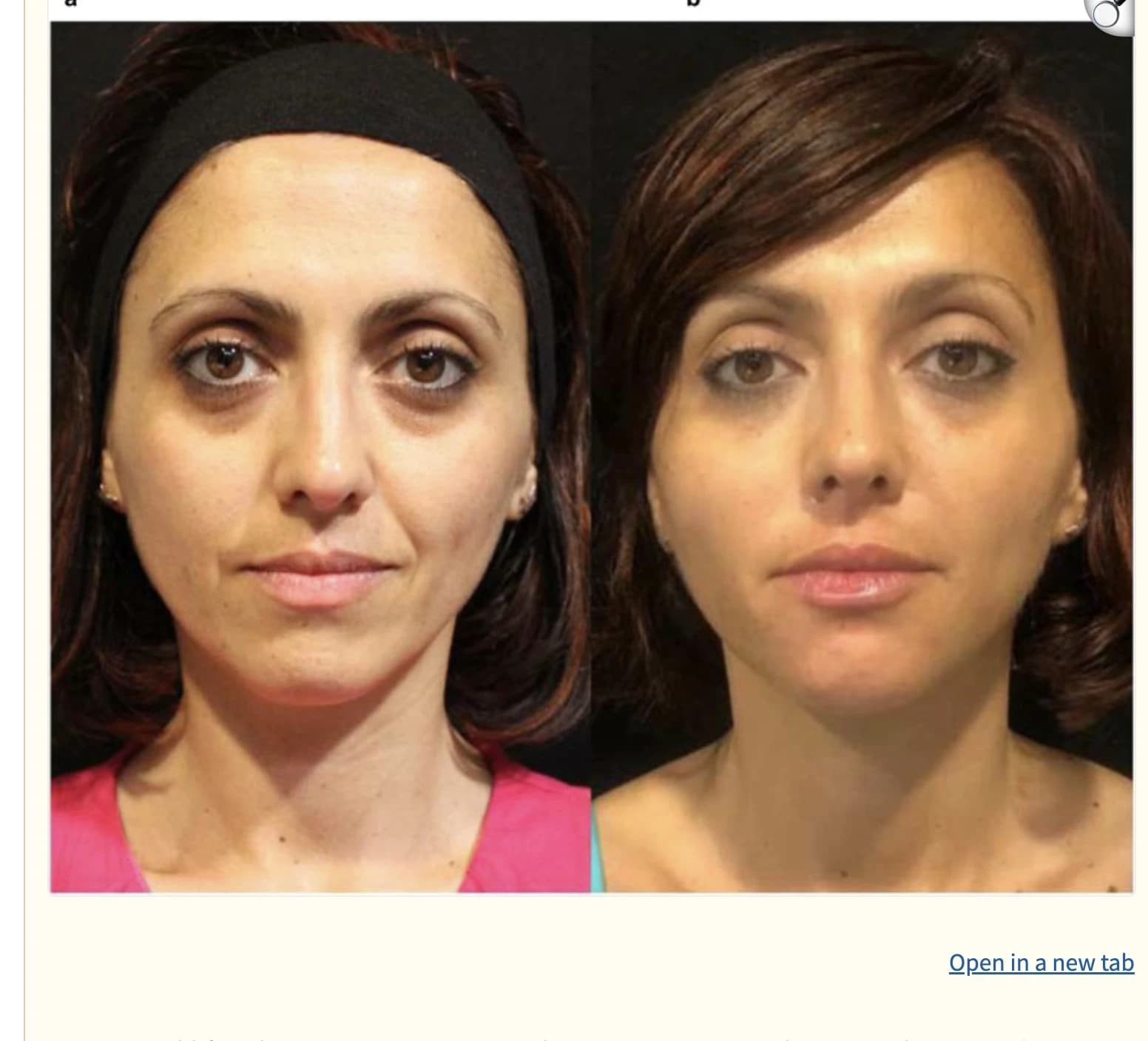
Interpreting the recommendation to distribute material
The author emphasizes matching a technique to the material rather than automatically apply assumptions about HA filling. The post favors even distribution and cautions against focal concentration.
This is a clinical interpretation of the cited literature. It does not prove universal superiority of a particular method or establish that all nodule formation is caused by focal injection.
The original post attributes a statement emphasizing technique and distribution to McCarthy and colleagues. The exact quotation requires verification; material, anatomy and individual tissue responses should not be excluded from assessment.
This article discusses public medical literature for education. Applicability varies between individuals, and specialist consultation is necessary.
The source summarizes literature including McCarthy AD et al. (2024) and de Almeida AT et al. (2019). It does not guarantee treatment outcomes or replace individualized care.
References linked by the source
Source: Original post on Dr. Hyemi Yu’s Naver blog (Korean)
The original publication date and the website revision date are shown separately.