
JOURNAL
Radiesse neck nodules: classification and assessment
A discussion of neck CaHA nodules, staged approaches in the source literature and interpretation limits.
Nodule categories and treatment levels describe the source literature, not an individual treatment plan. Priority claims, mechanisms, outcomes and permission to republish photographs require review.
A firm lump may become noticeable under the skin weeks after Radiesse (calcium hydroxylapatite, CaHA) treatment of the neck. Some patients say they were told it would be absorbed but can still feel it six months later.
Observation can sometimes be appropriate, but not every nodule resolves without intervention. The source discusses a 2024 Aesthetic Surgery Journal consensus review presenting a staged approach to CaHA nodules. Its priority claims and applicability require medical review.
Why consider the neck’s anatomy?
Radiesse contains CaHA microspheres suspended in carboxymethylcellulose (CMC) gel. As the gel is absorbed, surrounding tissue responses are discussed in relation to the microspheres. Local accumulation of particles is one possible explanation for a palpable nodule.
The source cites a 2025 Journal of Cosmetic Dermatology case report from Mayo Clinic regarding the neck’s anatomical characteristics.
Kang et al., J Cosmet Dermatol, August 2025.
The original post describes the thin, mobile skin of the neck and proposes that repeated movement may contribute to particle accumulation and noninflammatory nodules. The exact passage and the extent of evidence for that mechanism require verification.
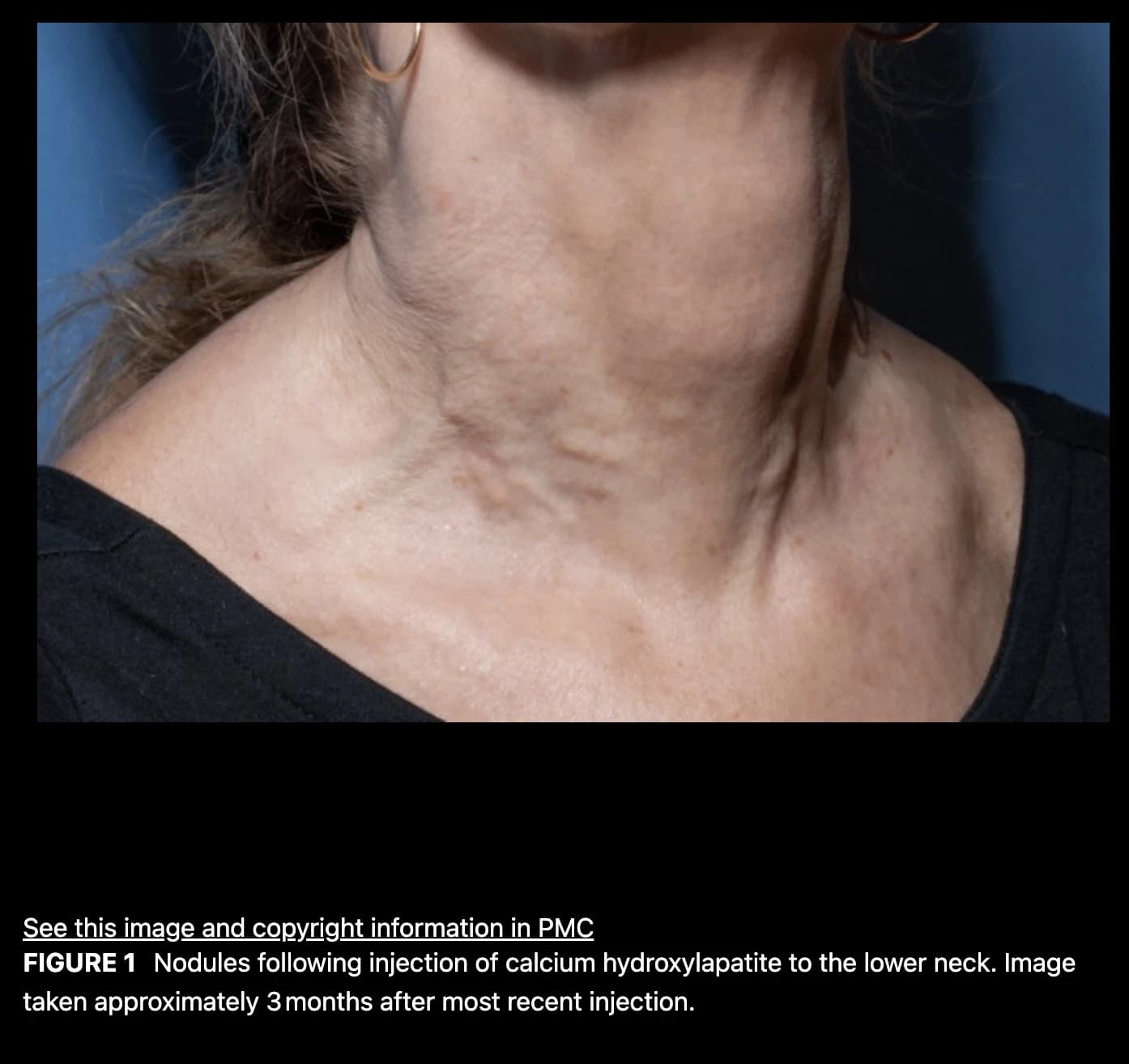
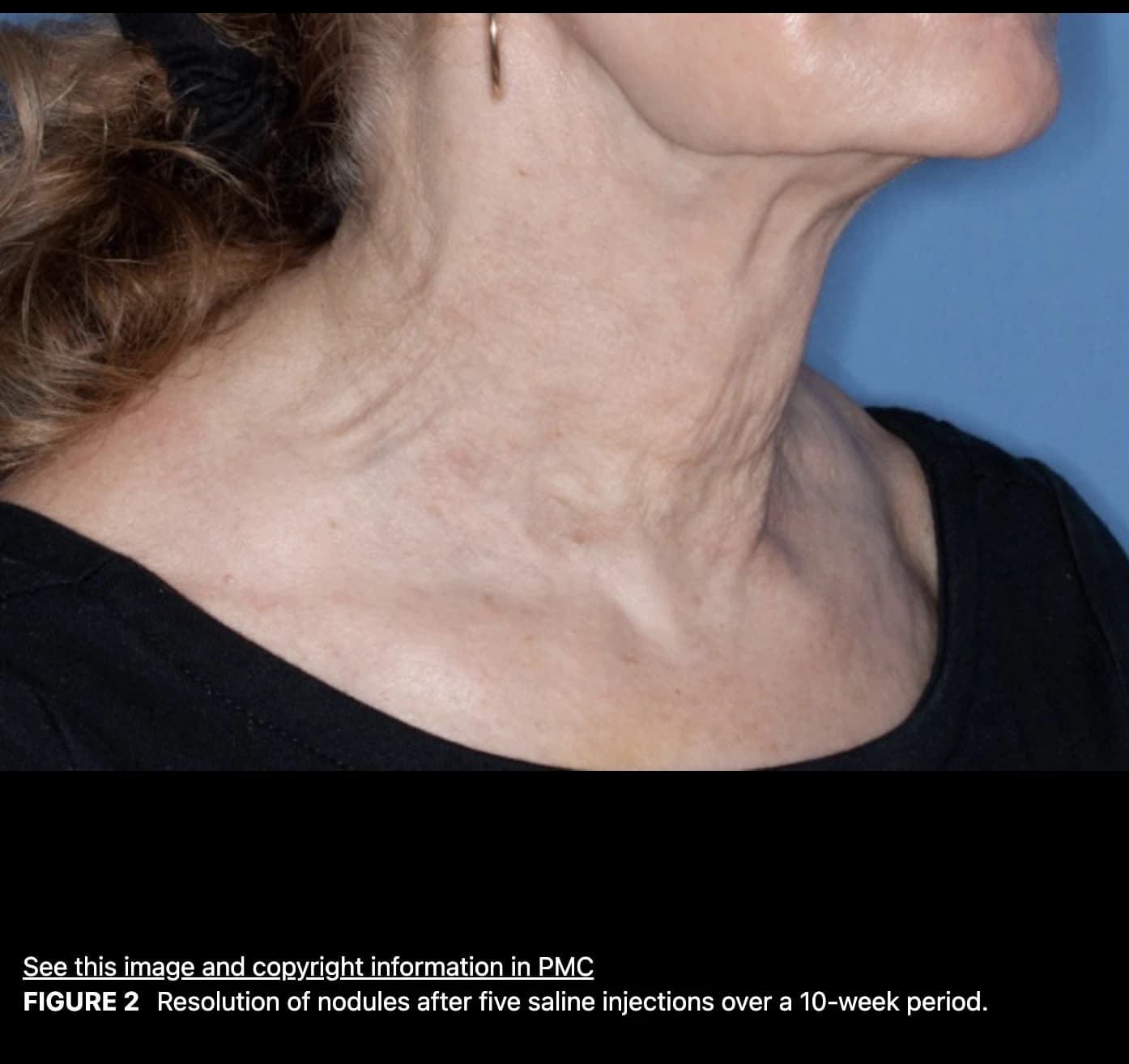
The source also describes an observation involving botulinum toxin to reduce neck movement. It interprets anatomy, treatment spacing, motion and technique as interacting considerations. A case observation does not establish that this combination prevents nodules in general.
Classifying the finding comes first
The source distinguishes noninflammatory nodules, described as localized accumulation without pain or color change, from granulomatous or inflammatory reactions that may involve redness, pain and firmness.
These descriptions are not sufficient to diagnose a particular lump. The source’s frequency and mechanism statements require review; inflammatory and noninflammatory possibilities must be assessed clinically rather than inferred from material alone.
The staged approach discussed in the 2024 review
The source attributes four levels, 0–3, to McCarthy and colleagues’ consensus review, considering invasiveness, cost, risk and reversibility.
McCarthy AD et al. Aesthet Surg J. 2024;44(8):869–879.
The source interprets the review as recommending staged assessment according to the nodule’s characteristics, onset and location. Exact wording and individual applicability require specialist review.
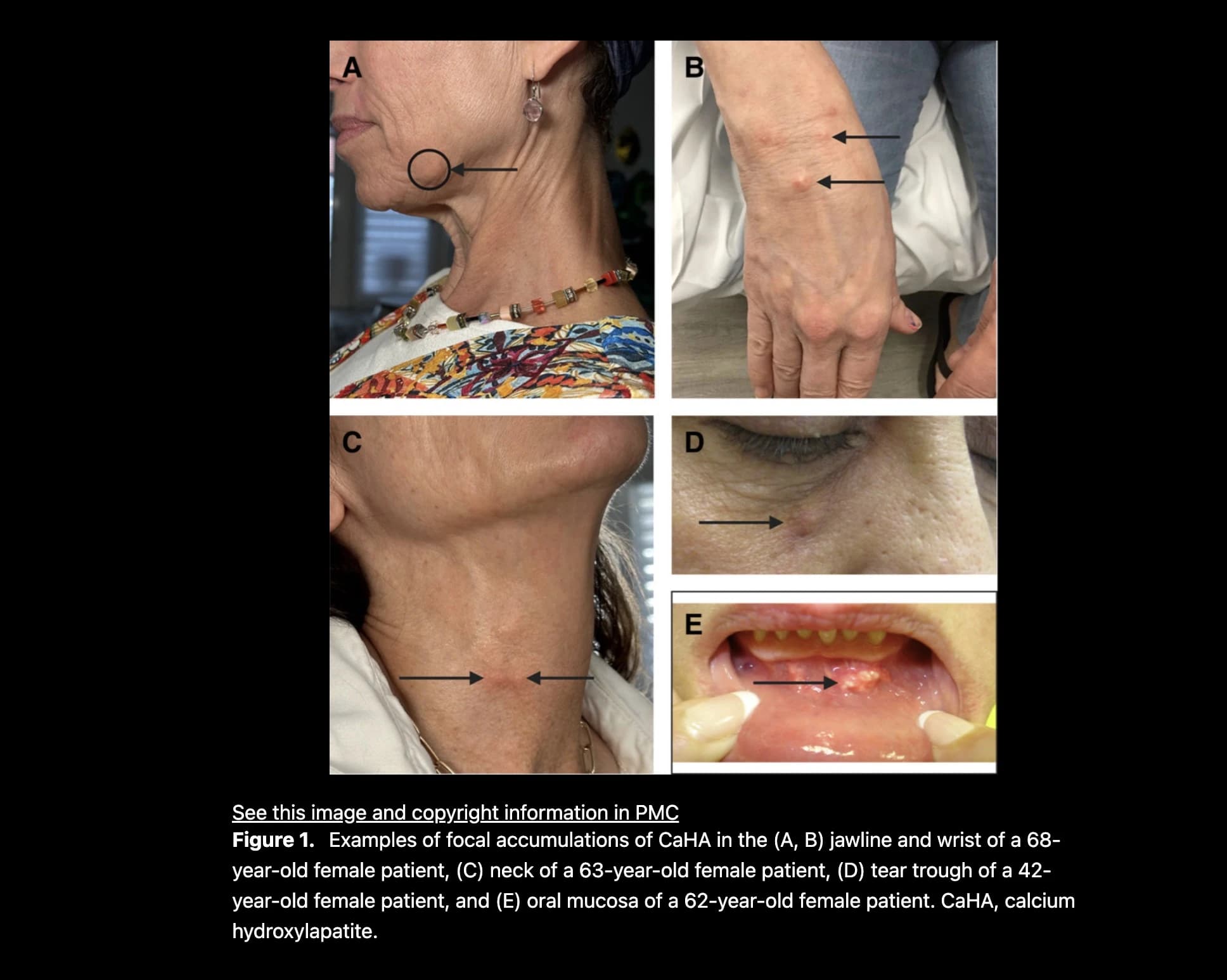
Level 0: observation
For selected small, asymptomatic or early findings, observation may be considered. CaHA does not behave like HA filler treated with hyaluronidase, so waiting indefinitely is not necessarily appropriate.
Level 1: mechanical dispersion
The source discusses physical dispersion with a cannula and local saline, sometimes described as in-situ hyperdilution, to redistribute accumulated material. These are interventional procedures, not proof of a noninvasive or guaranteed treatment.
It also cites a separate 2024 case report describing saline and vibration from a microneedling device, with a reported reduction in nodule size. A case report does not establish general success rates.
Level 2: medication or energy-based approaches
Where initial approaches do not help, the source discusses intralesional 5-fluorouracil, dexamethasone or triamcinolone and energy-based options such as lasers. Inappropriate use can cause further complications, including atrophy; professional assessment is essential.
Level 3: later options
The review is described as discussing calcium-chelating agents such as sodium thiosulfate and surgical excision after other approaches have not worked, considering scarring and tissue-injury risks. This is not a self-treatment sequence.
Prevention and planning
The source attributes prevention considerations to Kang et al. (2025): dilution, injection depth in mobile regions and possible use of botulinum toxin to reduce movement. These observations require checking against the paper and labeling rather than treating them as universal recommendations.
The original post interprets the report as suggesting that limiting movement with botulinum toxin may reduce risk. The scope of that statement requires medical review.
What the discussion means
A neck nodule after Radiesse is not always a matter of simply waiting. Some findings may be observed, while others may warrant procedural or medical assessment. Texture, size, timing and location matter.
This is a review of medical information discussed in public literature. Applicable options differ between individuals and require consultation with a suitably qualified clinician.
The source summarizes literature including McCarthy AD et al. (2024) and Kang BY et al. (2025) for medical education. It does not guarantee treatment effects or replace individual assessment.
References linked by the source
Source: Original post on Dr. Hyemi Yu’s Naver blog (Korean)
The original publication date and the website revision date are shown separately.