
JOURNAL
Do more bumps after Rejuran mean better results?
Distinguishing immediate Rejuran bumps from longer-term outcomes and considering limits of PN reports.
This article asks why the number of visible bumps alone cannot establish efficacy. Exact wording and outcome measures in the cited studies require verification; a lip case report cannot establish comparative efficacy or equivalence of techniques across the whole face.
Questions about bumps after Rejuran, PN injections and intradermal delivery arise repeatedly in consultations.
A familiar claim is that closely spaced intradermal bumps mean a better result. It can sound convincing, especially when looking at photographs immediately after treatment. But the scientific basis for using bump density as an efficacy measure needs to be examined.
This article discusses PN (Rejuran) and PDRN research in relation to two questions: why visible bump density alone cannot establish efficacy, and what has been reported after cannula delivery. Exact wording and interpretations of the source’s cited passages still require verification.
1. An analogy
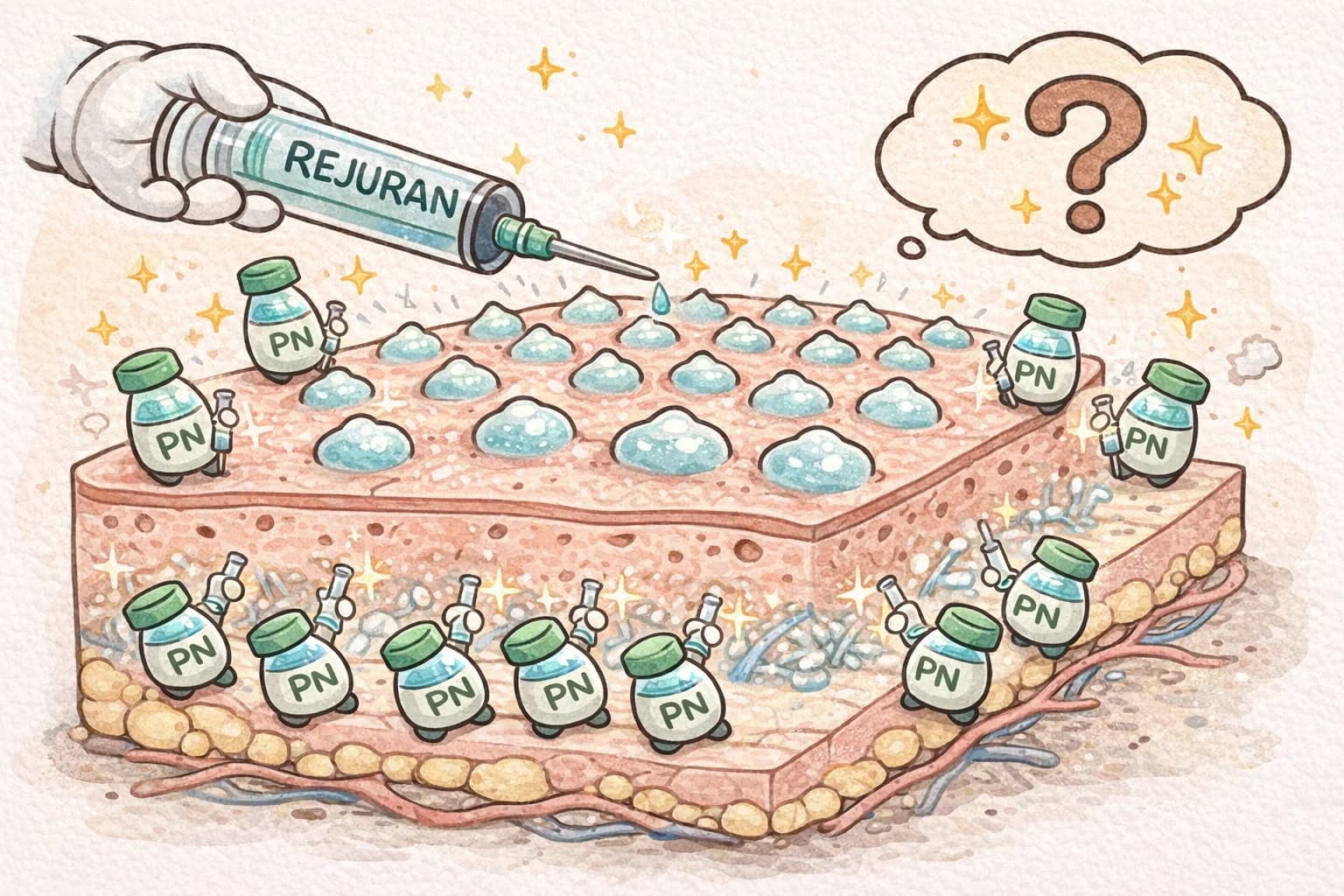
Imagine the skin as a building. Making many visible bumps is compared with placing many nails in an outside wall: from a distance, it can look as though much has been done.
A building’s stability, however, depends on how its loads are distributed and its structure supported, not simply on the number of nails. This analogy explains why a visible immediate sign is different from a later tissue outcome.
2. Bump density is not itself the outcome
The original post points to PN literature evaluating changes in skin over time rather than the shape or density of immediate bumps.
Reference cited in the source: PMC11311621.
The relevant question is what changed after treatment, rather than only how many injection marks were visible. The exact outcomes measured in the cited review require verification.
3. Looking beyond the immediate bumps
The source describes PN using a scaffold concept rather than as a material intended primarily for immediate volume. It attributes the following interpretation to the literature.
The source interprets PN as potentially supporting an extracellular matrix environment rather than acting primarily as a volumizing agent. The exact quoted wording has not been verified.
Reference cited in the source: PMC11311621.
The author interprets this as support for an environment in which cells can respond, and emphasizes tissue distribution rather than counting visible bumps. This is an interpretation requiring review, not a demonstrated comparison of injection techniques.
4. What about cannula delivery?
The source asks whether PN delivery with a cannula can have meaningful effects without many closely spaced needle injections, and refers to a case report.
The source describes a report of changes in lip texture and hydration after cannula delivery, with observations extending to approximately six months. Exact wording and follow-up details require verification.
Reference cited in the source: PMC11884830.
The post interprets this as an observation after cannula delivery. It is not a large randomized trial. A lip case report cannot establish that cannula and needle approaches are equivalent or superior across the face, nor that visible bumps never matter.
5. Why can more bumps look more convincing?
The immediate appearance of treatment needs to be distinguished from its long-term effects. Closely spaced bumps can make a post-treatment photograph look more dramatic, encouraging the impression that more treatment means more benefit.
The research question is different.
Does that immediate scene explain the condition of the skin three months later?
The source argues that the available observations do not establish such a relationship. The strength and scope of that conclusion require medical review.
6. What to take from the question
Visible bump density alone is not enough to determine efficacy. The source discusses outcomes such as elasticity, texture and wrinkles, and reports of tissue changes following cannula injection.
A bump is an immediate observation during the treatment process, not the final result. Longer-term outcomes matter. This does not by itself establish the best delivery method for an individual patient.
Source: Original post on Dr. Hyemi Yu’s Naver blog (Korean)
The original publication date and the website revision date are shown separately.