
JOURNAL
Pregnancy While Taking Wegovy: Understanding “Ozempic Babies”
Research on weight-management medication, fertility, and timing when planning pregnancy.
You may have heard stories of someone becoming pregnant while taking Wegovy, or conceiving after losing weight.
For someone who has struggled to conceive, this may raise hope. For someone already taking Wegovy, it may raise questions about an unplanned pregnancy or when to stop before trying to conceive.
This article examines published research. The connection between Wegovy and pregnancy is only part of the story.

As a doctor working on obesity and aging, and an author of Korean-language work on slow-aging diets, I regularly encounter the links between weight, hormones, and fertility.
Rather than relying on anecdotes, let us examine what the studies actually report.
Wegovy is not a fertility treatment
Wegovy is neither an infertility treatment nor a drug intended to promote conception. It does not directly increase reproductive hormones.
Obesity, insulin resistance, and polycystic ovary syndrome (PCOS) can disrupt ovulation. If weight decreases and insulin sensitivity improves, ovulation that had been disrupted may resume.
Small studies and meta-analyses of GLP-1 medicines in women with PCOS report improvements in menstrual cycles and ovulation. Improved insulin sensitivity may reduce excess ovarian androgens and adipose inflammation, supporting the hormonal axis involved in ovulation.
The analogy is clearing an obstructed path rather than the drug “creating a baby.” This may help explain some unexpected pregnancies referred to as “Ozempic babies.”
If pregnancy is not planned, contraception matters
Fertility can return without warning. If you are not planning pregnancy, effective contraception is important from the start of treatment.
Research cited in the original reports that semaglutide did not meaningfully reduce blood concentrations of oral contraceptive hormones. Some other medications in this group, such as tirzepatide, may reduce those concentrations, with recommendations to use non-oral contraception, including condoms, for specified periods after starting or increasing the dose.
Dose titration is a period when medication absorption can vary. Discuss the medication-specific implications with your clinician.
When pregnancy is planned, stopping time is important
Wegovy is not recommended during pregnancy. The original review states that it was not classified as a direct teratogen in animal studies, while emphasizing insufficient safety data in pregnant women and the precautionary approach of avoiding use during pregnancy.
Because elimination takes time, a washout period is needed before trying to conceive. The FSRH recommendations cited in the original article (2025) list:
- Semaglutide (Wegovy): stop approximately two months, or eight weeks, before attempting pregnancy.
- Tirzepatide: approximately one month before.
- Exenatide: twelve weeks before.
If pregnancy is discovered while taking Wegovy, stop treatment and contact your clinician.
A small study of first-trimester exposure did not observe an increased risk of major congenital malformations, but the authors still advise effective contraception until larger studies clarify safety.
Preparing for IVF
Weight optimization before treatment is being researched for people with obesity or PCOS. Obesity-related inflammation and immune changes can affect implantation. Research in overweight or obese women preparing for IVF reports improvements in maternal glucose and insulin resistance after weight loss before treatment.
Caution remains. Preclinical information about semaglutide’s direct effects on the ovaries is incomplete. Ongoing IVF studies therefore incorporate washout before ovarian stimulation and embryo transfer.
The principle is to consider it in the preparation phase and discontinue it before and during the procedure, with medical guidance.
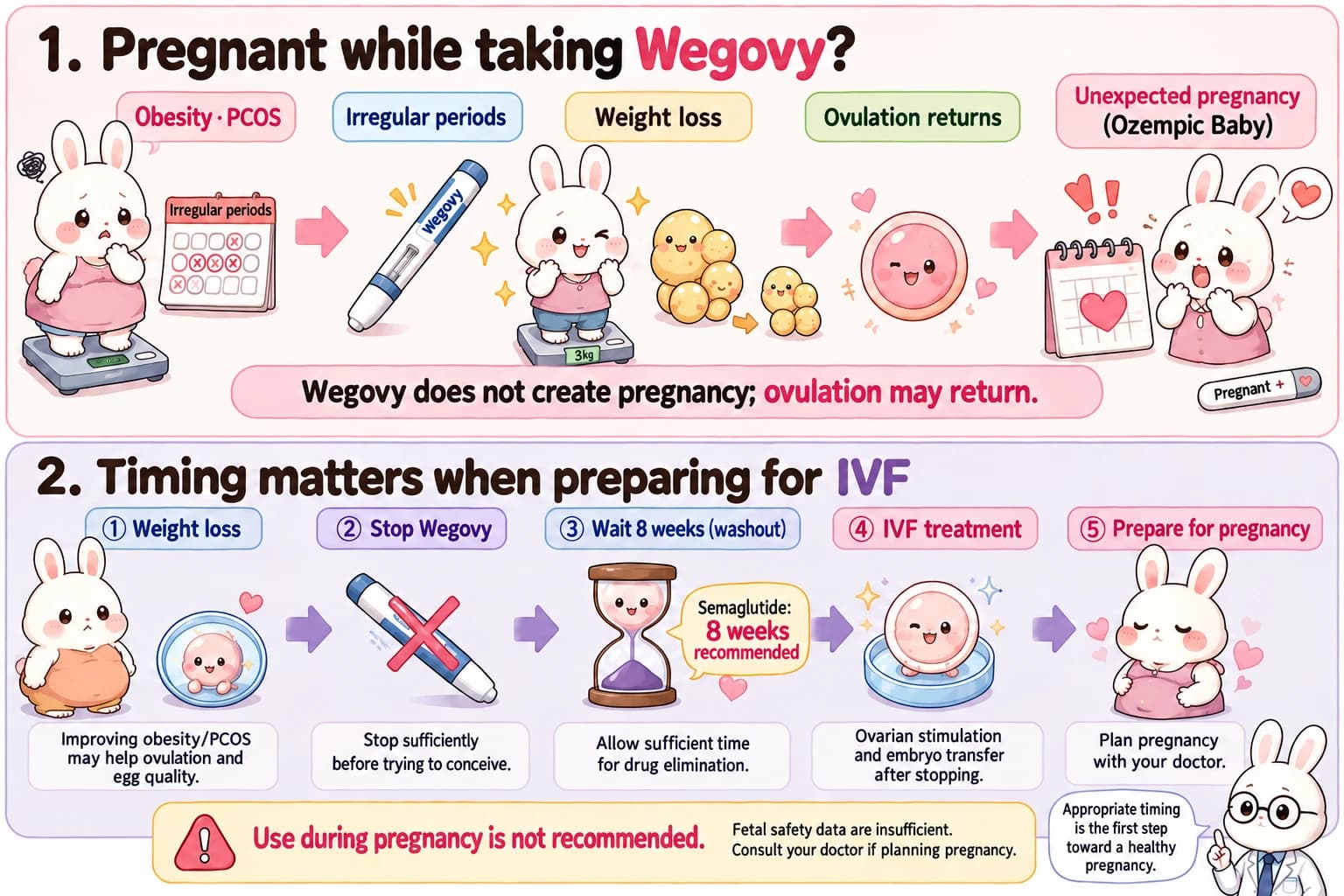
Wegovy does not “make” a pregnancy. It may help clear a path to conception that obesity had obstructed. Timing remains central.
- No pregnancy planned → use contraception from the start.
- Planning pregnancy → discontinue approximately two months before trying; avoid use during pregnancy.
- Preparing for IVF → consider only the preparation phase and discontinue before treatment.
For someone with obesity or PCOS-related difficulty conceiving, the first question is not simply whether to take a medication, but how to align treatment with health and pregnancy plans. This should be planned with a clinician.
References
Parker et al. GLP-1 RAs' use during pregnancy: safety data from regulatory clinical trials. Diabetes Obes Metab. 2025 — https://dom-pubs.onlinelibrary.wiley.com/doi/10.1111/dom.16437
Pregnancy outcomes following first trimester exposure to semaglutide. PMC12141256 — https://pmc.ncbi.nlm.nih.gov/articles/PMC12141256/
Semaglutide and human reproduction: caution at the intersection of energy balance, ovarian function, and follicular development. PMC12333279 — https://pmc.ncbi.nlm.nih.gov/articles/PMC12333279/
A Systematic Review on GLP-1 RAs in Reproductive Health: Integrating IVF Data, Ovarian Physiology and Molecular Mechanisms. PMC12841515 — https://pmc.ncbi.nlm.nih.gov/articles/PMC12841515/
FSRH Statement: GLP-1 agonists and contraception (washout recommendations, 2025) — https://www.cosrh.org/Common/Uploaded%20files/documents/CEU-statement-GLP-1-agonists-and-contraception.pdf
Medical information notice
This article reviews published literature for information. It does not guarantee effects or safety regarding pregnancy or infertility. Wegovy (semaglutide) is a prescription medication not recommended during pregnancy. Suitability and discontinuation timing depend on health, history, and pregnancy plans. This article does not replace medical care; decisions about pregnancy, contraception, and medication require consultation with a specialist.
Source: Original post on Dr. Hyemi Yu’s Naver blog (Korean)
The original publication date and the website revision date are shown separately.