
JOURNAL
Does Stress Really Make Your Beard Grow Faster?
A look at stress, beard growth, hormones, and sleep through published medical literature.
This article is an informational literature review based on publicly available medical research.
Individual circumstances vary. It does not replace medical diagnosis or treatment.
“My beard seems to be growing much faster lately. Is it because I am stressed and not sleeping well?”
You may have heard someone say this, or felt it yourself.
From a medical perspective, however, the relationship is almost the opposite.
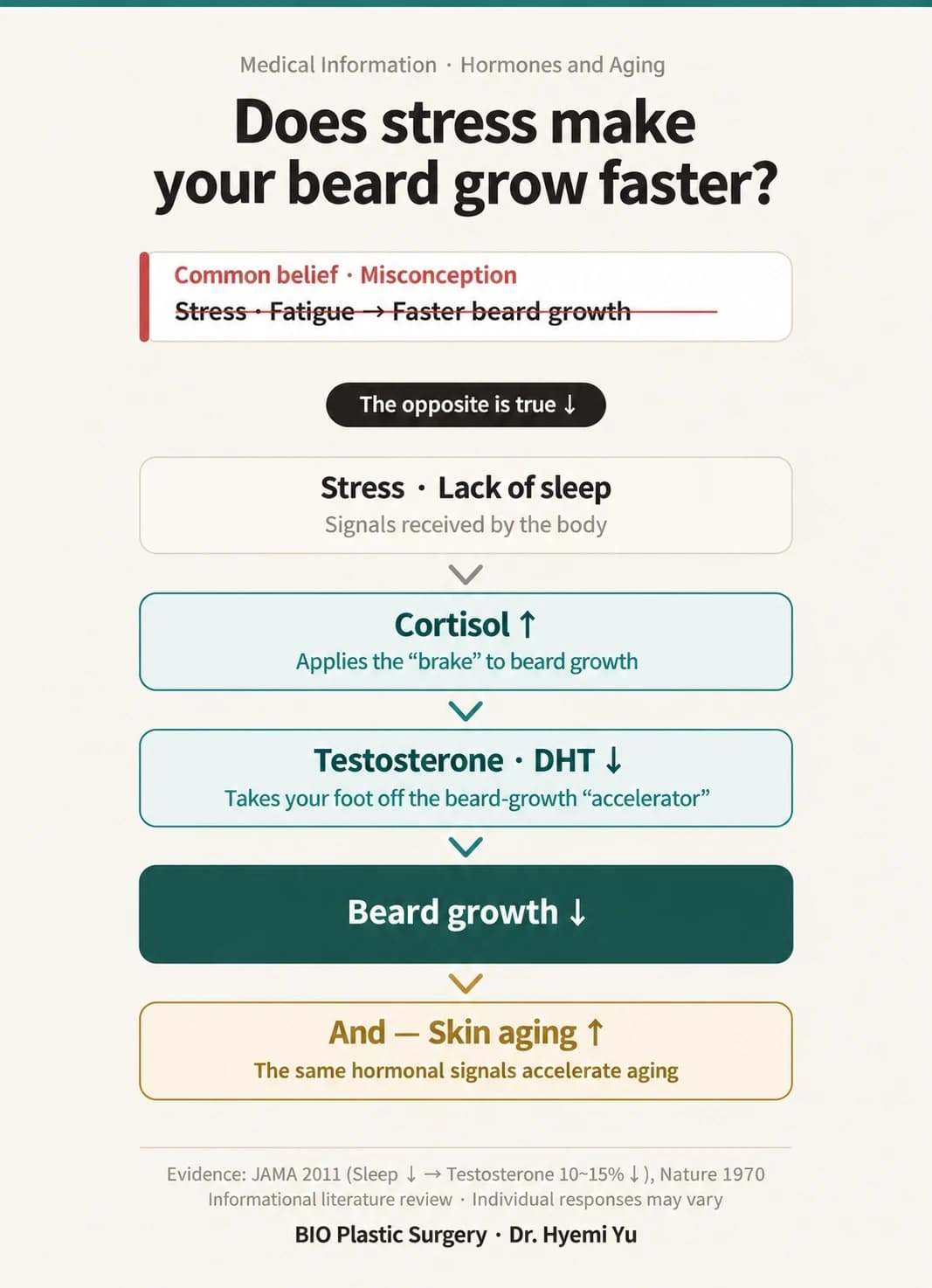
Stress and lack of sleep do not make a beard grow faster. They tend to switch off the signals that drive its growth.
More importantly, those same signals can also accelerate skin aging.
If you opened this article, you may already be interested in how your physical condition, hormones, and aging are connected.
Perhaps you have wondered, “Why do I look older when I am tired?”
Today, I will explore that feeling through a surprisingly revealing clue: your beard.
It takes just three minutes.

Specialist in plastic surgery
Author of a Korean-language book on the fundamentals of slow-aging diets, among other works
Numerous television appearances
In my practice, I often hear questions such as, “Why does my beard seem to grow so quickly when I am tired?”
It may seem trivial, but beard growth can offer a clue to our hormonal state. Let us take a closer look.
1. The real “switch” behind beard growth
Beards do not grow on their own. A particular hormonal switch needs to be active: androgens, especially DHT (dihydrotestosterone).
When testosterone is converted into DHT in the skin, DHT stimulates the hair follicles on the chin and upper lip. Interestingly, the same hormone can contribute to hair loss on the scalp. Beard growth is therefore classified as a secondary sexual characteristic.
Think of a beard as a car powered by a testosterone “accelerator.” Take your foot off the accelerator, and its speed naturally decreases.
2. Stress applies a “brake” to that accelerator
When we are stressed, our bodies release a hormone called cortisol.
The issue is that cortisol and testosterone tend to move in opposite directions, like a seesaw.
As cortisol rises, testosterone tends to fall.
In other words, chronic stress follows this sequence:
Stress → Cortisol ↑ → Testosterone ↓ → DHT signaling ↓ → Slower beard growth
It is like pressing the accelerator (testosterone) while simultaneously applying the brake (cortisol).
Severe stress has also been reported in association with alopecia areata of the beard, which causes round patches of hair loss.
3. “Less sleep makes your beard grow faster” is another misconception
What about sleep deprivation? In brief, it lowers testosterone.
In a study of healthy young men conducted by researchers at the University of Chicago and published in JAMA, testosterone reportedly fell by 10–15% after a week of sleeping fewer than five hours per night.
This is because a substantial proportion of testosterone secretion in men occurs during sleep.
There are also reports of reduced beard growth following sleep deprivation.
In short, the more tired and sleep-deprived you are, the more you take your foot off the accelerator—the opposite of the feeling that your beard grows faster when you are exhausted.
4. Why does it sometimes feel as though your beard has grown more?
There are two possible explanations.
First, perception can be misleading.
When busy and tired, you may skip shaving or shave less carefully. You may also scrutinize your face more closely in the mirror.
Coarse stubble becomes more noticeable, rather than necessarily growing faster.
Second, stress can be confused with arousal or excitement.
In 1970, Nature published an intriguing account from a biologist who had been isolated on a remote island.
He reported that his beard grew more slowly on the island, then began growing faster on the day before he returned to the mainland.
Anticipation and excitement can temporarily increase testosterone. This is a different process from stress associated with elevated cortisol.
The point is that excitement and anticipation may coincide with faster growth, whereas chronic stress tends to work in the opposite direction.
5. The more important issue is aging, not your beard
This could end as an interesting piece of trivia, but there is another reason I wrote this article.
The signals that reduce beard growth—higher cortisol and lower testosterone—are also signals associated with accelerated skin aging.
When cortisol remains chronically elevated, collagen synthesis decreases, recovery slows, and the skin tends to become thinner and more prone to sagging.
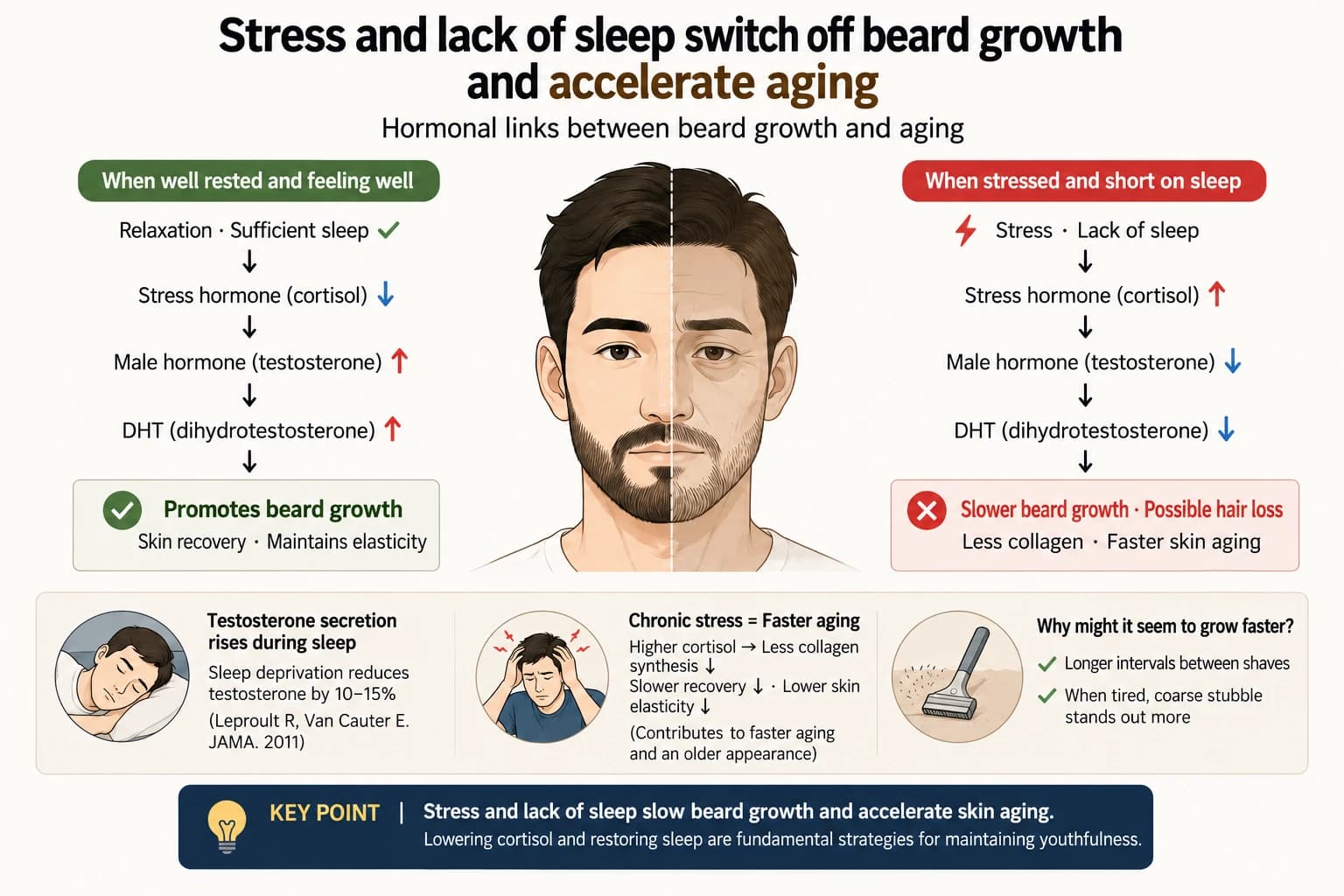
This helps explain why looking older on a tired day may be more than just an impression.
The small clue of beard growth points to a larger message
Stress and sleep influence the pace of aging every day through our hormones.
This is a central point I have emphasized in my work on slow aging.
Before considering expensive procedures, it is worth examining the everyday foundations of lowering cortisol and restoring sleep.
View the Korean-language book on Kyobo Book Centre
My book explores in greater depth how physical condition and hormones affect skin aging from a slow-aging perspective.
Follow the book link for more information.
This article is an informational review of publicly available medical literature. Individual responses may vary. It does not guarantee any particular effect. If you have symptoms, consult a medical specialist.
References
Leproult R, Van Cauter E. Effect of 1 Week of Sleep Restriction on Testosterone Levels in Young Healthy Men. JAMA. 2011;305(21):2173-2174. PMID: 21632481 / DOI: 10.1001/jama.2011.710
Anonymous. Effects of Sexual Activity on Beard Growth in Man. Nature. 1970;226(5248):869-870. PMID: 5444635 / DOI: 10.1038/226869a0
(DHT and beard growth: general literature on the mechanisms of secondary sexual characteristics.)
Source: Original post on Dr. Hyemi Yu’s Naver blog (Korean)
The original publication date and the website revision date are shown separately.