
JOURNAL
Ultherapy in Gangnam: Five Reasons Results May Be Limited
Skin conditions and treatment-planning questions to consider before Ultherapy.
This article is an informational review of publicly available medical literature. Effects and responses vary, and no particular result is guaranteed. Accurate assessment requires consultation with a specialist.
“I had Ultherapy, but honestly, I cannot tell whether it helped.”
After spending a considerable amount, an unclear change in the mirror can leave you wondering whether the result is subtle or whether treatment did not work for you. You may then consider another session.
People who notice particularly limited results can share certain underlying conditions. If one applies, repeating the same procedure may not be the best answer and may add cost without addressing the cause.
Whether you have already had Ultherapy or are considering it, the central question is not only whether to have it, but how treatment is planned.
I am often asked whether another Ultherapy session is needed. For some people, additional tightening is not the appropriate next step. The literature helps explain why.
What Ultherapy does
Ultherapy uses heat to contract tissue and stimulate collagen remodeling. Research describes microthermal coagulation points targeting the deep dermis and SMAS, followed by formation of new collagen and elastic fibers.
The original article compares this contraction to meat shrinking when heated. The mechanism is relevant to loose tissue, but there are conditions under which it may be less suitable.
Five reasons results may be limited
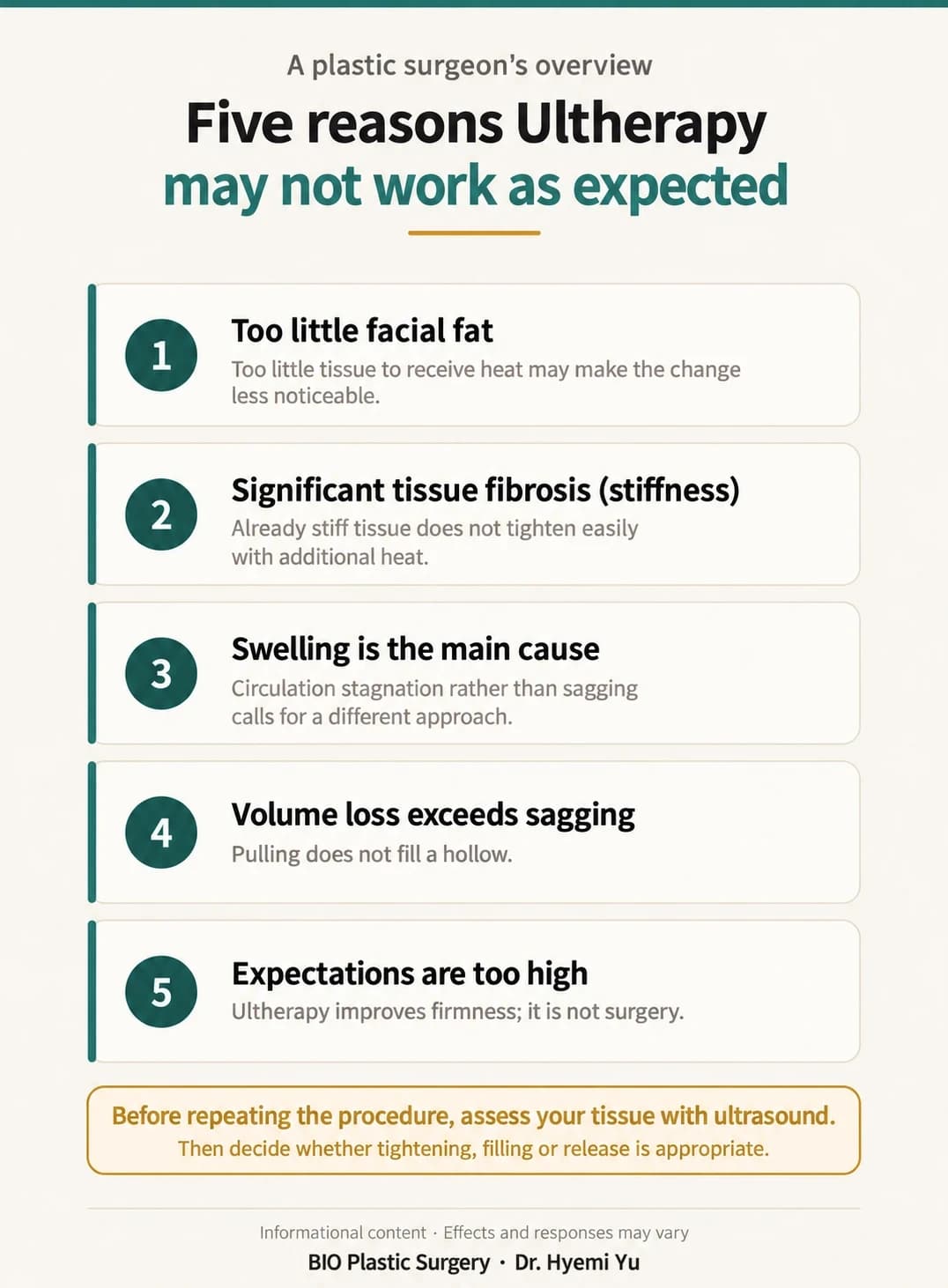
- Too little facial fat. A very thin face may have insufficient tissue to receive the intended heating effect, making changes less noticeable.
- Significant fibrosis or stiffness. Facelifts, threads, radiofrequency, or repeated procedures can contribute to tissue stiffness. Already stiff tissue may not contract readily with more heat. A release-oriented approach may be considered before further tightening.
- Swelling is the main issue. If fullness reflects fluid or circulatory stagnation rather than sagging, tightening addresses a different problem.
- Volume loss exceeds sagging. Aging-related hollows cannot be filled simply by pulling. A volume-restoring approach, such as fillers or collagen-stimulating treatment, may be more relevant.
- Expectations are too high. Ultherapy is a procedure intended to improve firmness, not surgery. Expecting a dramatic one-session lift can lead to dissatisfaction even when some improvement occurs.
In addition, applying excessive energy with a uniform shot count without individual facial planning may reduce fat in areas where volume should be preserved, such as the cheeks or temples, creating hollows or contour irregularities.
Planning treatment appropriately
Skin thickness and the depth of the target fascial layer vary between individuals, sometimes by millimeters.
First, assess the tissue layers directly with ultrasound. Without checking dermal, fat, and fascial thickness, using the same depth for everyone may produce insufficient treatment in one person and excessive treatment in another.
Second, select tips and depths by site. Areas at risk of hollowing need a different approach from areas requiring stronger treatment.
Third, prioritize accuracy over shot count. The aim is to target the areas that need treatment rather than simply deliver more shots.
Other directions when results have been limited
If the cheeks are already hollow, stiff, or swollen, the approach may need to change. These are possibilities to consider after assessment, not a blanket recommendation for a particular procedure.
When volume loss is the main problem, a volume-restoring approach is more relevant. With stiffness or circulatory stagnation, release may be considered before tightening.
ESWT is discussed in this context. Literature reports reductions in fibrosis-related factors such as TGF-β1 and α-SMA, clinical improvement in some facial or post–plastic surgery fibrosis cases, and possible effects on blood flow and lymphatic circulation.
An important limitation remains: large clinical studies demonstrating superior facial-lifting outcomes from combining Ultherapy with ESWT are limited.
Ultherapy contracts tissue and promotes collagen remodeling. ESWT may have a role in circulation and fibrosis regulation. Their mechanisms differ, so complementary effects have been proposed in some patients, but further research is needed.
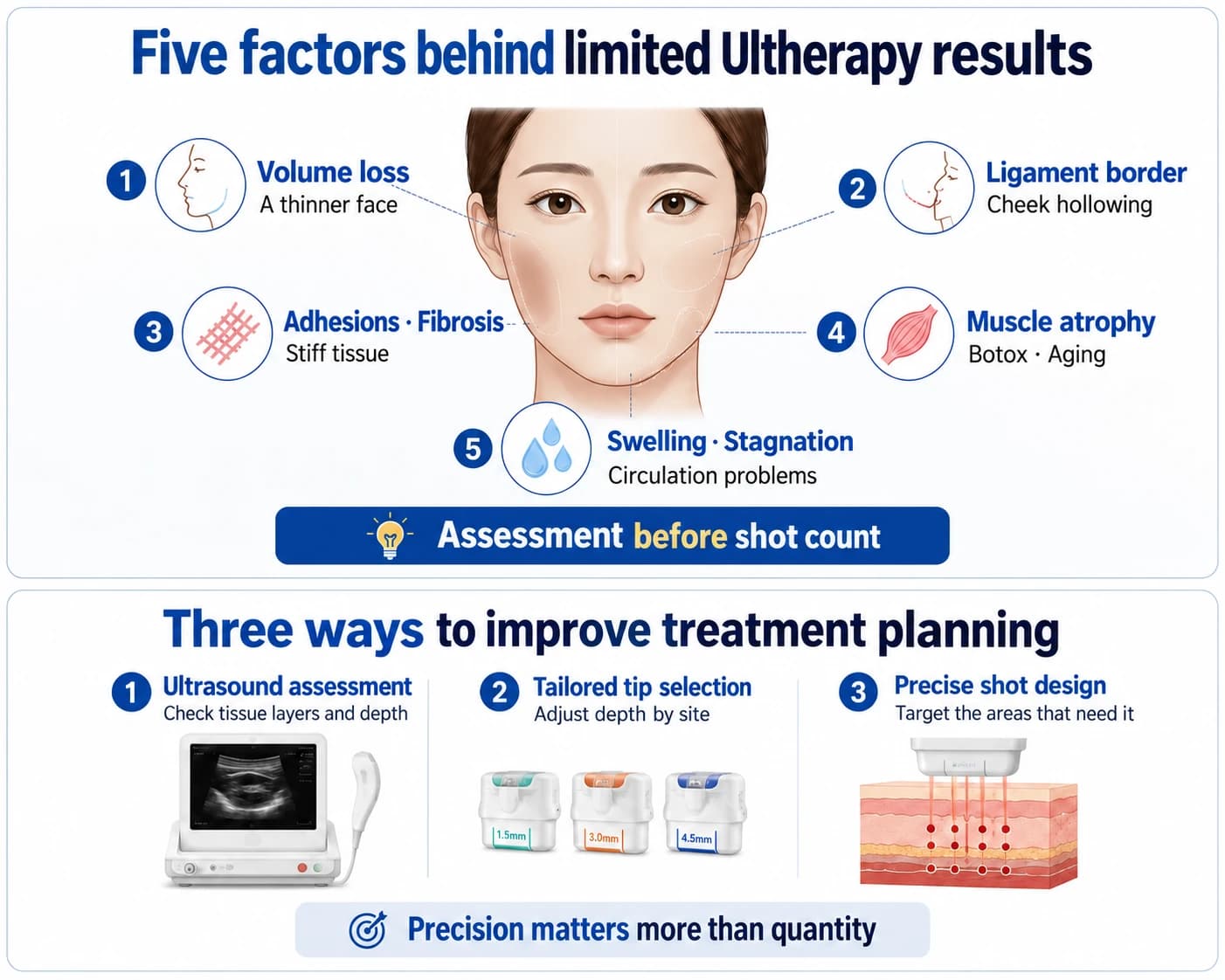
Before repeating Ultherapy, consider which issue may apply: low fat volume, stiffness, swelling, volume loss, or excessive expectations.
Photographs alone may not establish this accurately. Direct assessment of tissue layers with ultrasound can inform whether tightening, filling, or release is appropriate and help avoid unnecessary treatment.
If you are unsure whether more Ultherapy or a different approach makes sense, begin by assessing your individual condition.
This article is an informational literature review and does not replace diagnosis or treatment. All procedures may have adverse effects and limitations; effects and responses vary between individuals.
References
Pavicic T, et al. Microfocused Ultrasound With Visualization in Skin Quality: A Narrative Review. J Cosmet Dermatol. 2025. PMC12374570
Ko et al. Clinical Efficacy and Safety of Low-Energy ESWT for Deep Dermal and Subdermal Fibrosis (incl. post–plastic surgery facial fibrosis). Skin Res Technol. 2024. PMC11452247 / DOI 10.1111/srt.70082
Kimura M, Tanaka S. Facial Tightening Effects Following Focused and Radial Acoustic Wave Therapy. Lasers Surg Med. 2021;53(5). PMID 33211338 / PMC8246538
Cui HS, et al. ESWT Alters Fibrosis-Related Molecules in Hypertrophic Scar Fibroblasts. Int J Mol Sci. 2018;19(1):124. PMC5796073
Shock Wave Therapy in Plastic Surgery: A Review of the Current Indications. Aesthet Surg J. 2023;43(3):370.
Source: Original post on Dr. Hyemi Yu’s Naver blog (Korean)
The original publication date and the website revision date are shown separately.