
JOURNAL
How Wegovy and Mounjaro act in weight management
An introduction to appetite, gastrointestinal and glucose pathways, differences between Wegovy and Mounjaro, and research limits.
Wegovy contains semaglutide, a GLP-1 receptor agonist; Mounjaro contains tirzepatide, a dual GIP/GLP-1 receptor agonist. The mechanisms discussed below are not all equally established in humans or approved product claims. The BDNF discussion is not a prescription for fasting or sun exposure.
GLP-1-related medicines are now central to many discussions about obesity treatment. Names such as Wegovy and Mounjaro have attracted international attention because of their effects on body weight.
They are often described simply as injections that reduce appetite, but their actions are more complex.
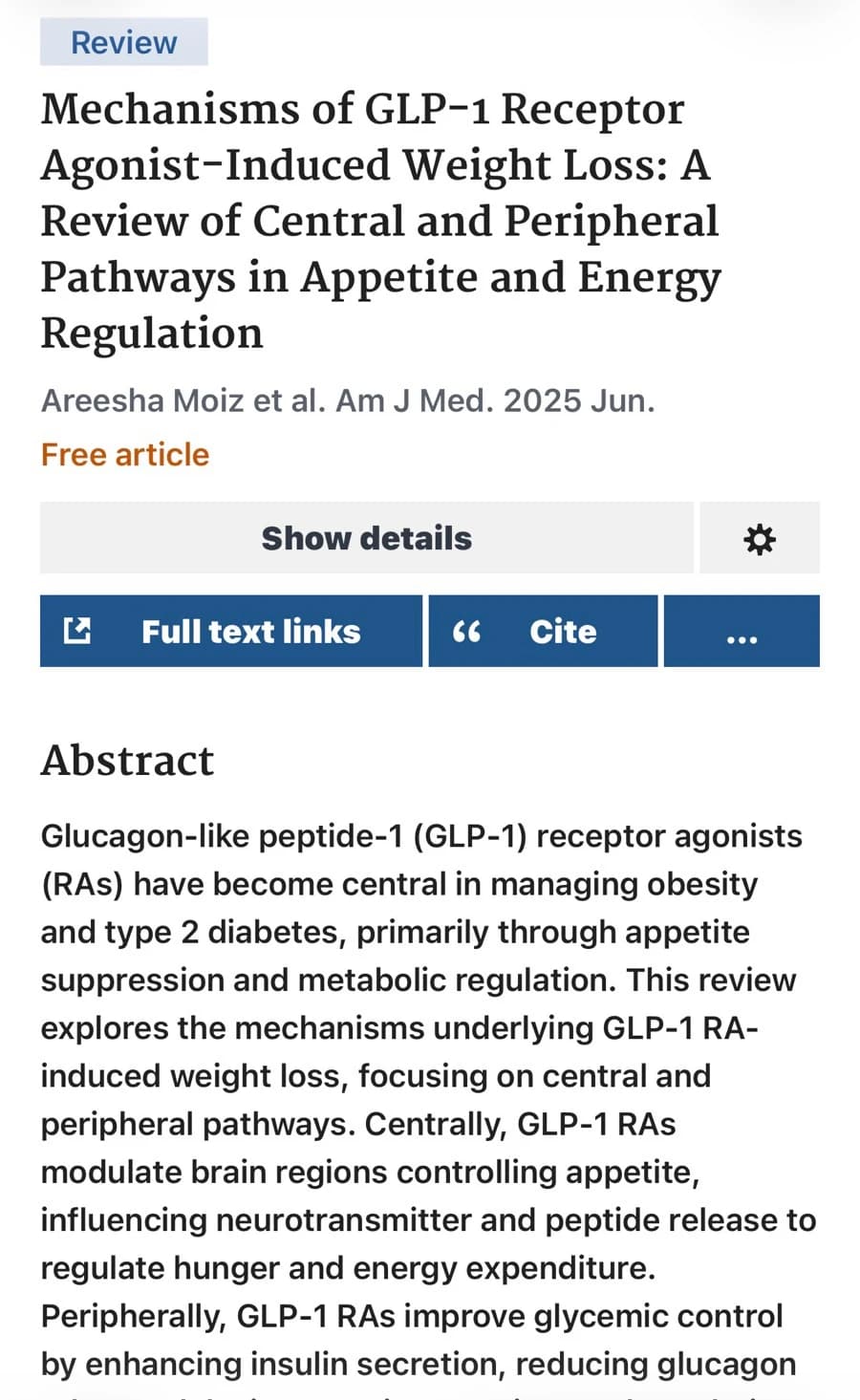
The 2025 American Journal of Medicine review, “Mechanisms of GLP-1 Receptor Agonist-Induced Weight Loss: A Review of Central and Peripheral Pathways in Appetite and Energy Regulation,” discusses central and peripheral pathways. Wegovy contains semaglutide, a GLP-1 receptor agonist. Mounjaro contains tirzepatide, which acts at both GIP and GLP-1 receptors.
GLP-1-related therapies can be understood as acting through interacting systems involving the brain, gastrointestinal tract, pancreas and metabolic tissues rather than a single site. The strength of the evidence differs between mechanisms and products.
1. Appetite signaling in the brain
Hunger is not simply a sensation of an empty stomach. The hypothalamus and other brain regions integrate signals involved in hunger and satiety.
GLP-1 signaling interacts with these networks in ways that can increase fullness and reduce hunger. Some patients describe not wanting as much food rather than constantly having to resist eating.
The source compares constant restraint to holding down a car’s brake, while altered appetite signaling is compared with reducing the engine’s speed. This is an explanatory analogy, not a literal account of every patient’s response.
2. Food-reward pathways
Research also examines effects on dopamine-related reward pathways. Food can engage reward systems, which may contribute to cravings or stress-related eating.
Studies discuss possible changes in food preoccupation, binge-type behavior and impulsive appetite. Some researchers explore relationships with behaviors described as food addiction. These research directions do not establish an approved treatment for every such behavior or guarantee an individual response.
3. Gastric emptying and fullness
Some patients report feeling full for longer after smaller meals. GLP-1-related effects on gastric emptying—the movement of food from the stomach to the intestine—can contribute to this experience.
The source likens this to a fuel gauge that responds to a smaller meal. The magnitude and persistence of gastric-emptying effects vary, and the analogy does not capture all mechanisms of weight loss.
4. Pancreatic effects on blood glucose
GLP-1 is an incretin hormone involved in glucose regulation. It can increase insulin secretion and reduce glucagon secretion in a glucose-dependent context.
The source discusses how changes in glucose and appetite can interact. People may experience sudden hunger or cravings when glucose falls. This does not mean these medicines eliminate glucose fluctuations or cannot be associated with hypoglycemia, particularly in combination with other glucose-lowering treatment.
5. Metabolic responses in adipose tissue
The review also discusses possible changes involving adipose tissue, inflammatory pathways and energy-metabolism signals.
These are mechanisms under investigation, not proof that every drug directly produces the same tissue effects in humans. Reduced food intake, systemic pathways and differences between experimental settings need to be considered.
6. BDNF and appetite research
BDNF stands for brain-derived neurotrophic factor, a protein involved in neuronal growth and function. The source compares it to fertilizer for the brain.
Research also examines BDNF signaling in appetite regulation. Reduced hypothalamic BDNF signaling has been associated with disturbed appetite regulation and weight gain in relevant research settings.
The original post mentions exercise, adequate sleep, sunlight exposure, fasting and calorie restriction in connection with BDNF. The evidence and applicability of these associations differ; the list is not a recommendation to fast, restrict calories or increase sun exposure.
The broader idea is that appetite involves biology as well as conscious choices. GLP-1 signaling, BDNF, reward pathways and gut hormones interact, but their relationships and clinical implications continue to be studied.
Putting the pathways in context
GLP-1-related therapies are discussed in relation to brain appetite networks, gastrointestinal satiety signals, pancreatic glucose regulation and the metabolic environment.
Appetite is not created by one “empty stomach” signal. The brain, gut, hormones, nerves and habits form an interacting biological system. Research is still clarifying that system, and mechanistic explanations should not be confused with guaranteed treatment effects.
Reference: Mechanisms of GLP-1 Receptor Agonist-Induced Weight Loss, American Journal of Medicine, 2025.
Source: Original post on Dr. Hyemi Yu’s Naver blog (Korean)
The original publication date and the website revision date are shown separately.