
JOURNAL
Brow droop after forehead botulinum toxin: what to check
Points to consider when assessing brow droop after forehead botulinum toxin and prior treatment history.
Brow ptosis and eyelid ptosis require separate assessment. The source’s incidence figures and small-study findings are not individual risk estimates. Material classification, anatomy, citations and fibrosis explanations in the source diagram require medical review.
The following symptoms can occur after botulinum toxin treatment of the forehead.
- A heavy feeling around the eyes or a sensation of drooping eyelids
- Brows appearing lower, changing the facial expression
- A thinner or less visible upper-eyelid crease
- Facial expressions feeling less natural
The source cites a frequency of approximately 1–5% for post-treatment symptoms. This figure requires checking against the specific outcome and population studied. Although uncommon, such symptoms can affect daily life.
Patients may be told that the symptoms will improve with time, and spontaneous recovery can occur. Understanding the cause is nevertheless important when deciding how to respond.
A history of Ellansé, Sculptra or fat grafting in the forehead may also matter. Different causes may require different approaches.

Why can the brows drop?
The frontalis elevates the brows
The frontalis is the muscle that raises the eyebrows. Other muscles, including the corrugator supercilii and procerus, draw the brow region downward. Brow position reflects the balance of these forces.
The source cites Borba and colleagues (2022), from the University of São Paulo, on the frontalis’s role in eyebrow positioning.
The cited passage describes the frontalis as the elevator of the upper third of the face and as fundamental to eyebrow position.
In other words, weakening the muscle that lifts the brow can affect where the brow rests.
How common is it?
Brow ptosis is a recognized complication after forehead botulinum toxin. The original post cites a 2021 review by Kroumpouzos and colleagues for a frequency of 1–5%. It also describes the following small study.
The source reports that, among 25 patients treated for forehead lines, 22 had a mean brow descent of 2.3 mm.
This is a small-study observation, not a risk estimate for everyone receiving forehead treatment. A change of 1–2 mm may nevertheless alter how the brow and eyes appear. Some people may feel they look more tired or stern, or that their eyes appear smaller.
Why previous forehead treatment matters
A history of biostimulators such as Ellansé (PCL) or Sculptra (PLLA), fat grafting or a forehead lift may change the assessment.
The original post uses a simplified layered description: skin → subcutaneous fat → frontalis → fascia → periosteum. Its schematic anatomy requires medical review.
The author discusses collagen accumulation and fibrosis after repeated PLLA treatment, and changes to the subcutaneous layer after fat grafting. These explanations require checking against the specific material and procedure; they do not establish that every previously treated forehead has the same changes.
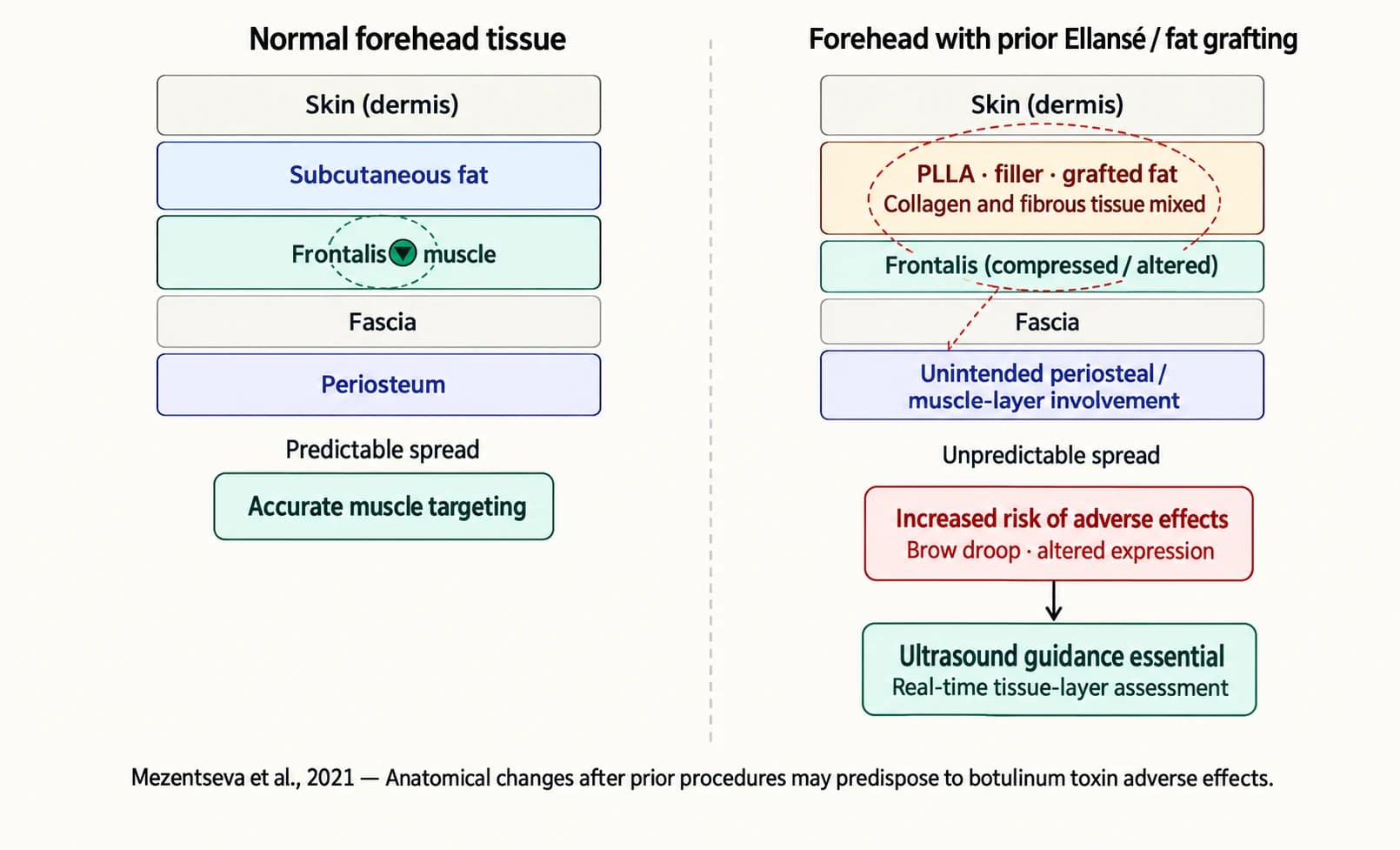
Such changes may alter the anatomical context in which botulinum toxin is injected. The source cites Witmanowski and Błochowiak’s review on altered anatomy after previous facial surgery.
The cited review discusses previous facial plastic surgery as a factor that may predispose patients to more severe botulinum-toxin-related adverse effects.
Witmanowski H, Błochowiak K. The whole truth about botulinum toxin – a review. Postepy Dermatol Alergol. 2019. PMC7874868.
The relevant point is that prior procedures and their anatomical effects belong in the assessment. The review also discusses the clinician’s role.
The source emphasizes knowing the relevant muscle anatomy, including changes caused by previous surgery, to help avoid serious adverse events associated with unintended diffusion.
A clinician therefore needs to consider both the original anatomy and the treatment history. Botulinum toxin is widely used and often perceived as simple, but a history of earlier procedures still matters.
The source raises one further consideration.
The original post cites a passage discussing repeated injections, pathological innervation, tolerance, worsening local symptoms and muscle fibrosis after several years.
The clinical setting and scope of that passage require review before applying it to routine cosmetic forehead injections. The source interprets repeated botulinum toxin treatment as another reason to consider possible changes in tissue structure and to individualize assessment.
What ultrasound may add
If anatomy has changed, further information may be useful. Forehead ultrasound can help visualize tissue beneath the skin in real time.
The clinician may assess the frontalis’s appearance and movement, the location of previously injected materials and changes in surrounding tissue that are not visible externally.
Treatment history, tissue findings and symptom severity vary between individuals. The approach should reflect those differences.
References cited in the source
- Witmanowski H, Błochowiak K. The whole truth about botulinum toxin – a review. Postepy Dermatol Alergol. 2019;37(6):853–861. PMC7874868.
- Kroumpouzos G, Kassir M, Gupta M, Patil A, Goldust M. Complications of Botulinum toxin A: An update review. J Cosmet Dermatol. 2021;20:1585–1590.
- Borba A, Matayoshi S, Rodrigues M. Avoiding Complications on the Upper Face Treatment With Botulinum Toxin: A Practical Guide. Aesthetic Plast Surg. 2022;46:385–394. PMC8328485.
- Xu et al. A Case of Forehead Subcutaneous Fat Atrophy Following Botulinum Toxin Injection. J Cosmet Dermatol. 2025.
The exact quotations, study populations and relevance of the fibrosis discussion require medical review.
This article provides medical information and is not an advertisement for a particular clinic. Individual symptoms and treatment decisions require consultation with a qualified specialist.
Source: Original post on Dr. Hyemi Yu’s Naver blog (Korean)
The original publication date and the website revision date are shown separately.