
JOURNAL
CureJet delivery of Rejuran: self-observation and clinical research
Distinguishing a CureJet/needle self-observation from a small trial and proposed mechanisms.
The author’s one-person comparison and a ten-person trial are separate observations. Mechanical stimulation does not establish clinical equivalence to ESWT; figures, superiority/equivalence claims and product labeling require source review.
A recurring question about Rejuran delivery is: “Without a needle, does the material really get in?” It is understandable. We grow up associating an injection with a needle, so a needle-free injector can sound counterintuitive.
I decided to observe the two approaches on opposite sides of my own face.
Why I tried the comparison
Explaining a treatment I had read about but not personally experienced felt different from observing it myself. For a presentation at a laser-medicine meeting, I compared manual injection and CureJet delivery using 3D skin imaging.
- Left cheek: manual injection with a 33G nano needle, described in the source as punctures approximately 1 cm apart.
- Right cheek: needle-free, high-pressure CureJet delivery.
- Material: the source describes the same 2 mL amount of Rejuran on each side.
- Assessment: before/after 3D vectors, volume, pores and texture.
This is a one-person observation, not a controlled clinical trial. The dose description and measurement protocol require source review.
What the imaging showed in this observation
The source identifies the red-colored areas as regions interpreted as elevated after CureJet treatment. Color mapping alone cannot establish a treatment effect without the imaging protocol and conditions.
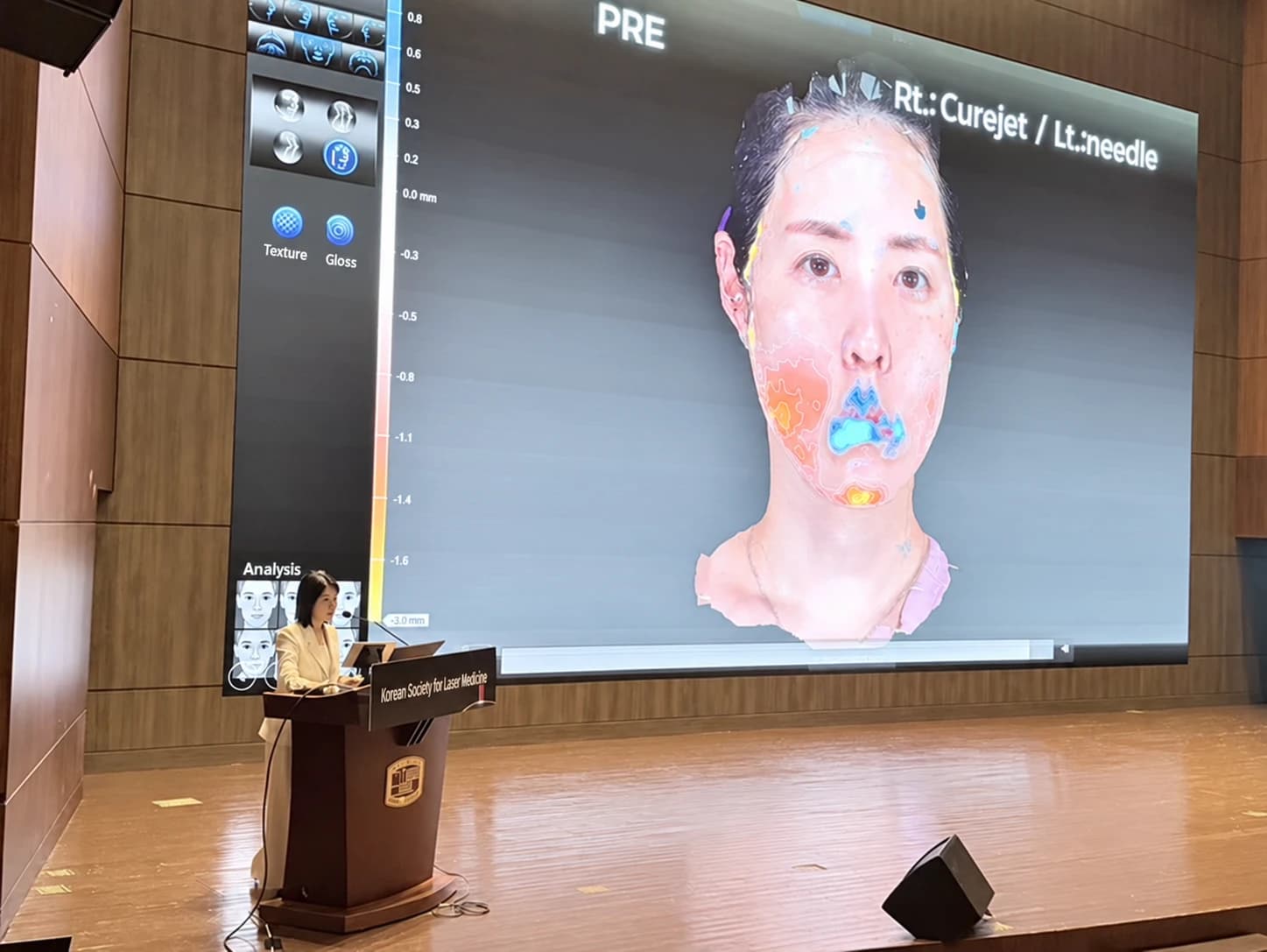
The author describes a lifting-vector observation on the CureJet-treated side. Separately, the source cites a ten-person split-face study by Hong and colleagues at Chung-Ang University Hospital, published in Journal of Cosmetic Dermatology in 2025. That trial and this self-observation must remain distinct.
According to the source, the trial reported higher Global Aesthetic Improvement Scale (GAIS) and satisfaction measures and lower pain visual-analogue-scale (VAS) scores on the CureJet side. It describes pore and wrinkle measures improving on both sides, with larger changes on some CureJet measures.
Study design, statistical findings and the scope of any superiority or equivalence interpretation require original-paper review.
Hong JY et al. J Cosmet Dermatol. 2025;24(1):e16595. PubMed 39370844.
Delivery mechanism
The source uses a parcel-delivery analogy to distinguish different ways material may reach tissue. It describes an electromagnetically driven piston producing liquid jets at approximately 2.21–6.57 MPa.
It also proposes that the jet may supply mechanical stimulation and compares this with aspects of extracorporeal shock-wave therapy. Similar-sounding mechanical concepts do not establish equivalent physical delivery or clinical effects. This mechanism remains a source interpretation requiring verification.
The post also cites a review of injectable skin boosters.
The original post interprets the review as discussing millimeter-scale penetration with electromagnetic delivery and the ability to deliver viscous materials. It mentions scar or scalp applications. Depth, settings, indications and safety cannot be generalized from this description.
Reference: Injectable skin boosters review, PMC11560330.
What is Rejuran?
Rejuran is a PN, or polynucleotide, product described as derived from salmon DNA. The source discusses regenerative, collagen-associated and inflammatory pathways using an analogy of supporting an environment rather than only adding water.
These are simplified mechanism descriptions, not guarantees of clinical effects. The post also cites a 2024 survey of 235 Korean dermatologists, with 88% reportedly using PN injections in aesthetic practice. Survey prevalence does not prove efficacy or establish an indication.
No single method fits every situation
The source describes a per-shot CureJet amount of approximately 0.5–0.8 μL. Delivering a particular total amount may therefore require many shots and additional time. Manual injection also lets the clinician control needle depth directly.
Choice can depend on skin, tissue thickness and treatment goals rather than a universal ranking. Device specifications and product compatibility require verification.
What to take from the comparison
There is research comparing needle-free and manual delivery, and some reported outcomes may favor a particular approach under study conditions. A lack of a needle does not, by itself, establish a lack of delivery.
However, a one-person observation cannot demonstrate general superiority, equivalence, less bruising or swelling, or ESWT-like clinical regeneration. These source claims need to be assessed individually against the evidence.
This article shares literature and a presentation-related observation. It does not prescribe a procedure at a particular clinic; suitability requires individual specialist assessment.
References cited in the source
- Hong JY et al. J Cosmet Dermatol. 2025;24(1):e16595. PubMed.
- Injectable skin boosters review. 2024. PMC11560330.
References linked by the source
Source: Original post on Dr. Hyemi Yu’s Naver blog (Korean)
The original publication date and the website revision date are shown separately.