
JOURNAL
Finding a direction for my motivation: a personal experience
Finding a direction for my motivation: a personal experience: a personal record from the original blog publication.
This is a personal record from the original publication date. Food, exercise, weight, and procedure experiences describe one person’s circumstances, rather than current treatment recommendations or guaranteed outcomes.
To change my weight, I felt I needed to challenge my habits and assumptions. For example: “I have to eat less, and if that does not work, I should stop eating.” It resembles the belief that doing well at school requires studying all night and reducing sleep.

Excessive effort in the wrong direction can destroy me. It may simply be uninformed enthusiasm. If I learn the method, I can direct that energy more effectively.
Looking back, I have always been passionate, especially about studying. I used every break and sacrificed sleep. In middle school I studied during breaks and lunch, ignoring comments that I studied all the time. I envied friends who played and still did well, but I did not think I was especially clever and believed effort was my only option. That kept me first in class, but only through middle school.
It did not work in high school. After placing around 19th in my class on the first exam, I was shocked and decided to work even harder. I stayed up until 3 a.m., drank coffee from a rice bowl, and asked my mother to sit beside me and wake me if I nodded off. I worked through problem books all night.
Despite doing everything I could, my grades kept falling. Without sleep, I felt foggy and drowsy in class and could not concentrate. Going from always being first to struggling felt like sinking into dark mud. More all-night study did not improve things.
At Chuseok, my aunt and older cousins visited. After worrying about it, I asked my cousin, who studied law at Seoul National University, how to do better. He listened to my routine and advised me simply to sleep at midnight and concentrate as well as possible while awake.
That was all. I began going to bed at 12 and dividing my waking time carefully for study. Soon I ranked second in the whole senior year and first in the science track. My homeroom teacher was astonished at the rapid change, and I was delighted. I realized how empty effort in the wrong direction could be.
Sleeping well, my grades and confidence improved. I memorized notes while walking to and from school and covered the bathroom with things to learn. When ill, I recorded myself reading textbooks and listened to the tapes lying down. My effort finally showed in my results. Had I ignored my cousin's advice, I might never have improved. Thank you, Junmin.
Weight management felt similar. In my late thirties, I found it especially difficult. As I wrote before, I had tried exercising daily, fasting, and eating less in my own way. Seeing my weight rise rather than fall brought back that feeling of sinking into mud. Later, after changing my approach, I personally lost 10kg in 10 weeks.
When I was struggling to lose weight, I felt I needed to learn more.
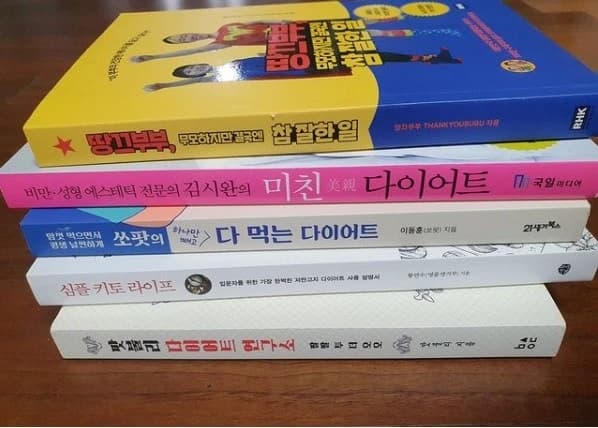
Diet books I had read recently.
My suggestion at the time was to read at least three recent books by experts. Someone might offer the insight my cousin had given me. I did not want to jump at every fashionable diet. I felt my approach later in life needed to differ from when I was young, especially by avoiding starvation-style dieting and understanding my body scientifically and medically.
Learning can help us care for our health and leave misleading information behind. One sentence in a book, a realization from an experienced professional, and a clear decision to act can change a life.
Source: Original post on Dr. Hyemi Yu’s Naver blog (Korean)
The original publication date and the website revision date are shown separately.