
JOURNAL
Assessing facial asymmetry after botulinum toxin
Assessing facial asymmetry after botulinum toxin. Source observations, research context and limitations.
This article discusses the source author’s earlier literature, cases and experiences. Research populations and limitations matter; individual diagnosis and treatment require clinical assessment.
This article records an individual clinical perspective. It does not replace diagnosis or establish approval of the original medical claims.
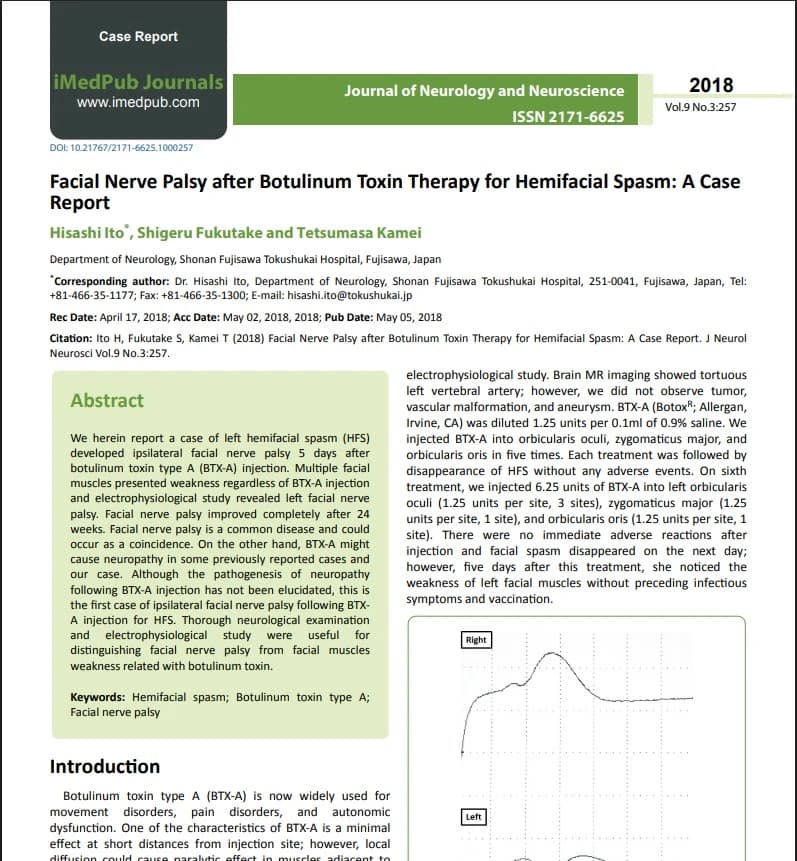
Bell’s palsy is an acute peripheral facial nerve palsy with no identified specific cause after assessment. Facial movement, taste, tearing or salivation may be affected. The source cites a 59-year-old patient who developed facial palsy five days after toxin treatment for hemifacial spasm and recovered by 24 weeks. One case cannot quantify the risk of cosmetic treatment in people with a previous palsy.
References listed by the source: Facial nerve palsy after botulinum toxin therapy for hemifacial spasm: a case report. 2018. https://www.itmedicalteam.pl/articles/facial-nerve-palsy-after-botulinum-toxin-therapy-for-hemifacial-spasm-a-case-report-107584.html
Clinical practice guideline: Bell’s palsy. Otolaryngology–Head and Neck Surgery. 2013;149(3_suppl):S1–S27.
The author describes patients seeking help for eyelid, eyebrow or mouth asymmetry before important events. Some had pre-existing facial weakness that they had not recognized. Earlier surgery or injections and the local tissue environment were also discussed, but these observations do not establish the cause or an increased comparative risk.
Bell’s phenomenon is an upward movement of the eye during attempted closure. It is not itself a diagnosis of Bell’s palsy, and incomplete closure is different from inability to lift the upper lid. Photographic asymmetry or ear height alone cannot establish nerve disease.
The source discusses combined treatment for toxin-related symptoms and possible facial palsy. Faster recovery than observation requires comparative evidence and is not established here. Sudden one-sided weakness, speech difficulty or arm or leg weakness must not be dismissed as a cosmetic complication; seek immediate emergency assessment. Previous nerve disease and current symptoms should be reviewed before elective treatment.
Source: Original post on Dr. Hyemi Yu’s Naver blog (Korean)
The original publication date and the website revision date are shown separately.