
JOURNAL
Hollow Cheeks: A Problem to Fill or an Adhesion to Release?
Distinguishing volume loss from adhesion-related pulling when assessing hollow cheeks.
This article is an informational literature review based on publicly available medical research. Effects and responses vary, and no particular outcome is guaranteed. Accurate assessment requires consultation with a specialist.
Imagine a tent.
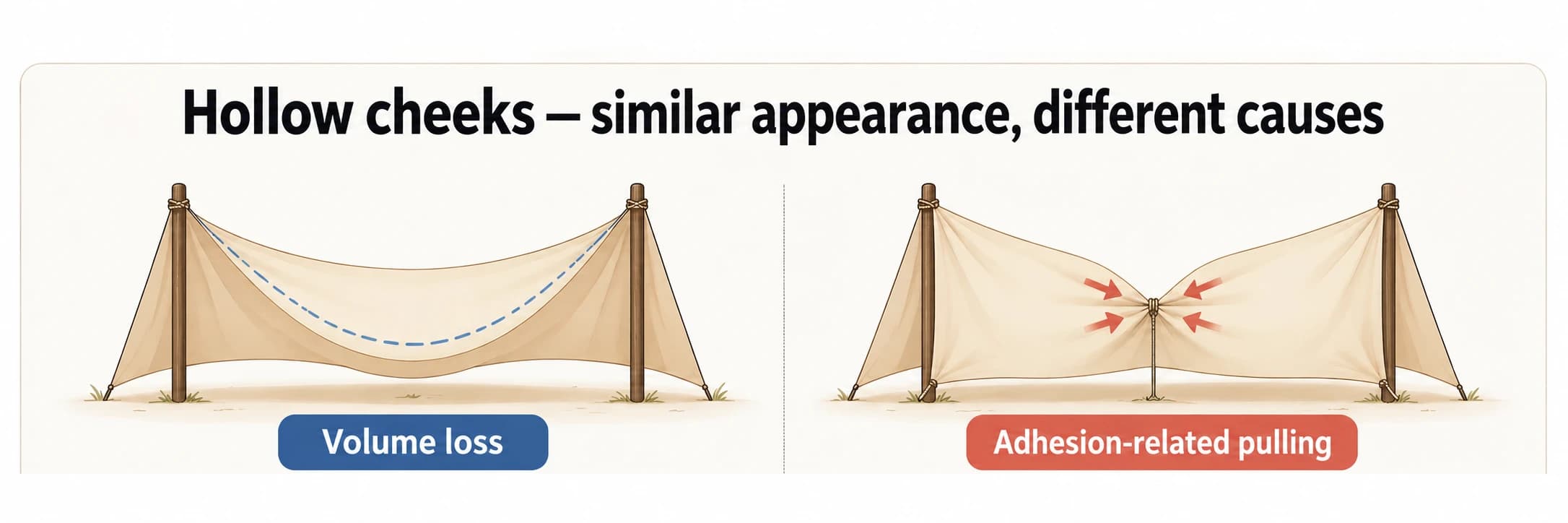
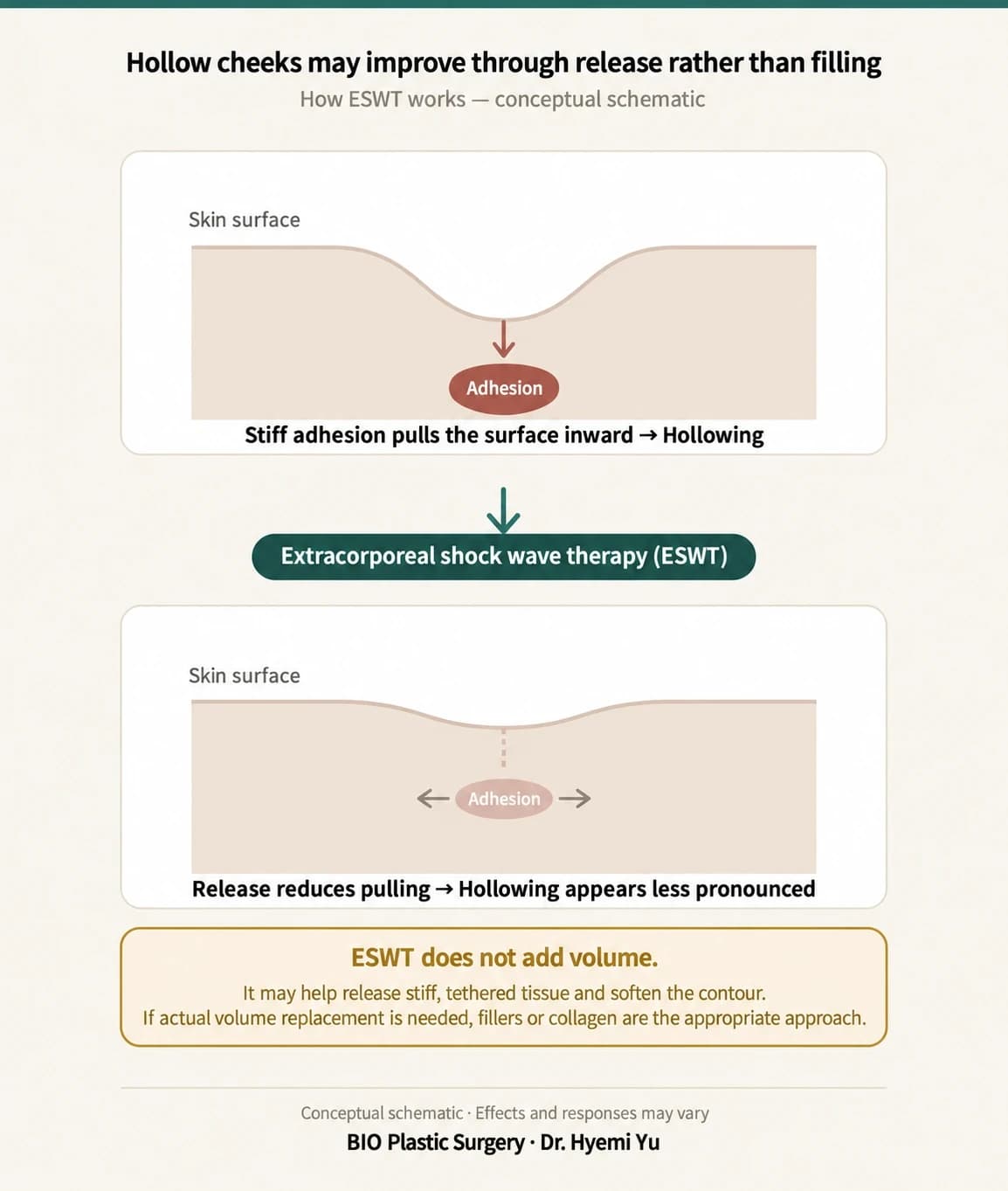
If the middle is sunken, there may be too little fabric and support, representing volume loss. Alternatively, the fabric may be intact, but a stitch behind it is pulling one spot inward, representing adhesion-related traction.
The approaches differ. Missing fabric needs additional material; a pulling stitch needs release. Releasing a stitch where volume is missing, or adding material where traction is the problem, may produce an awkward result.
Cheeks that appear hollow can present the same distinction. Many people assume that filler is always the first step, without separating the possible causes. They may then be dissatisfied or need to reconsider their approach.
If you are considering treatment for cheek hollows or researching before adding volume, this article explains how to distinguish a problem to fill from one to release.
Specialist in plastic surgery
Similar cheek hollows can have different causes
There are three broad possibilities:
- True volume loss: aging reduces fat and bony support.
- Adhesion-related pulling: fibrosis or adhesions after previous procedures can tether tissue inward. The area looks hollow because it is being pulled, rather than solely because volume is missing.
- A relative contour effect: surrounding contours or swelling can make an area look more hollow.
Different causes call for different approaches.
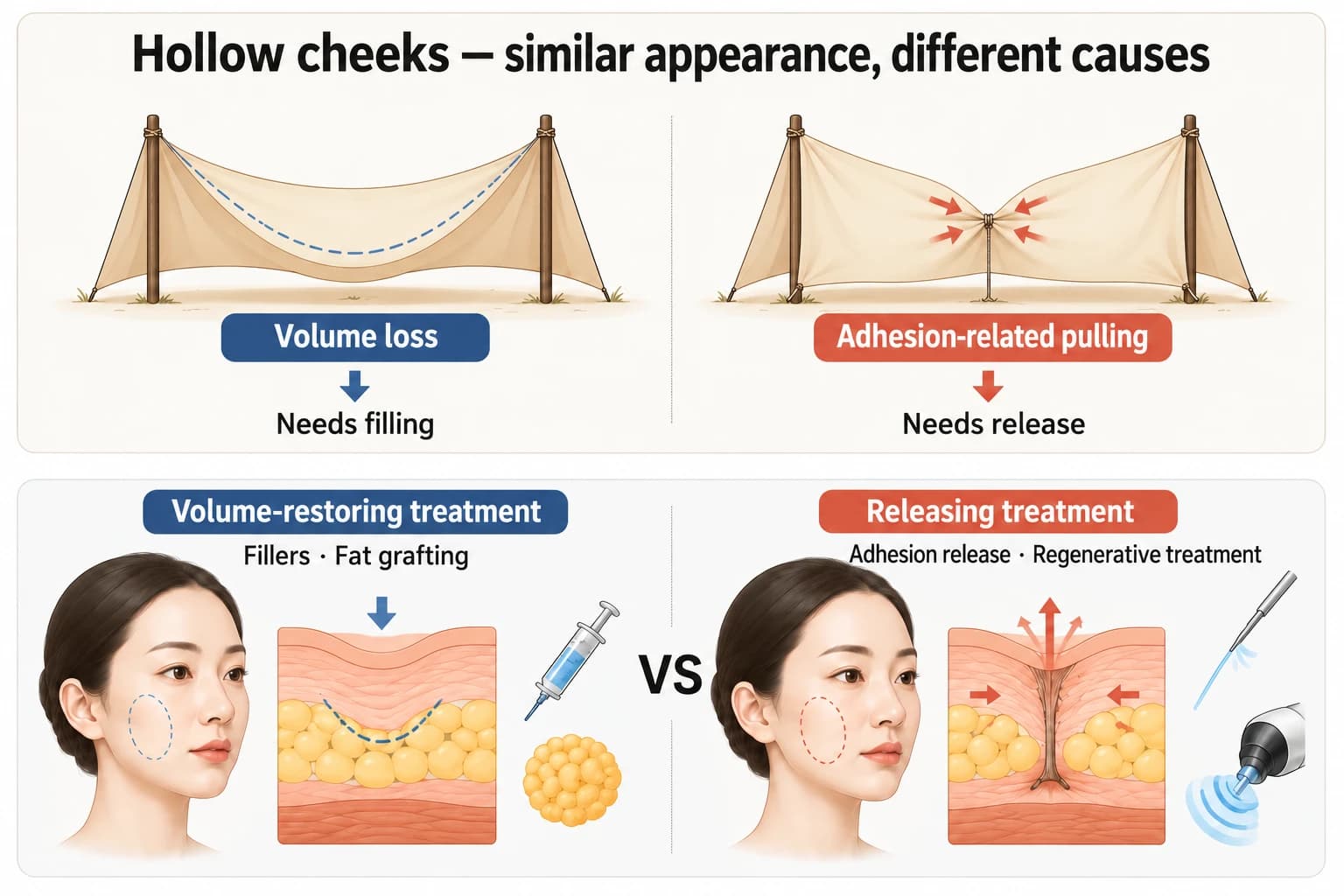
When volume is genuinely missing, a volume-restoring approach is relevant
If actual loss of cheek volume is the main cause, replacing volume is the appropriate direction described here. Fillers and collagen-stimulating treatments are examples.
This is not a problem that tightening devices or extracorporeal shock waves can replace. Missing fabric needs additional fabric.
When adhesions are pulling, ESWT may have a role
The situation differs when fibrosis or adhesions tether the cheek inward.
Extracorporeal shock wave therapy (ESWT) does not “fill” a hollow. It does not add volume.
Research reports that ESWT may reduce expression of fibrosis-related factors such as TGF-β1 and α-SMA, and may participate in tissue regeneration and angiogenesis.
A study of deep facial fibrosis after plastic surgery also reported tissue improvement (Ko et al., 2024).
In the tent analogy, releasing the pulling stitch may reduce traction and make the hollow less apparent. The surface moves closer to its original position because pulling decreases, rather than because material is added.
This does not apply equally to everyone, and further research is needed.
The key distinction
Before asking what to fill a cheek hollow with, determine whether it is a volume problem or a release problem.
Volume loss → a volume-restoring approach such as fillers or collagen-related treatment.
Adhesions or fibrosis → ESWT may have a role in release.
ESWT is not a volume-filling procedure.
Photographs alone may not establish this distinction. Direct ultrasound assessment of tissue can help determine whether volume is missing or the area is being pulled inward.
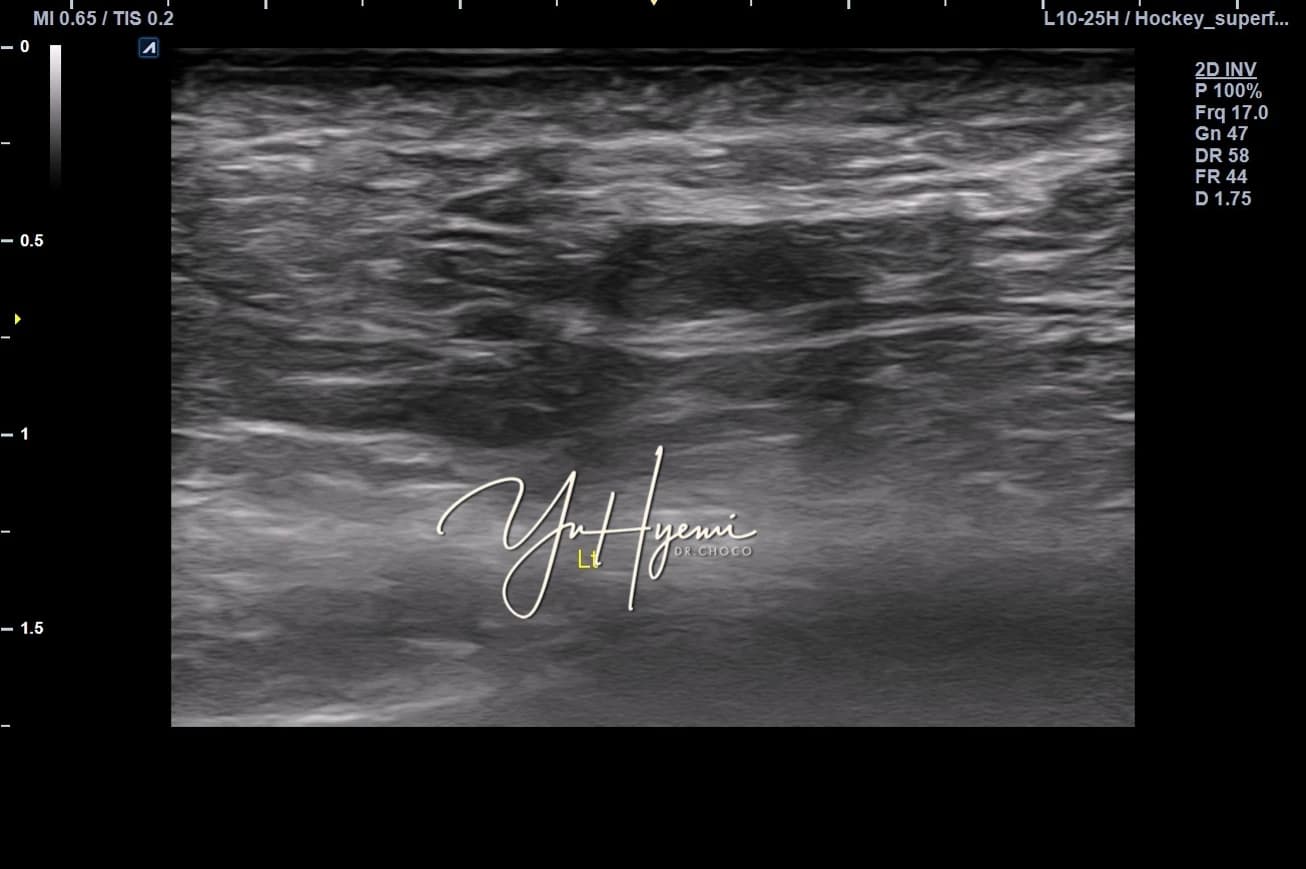
Assessing the cause can help reduce unnecessary procedures.
Determining whether a cheek hollow reflects loss or traction makes the next direction clearer.
This article is an informational review of publicly available medical literature and does not replace diagnosis or treatment. ESWT does not add volume. All procedures have possible adverse effects and limitations, and effects and responses vary between individuals.
References
Ko et al. Clinical Efficacy and Safety of Low-Energy ESWT for Deep Dermal and Subdermal Fibrosis (incl. post–plastic surgery facial fibrosis). Skin Res Technol. 2024. PMC11452247 / DOI 10.1111/srt.70082
Kimura M, Tanaka S. Facial Tightening Effects Following Focused and Radial Acoustic Wave Therapy. Lasers Surg Med. 2021;53(5). PMID 33211338 / PMC8246538
Cui HS, et al. ESWT Alters Fibrosis-Related Molecules in Hypertrophic Scar Fibroblasts. Int J Mol Sci. 2018;19(1):124. PMC5796073
Source: Original post on Dr. Hyemi Yu’s Naver blog (Korean)
The original publication date and the website revision date are shown separately.