
JOURNAL
Menopause, estrogen and changes in the skin
A conference discussion of menopause, hormones, skin, facial fat and research limitations.
Figures such as 2% a year, approximately 30% over five years, 1:2 dilution, 22-gauge and six-/twelve-week timing require original-source review. Observations in menopausal women do not establish safety in breast-cancer patients or recommend hormone therapy.
A lecture in New York prompted me to reconsider women’s skin aging. Dr. Bianca Viscomi from São Paulo, Brazil, spoke about estrogen, skin aging and regenerative responses after menopause.
It recalled a comment I sometimes hear: “My face seems to have aged suddenly.” Women in their late forties, fifties and beyond may notice greater dryness, reduced elasticity, hollow cheeks or a changing jawline.
Rather than simply attribute this to age, the speaker asked why skin can seem to change faster at certain times. The question involves estrogen, skin cells, facial fat and extracellular matrix—not only collagen loss.
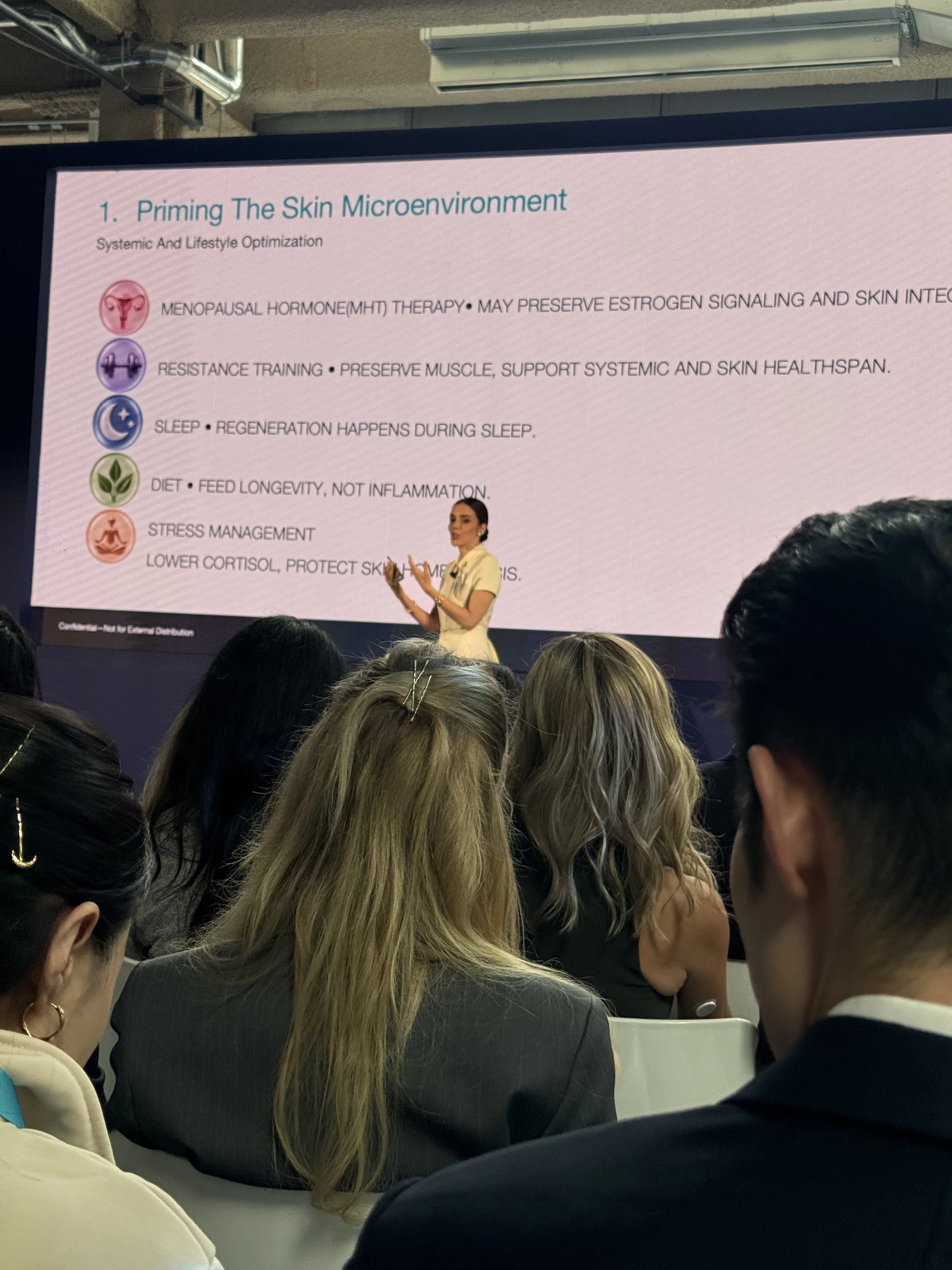
1. Skin responds to hormones
Skin is a living organ with estrogen receptors and local hormone metabolism. Estrogen can influence collagen and elastin metabolism, hydration, the barrier, immune responses and wound repair.
Using a house analogy, collagen is a pillar, elastin contributes flexible recoil, and estrogen is a regulatory signal affecting maintenance. A decline can change hydration, elasticity and recovery conditions, not just the number of pillars.
2. The “menopause cliff”
The speaker used this expression to describe how aging need not progress at a constant rate. Changing estrogen levels around menopause may be accompanied by relatively rapid skin changes.
She cited approximately 2% collagen loss annually after menopause and reports of substantial loss in the first five years, including a figure of up to approximately 30%. These are not changes experienced identically in every woman’s facial skin. Populations and measurement methods differ.
A patient’s perception of rapid change should not simply be dismissed, while UV exposure, genetics, weight changes and habits must also be considered. Menopause is one biological factor among several.
3. Facial fat and the skin environment
Fat is living tissue that releases signals and communicates with surrounding cells; it is more than a filling material. Deep facial fat can interact with fibroblasts, which produce collagen and ECM components.
In the house analogy, fat provides internal support and fibroblasts are maintenance workers. Changes in support can alter both shape and the workers’ environment. Adipose tissue also participates in hormone metabolism and responds to estrogen.
This does not mean reduced estrogen changes every woman’s facial fat identically. Weight, age and anatomy also matter.
4. Cells sense physical forces
The speaker emphasized mechanotransduction: cells sensing physical forces and converting them into biological signals. Fibroblasts connect with collagen and ECM and can respond to stiffness and tension.
Working on a stable platform differs from working on an unstable one. Changes in ECM can similarly change cellular signals. Skin aging therefore concerns not only collagen quantity but the environment of collagen-producing cells. Describing a procedure simply as “making more collagen” is incomplete.
5. Why discuss focused ultrasound first?
Dr. Viscomi described using focused ultrasound to initiate tissue responses before further treatment. Technologies such as Ultherapy create thermal-coagulation points at selected depths, followed by healing and remodeling processes.
The lecture highlighted possible fibroblast-related changes around 30–90 days and HSP47, a protein involved in collagen folding. The proposed sequence was ultrasound followed at an appropriate time by Radiesse’s CaHA microspheres—preparing a working environment before reinforcement.
This is a clinical rationale, not established proof that this sequence is superior to the reverse order or either treatment alone. Comparative studies of sequence and interval are needed.
6. Can postmenopausal skin still respond?
The speaker described a study comparing premenopausal and postmenopausal women. According to the presentation, Radiesse diluted 1:2 was delivered to the cheek subcutaneously with a 22-gauge cannula on day one and at six and twelve weeks. Skin findings and patient-reported improvement were evaluated.
The speaker reported improvement in postmenopausal women not receiving hormone replacement therapy and no statistically significant between-group difference in treatment results. She described this as unexpected.
A reduction in estrogen need not mean all tissue responses disappear. In the house analogy, a changed maintenance environment does not mean the workers have ceased to exist.
However, no statistically significant difference does not establish identical effects. Sample size, methods and effect sizes need review. The presentation cannot guarantee the same result for all postmenopausal women. It suggests that hormone status alone should not automatically determine whether tissue can respond.
7. Women who cannot receive hormone therapy
Some people with a breast-cancer history cannot receive, or are not advised to receive, systemic hormone therapy. They may still be concerned about skin changes.
A response observed in postmenopausal women not using hormone therapy is different from evidence of procedural safety in breast-cancer patients. Current health and cancer-treatment history require individual assessment. These claims must remain separate.
8. Menopause alongside GLP-1-related weight loss
Changes in estrogen may affect hydration, elasticity and ECM. Substantial weight loss during GLP-1-related treatment may also reduce facial fat volume. When these changes overlap, several facial structures may change together.
Menopause resembles a change in the house’s maintenance conditions; weight loss resembles smaller internal supports. The combined effect on actual regenerative capacity still needs study. GLP-1 medicines should not be assumed to selectively damage facial fat.
9. A case involving 12 kg of weight loss
The speaker described a 50-year-old woman who had experienced menopause at 42, could not receive hormone therapy and planned GLP-1-related weight reduction. Ultherapy Prime was reportedly used on the face, submental area and neck, followed after an interval by Radiesse.
After approximately 12 kg of weight loss, the speaker showed maintenance or improvement of skin texture and support. She emphasized assessing anticipated changes rather than responding only after major weight loss.
This is an individual clinical account. It does not establish the best sequence. Effects of ultrasound, Radiesse, other procedures and weight loss cannot be completely separated. It is not a recommendation that every GLP-1 user receive preventive aesthetic treatment.
10. Reconsidering skin aging
The lecture’s most useful contribution was its broader perspective. Estrogen, hydration, barrier function, ECM, facial fat and fibroblasts interact. Around menopause, assessment can consider skin thickness and elasticity, facial fat and weight changes alongside wrinkles.
Reduced estrogen and an absolute loss of the capacity to respond are different propositions. More research is needed to establish how well particular treatments work, but menopause is better understood as a changed biological environment than as a point after which skin cannot recover.
I believe our role is to understand that environment and distinguish needed treatment from unnecessary intervention. At 1PM Clinic Cheongdam, I intend to consider women’s skin aging with that care.
Source: Original post on Dr. Hyemi Yu’s Naver blog (Korean)
The original publication date and the website revision date are shown separately.