
JOURNAL
Reflections on midlife weight and muscle changes
Reflections on midlife weight and muscle changes. Source observations, research context and limitations.
This article discusses the source author’s earlier literature, cases and experiences. Research populations and limitations matter; individual diagnosis and treatment require clinical assessment.
The source opens with the author’s and patients’ experiences of midlife weight gain amid work, parenting, food choices and sleep changes. Age may be relevant, but there is no separate single cause of “age-related fat.”
Basal energy needs
Basal metabolic rate describes energy required under defined resting conditions. It is not an ability to expel waste, and body fat is not unexcreted waste. Body size, composition, activity and disease matter.
The original mentions 1,200–1,400kcal and annual decreases of 3.8kcal in men and 2.67kcal in women. These are not universal individual values or formulas. The cited population and adjustment for body composition require checking. The old external calculator link was removed.
The source introduces a graph of age and estimated basal expenditure. A calculator or group mean does not measure an individual’s actual requirement.
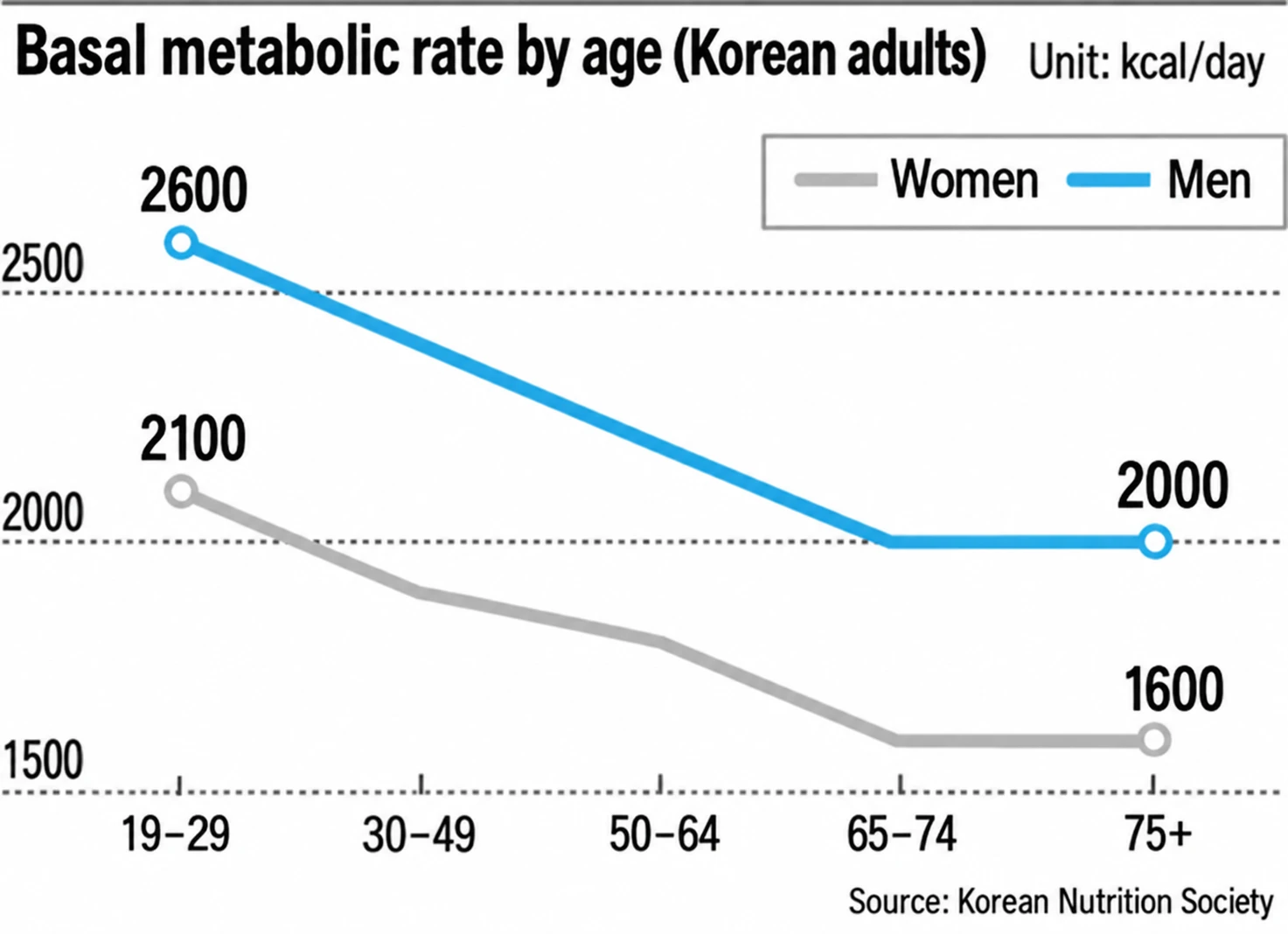
The author discusses water intake, activity, sleep and muscle. A personal 3L cold-water routine is not a prescription, and cold water does not guarantee meaningful weight loss. The original’s claim of 13% higher basal expenditure per 1°C cannot be applied directly to exercise or fat loss without checking its context. The author also used a medication, making effects impossible to isolate from this narrative.
Muscle and function
Muscle can change with age, activity and illness. The original’s fixed 3kg loss every decade is not universal. Muscle strength and fall risk deserve attention, but muscle is not simply a continuously operating fat furnace. Training adaptations do not require pursuing injury.
Ligaments can have relatively limited blood supply, yet they are not incapable of healing and do not always require surgery. Assessment depends on the structure and injury.
The closing reflection compares investing in muscle with financial investing and asks how busy adults can make activity sustainable. It does not establish that two hours daily are required or promise a minimal-time, maximal-result program.
Materials linked by the source
Source: Original post on Dr. Hyemi Yu’s Naver blog (Korean)
The original publication date and the website revision date are shown separately.