
JOURNAL
Assessing nasolabial folds after biostimulator treatment
Assessing nasolabial folds after biostimulator treatment. Source observations, research context and limitations.
This article discusses the source author’s earlier literature, cases and experiences. Research populations and limitations matter; individual diagnosis and treatment require clinical assessment.
The source considers shallow, irregular nasolabial lines that become noticeable when smiling after repeated biostimulator injections. Such a pattern needs assessment before deciding that more filler is the answer.
Some lines appear mainly during movement and look irregular rather than like a resting fold. The source proposes considering a different underlying process, but movement patterns alone cannot diagnose adhesions.
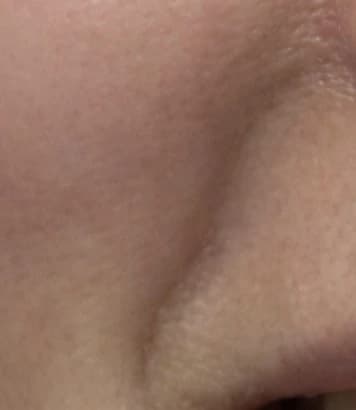
Resting nasolabial folds
The source describes lines visible at rest and discusses changes in skin support and volume. Filler or lifting may be considered in selected cases; the pattern is not itself a treatment indication.
Lines possibly related to adhesions
The source contrasts movement-related, irregular lines with resting folds. Whether another filler treatment would help requires individual assessment; an internal tether cannot be confirmed from appearance alone.
The proposed explanation is that fat normally buffers some muscle movement, whereas fibrosis or a tether between tissue layers might transmit force more directly to the skin. The source links this hypothesis with repeated PLLA treatment. It is a possible explanation, not proof that every smiling line after biostimulators is an adhesion.
Previous surgery adds further context
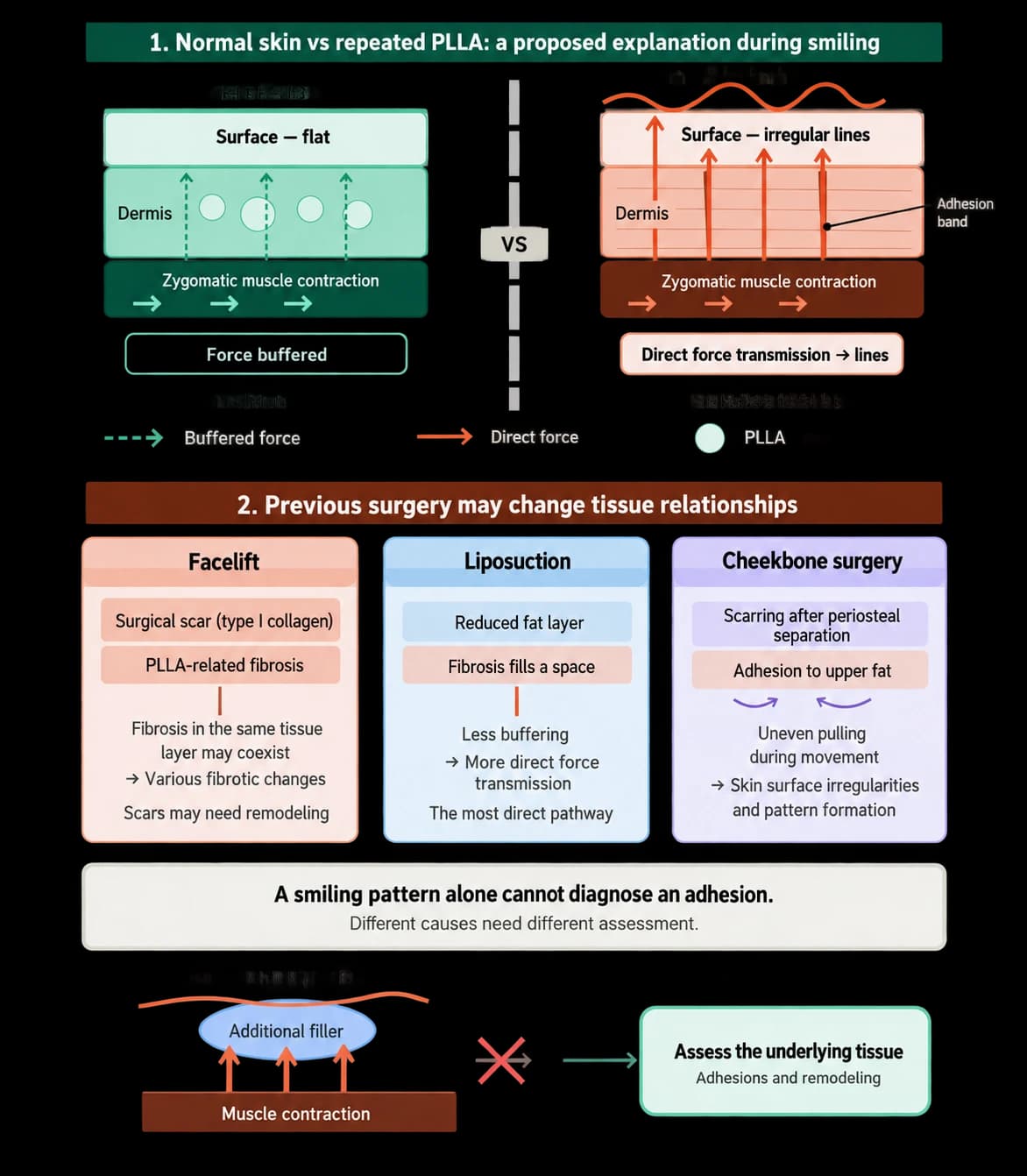
The source discusses three surgical histories: facelift-related scarring, loss of a fat layer after liposuction and tissue separation around the cheekbone. These can change the local anatomy in different ways. Combined tissue changes require assessment; a concrete-wall analogy cannot establish the mechanism or the appropriate treatment for an individual.
Assess the cause before adding filler
If tethering is present, increasing volume or pulling from the surface may not address its source. Conversely, not every irregular line is caused by tethering. Clinical evaluation of the tissue and earlier treatment history is needed before choosing an approach.
This article discusses a proposed explanation for a clinical pattern, not an individual diagnosis or guaranteed treatment result.
Source: Original post on Dr. Hyemi Yu’s Naver blog (Korean)
The original publication date and the website revision date are shown separately.