
JOURNAL
CaHA and burn scars: reading a pilot study
CaHA and burn scars: reading a pilot study. Source observations, research context and limitations.
This article discusses the source author’s earlier literature, cases and experiences. Research populations and limitations matter; individual diagnosis and treatment require clinical assessment.
This is a discussion of a pilot paper published in JPRAS Open in February 2025. It is not an advertisement for a particular institution. People with mature burn scars may have been told there are few options.
“There is nothing to do for a scar that is already stiff.” The source introduces research that asks a more specific question.
A 2025 JPRAS Open paper investigated an application of CaHA in mature facial burn scars.
Source paper topic: calcium hydroxylapatite for the biomechanical properties of facial burn scars, a pilot study.
Radiesse is a CaHA injectable often discussed for volume correction. Here the question was its potential effect in burn-scar tissue, not an approved standard treatment or guaranteed result.
An analogy for stiff tissue
The source compares a flexible riverbed with one hardened after drought. Burn healing may alter collagen organization, elasticity and movement. The analogy illustrates stiffness rather than proving a treatment mechanism.
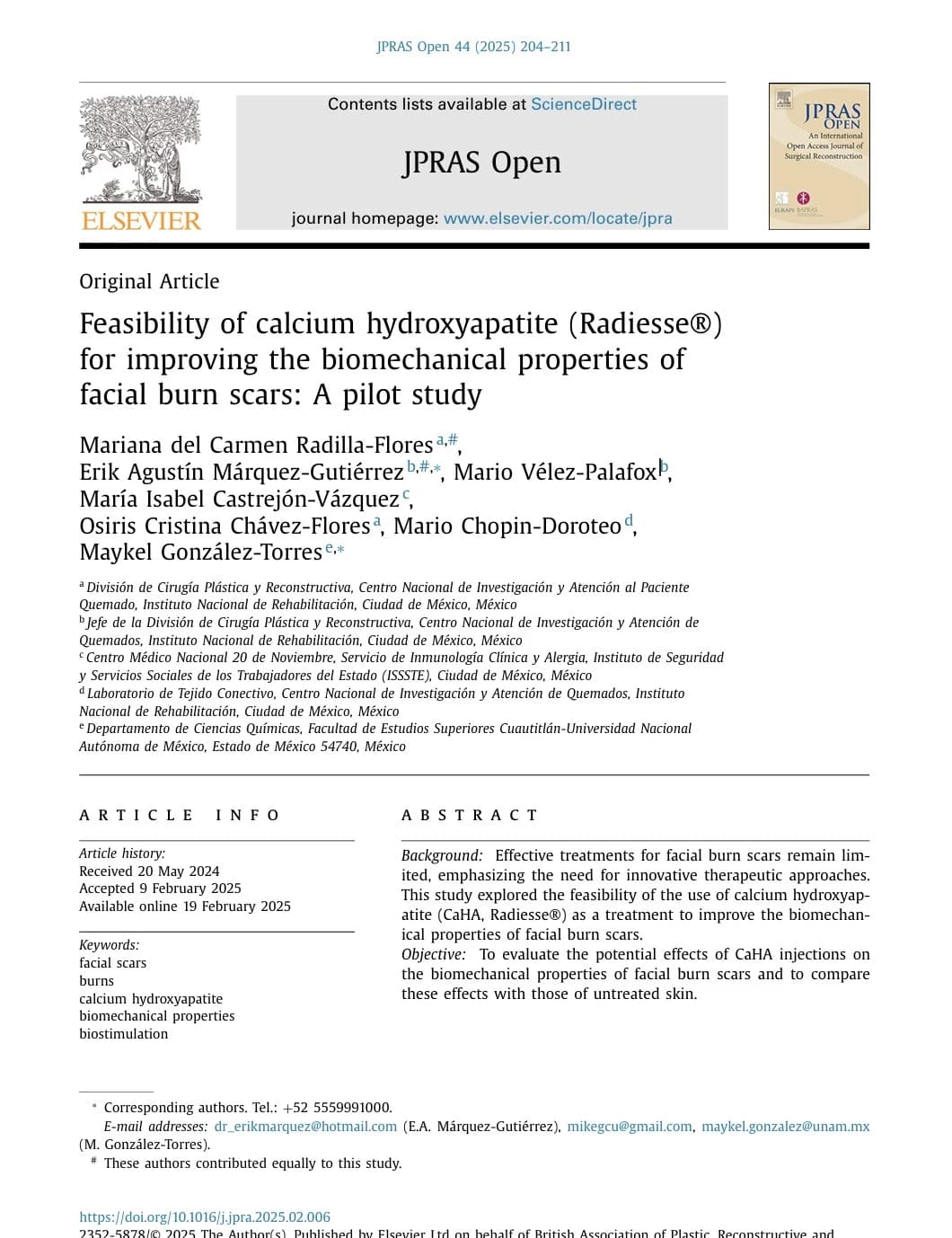
Could a stiff tissue environment change? This was the question the source took from the pilot study.
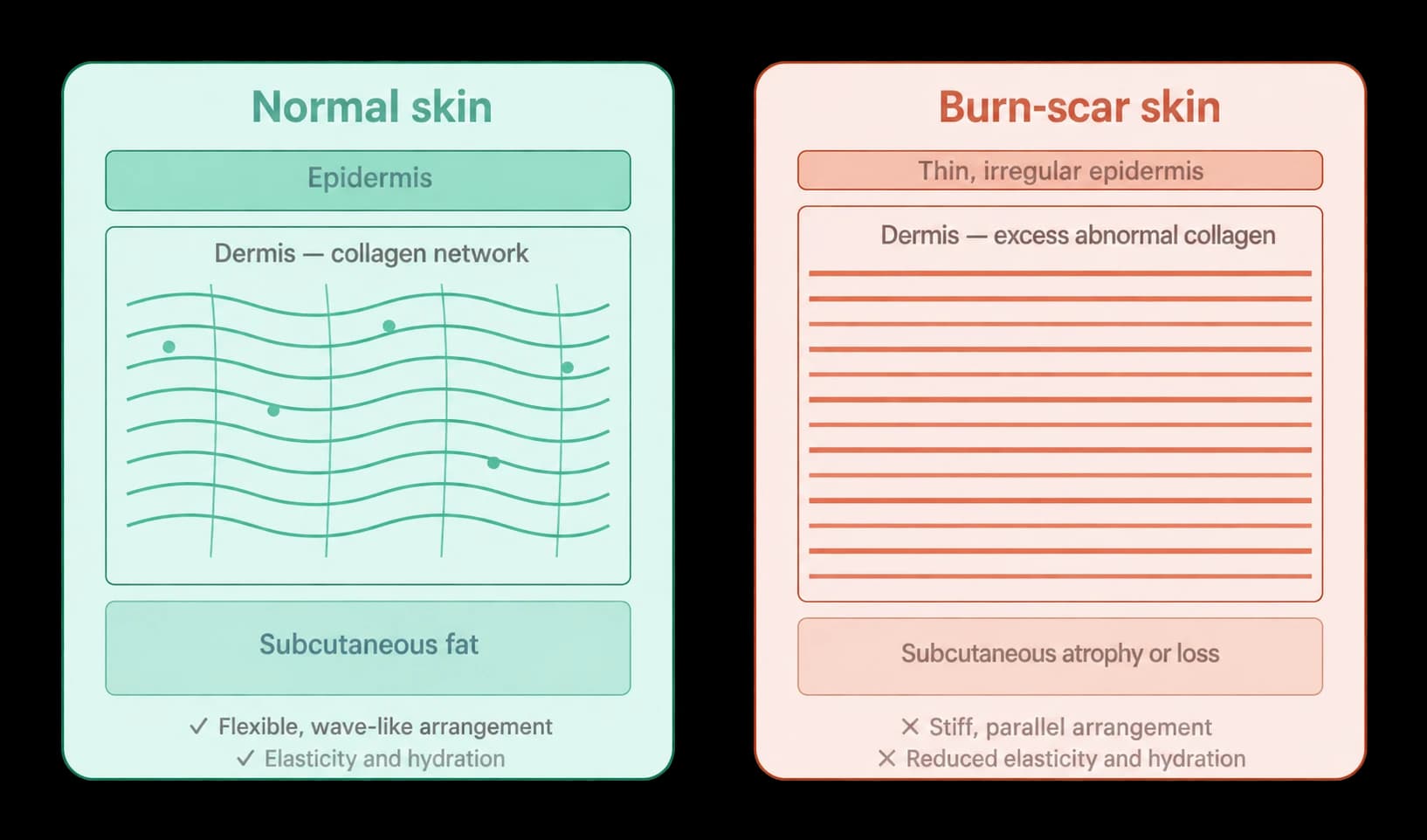
Source diagram caption: normal skin and scarred skin, illustrating different collagen arrangements. This is a simplified representation.
Thirteen participants and repeated measurements
The source describes 13 participants with facial burns covering over 90% of the face, with scars two to five years old and mixed scar characteristics. These are a small, selected group rather than all burn patients.
One side of the face was treated, with the opposite side used for comparison.
The source reports 312 measurements over six months at the forehead, cheek and chin, including Cutometer MPA 580 assessment of mechanical skin properties. Instrument measurements allow comparison but do not alone prove clinical benefit or generalizability.
Outcomes described in the source
Source figure caption: six measurements before and after CaHA treatment.
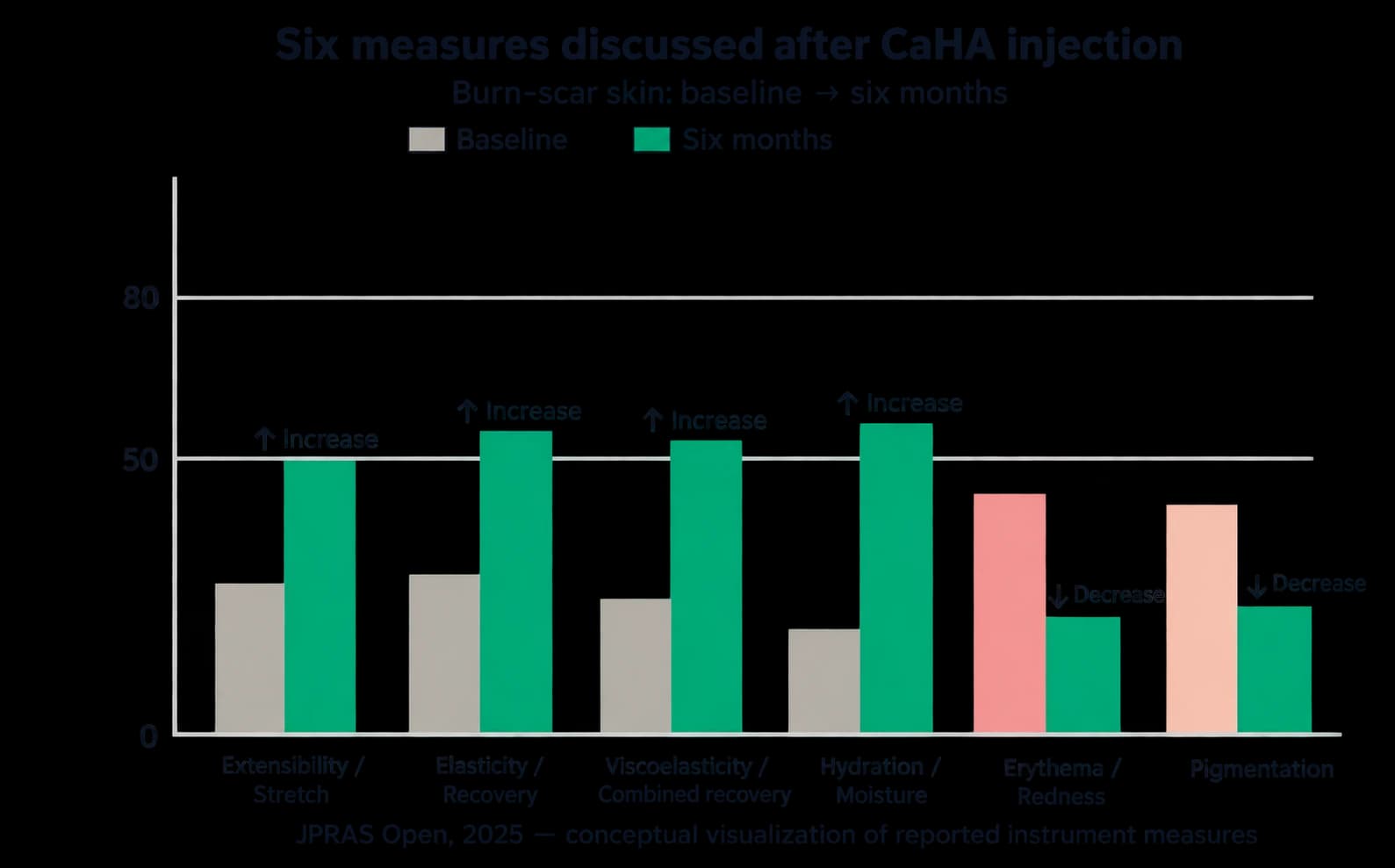
The source reports changes in extensibility, elasticity, viscoelasticity, hydration, redness and pigmentation on the treated side. The exact endpoints and statistical interpretation require comparison with the full paper.
CaHA and tissue response
The source distinguishes filling a space from stimulating a biological response. CaHA is a calcium-phosphate material also present in mineralized tissues, but an injectable device is not interchangeable with native bone or teeth. Initial volume and later tissue responses are different processes. The author discusses fibroblasts and collagen formation; type I collagen should not automatically be equated with soft “baby collagen.”
Why the author found the study interesting
The source recalls an earlier individual skin-graft scar case, an emotional patient response and a presentation in the United Kingdom. Earlier consent for that presentation does not establish permission for every new publication. The pilot used measurements in severe scars and six-month follow-up, but only 13 participants; long-term safety and broader effectiveness need more research.
The paper’s need for larger studies and longer follow-up is central to interpreting the findings.
The source reflects that research often starts with small observations. Historical discoveries are not evidence that a particular pilot intervention will succeed.
Does this establish a treatment for nodules?
Source conceptual illustration: nodules, fibrosis and scars share some tissue features.
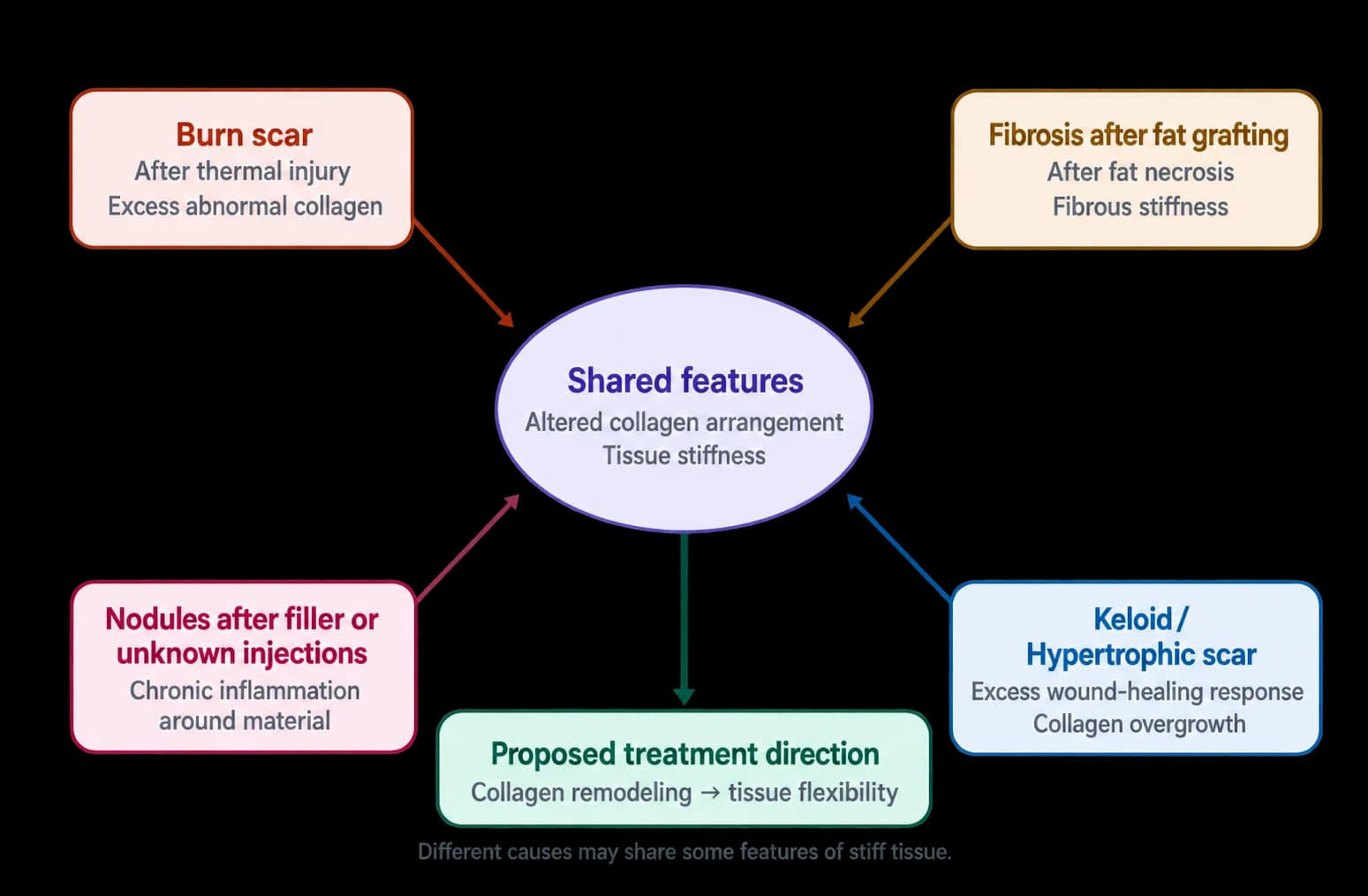
Burn scars, fat-grafting fibrosis and nodules after unknown injections have different causes. Shared stiffness or collagen changes do not establish the efficacy of CaHA, ESWT or hydrodissection combinations for other nodules. Diagnosis and condition-specific evidence are needed.
A clinical reflection
The source uses the image of a flowing river to describe change over time.
The author reflects on caring for people whose tissue has become stiff after earlier procedures and on supporting a natural appearance and self-confidence. This aspiration is distinct from a promise that scars or nodules can be fully removed.
Source paper identified as Radilla-Flores et al., JPRAS Open, 19 February 2025. Exact bibliographic details and the full study require review.
Burn scars, long-standing nodules and fibrosis require an individual assessment; the source’s old consultation call to action was removed.
Materials linked by the source
Source: Original post on Dr. Hyemi Yu’s Naver blog (Korean)
The original publication date and the website revision date are shown separately.