
JOURNAL
Why time matters when assessing CaHA treatment
Lecture notes on time, tissue responses and the assessment of CaHA-related changes.
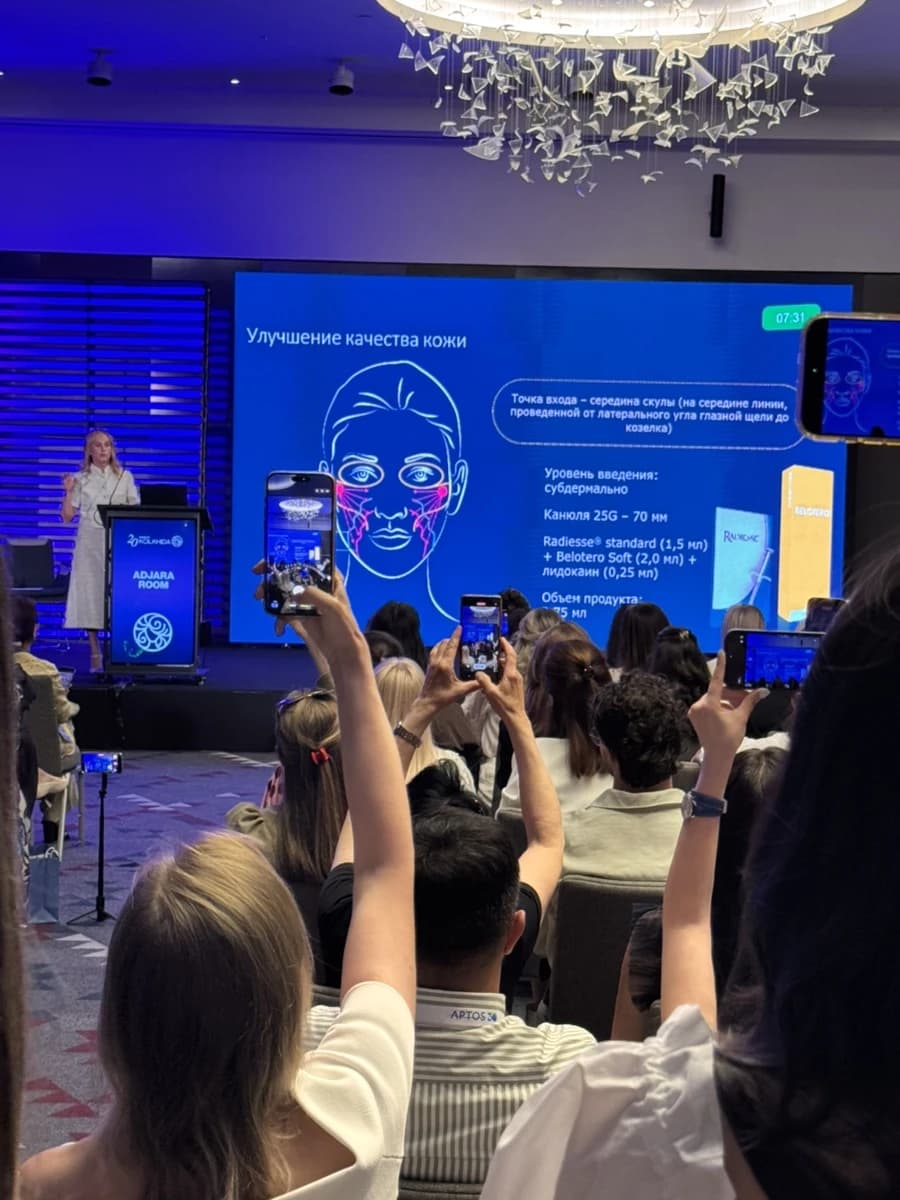
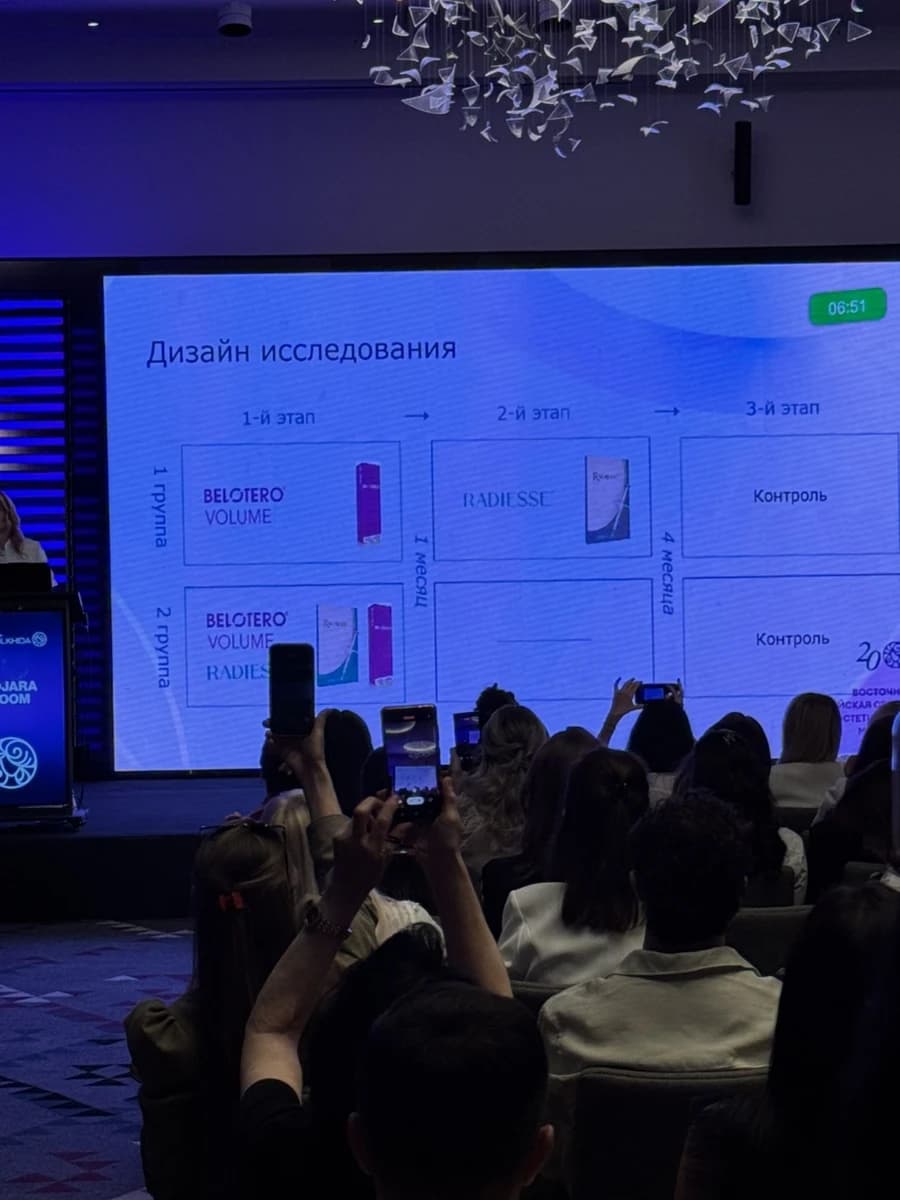
This is a treatment philosophy drawn from a lecture. Two weeks, three/six/nine months and one year are not guaranteed individual timelines. Russian-language lecture photographs are retained as source material with English contextual captions.
CaHA and the role of time
Many people judge a procedure by looking in the mirror immediately afterward. The lecturer argued that this can miss an important feature of CaHA: the end of injection is not necessarily the end of the tissue response.
Using the metaphor of “injecting time,” the speaker described a process that unfolds as tissue responds. This is a philosophy and analogy, not a guarantee of regeneration.
Immediate appearance is not the final assessment
Some immediate volume change can reflect carrier gel and injected fluid. The gel is gradually absorbed, while remaining CaHA microspheres are discussed in relation to surrounding biological responses. The lecturer emphasized tissue changes rather than judging only the presence of product.
A sequence of tissue responses
The source describes initial responses to microtrauma, including macrophages, cytokines, growth factors and fibroblast activity over the early days. It then discusses collagen formation, fiber organization and repeated matrix remodeling over time.
These are simplified descriptions. Not every inflammatory response is harmless, and the sequence cannot establish how an individual patient’s tissue will behave.
Assessing change over months
The lecturer discussed observations at two weeks, around three months, after six months and sometimes beyond nine months. Early findings were distinguished from later remodeling.
Those time points are the source’s account, not universal rules for the onset, duration or success of treatment. The metaphor was to think about future tissue rather than only today’s appearance.
Why remodeling takes time
After fibroblast activation, collagen synthesis and organization within ECM take time. The source discusses the balance between matrix metalloproteinases (MMPs) and tissue inhibitors of metalloproteinases (TIMPs) in breakdown and replacement over months.
Understanding tissue timing was central to the lecturer’s approach.
Interpreting longer-term appearance
The speaker contrasted immediate changes associated with HA with later tissue changes discussed for CaHA, including thickness, elasticity and fine lines. This does not establish a universal comparison or prove that tissue has become biologically younger.
Explaining expectations
The lecturer emphasized discussing delayed assessment before treatment, rather than promise an immediate final result. Three- and six-month follow-up may ask different questions from an immediate photograph. Clear expectations can support discussion, but satisfaction cannot be guaranteed.
Respecting biological time
The lecturer called regeneration a “medicine of waiting”: a clinician influences conditions, while subsequent changes depend on the patient’s biology. Respecting time was described as part of careful care.
My own reflection
When considering CaHA, I think about later tissue as well as the immediate face. An initially modest appearance is not automatically a reason to add more product. Conversely, adding excessive volume for an immediate effect may create unwanted longer-term appearances.
I find it helpful to consider the patient’s future tissue rather than only today’s contour. That is the aspect of the lecture with which I most identified.
Clinical reflection
The source describes CaHA as involving time as well as space. Photographs at three months, six months and a year can inform different assessments. The intended lesson is to consider natural change and tissue response rather than demand rapid visible change. It is not a promise that waiting itself will resolve a concern or produce a successful result.

Source: Original post on Dr. Hyemi Yu’s Naver blog (Korean)
The original publication date and the website revision date are shown separately.