
JOURNAL
Why Trapezius Botox May Not Work as Expected: Injection Depth Matters
An examination of injection depth and anatomy in trapezius botulinum toxin treatment.
This article provides medical information based on a publicly available paper published in Aesthetic Plastic Surgery (2023) and anatomical materials. Recognizing that content on a medical institution’s blog may be classified as medical advertising under Korea’s Medical Service Act, this article: (1) does not guarantee or definitively promise treatment effects or use patient testimonials; (2) presents foreseeable adverse effects in the same text size as the main content; (3) relies on objective evidence from research; (4) does not compare or disparage other medical professionals’ skills or treatment methods; (5) does not show procedures being performed; and (6) does not advertise discounts or promotional events for non-covered services. These principles follow Article 56(2) of the Medical Service Act and Article 23 of its Enforcement Decree, as stated in the original article.
The cited study was an observational study of 40 healthy young women, with level IV evidence. Its findings may not apply equally to everyone. Accurate diagnosis and treatment require consultation with a medical professional.
After having trapezius Botox, you may have wondered:
“I definitely had the injections. Why does the muscle not look much slimmer?”
“It seems to have worked on only one side. My shoulders look uneven.”
“It worked well before. Why is the effect weaker this time?”
If these questions brought you here, your first thought may have been, “Was the dose too low?” or “Have I developed resistance?”
Yet ultrasound research points to another variable that comes before those questions.
That variable is depth.
It can be frustrating not to understand the reason for an unexpected result.
Using a paper that directly measured the trapezius with ultrasound, I will explain why injecting at the “same depth” at every site may move treatment away from the intended target.

Trapezius Botox has become a common procedure.
However, surprisingly few measurements had established exactly where the trapezius lies and how deep it is.
The paper discussed here addressed that gap.
By the end of this article, you will have an anatomical explanation for why results may differ.
Please take three minutes to read on.

1. A study that directly measured the trapezius with ultrasound
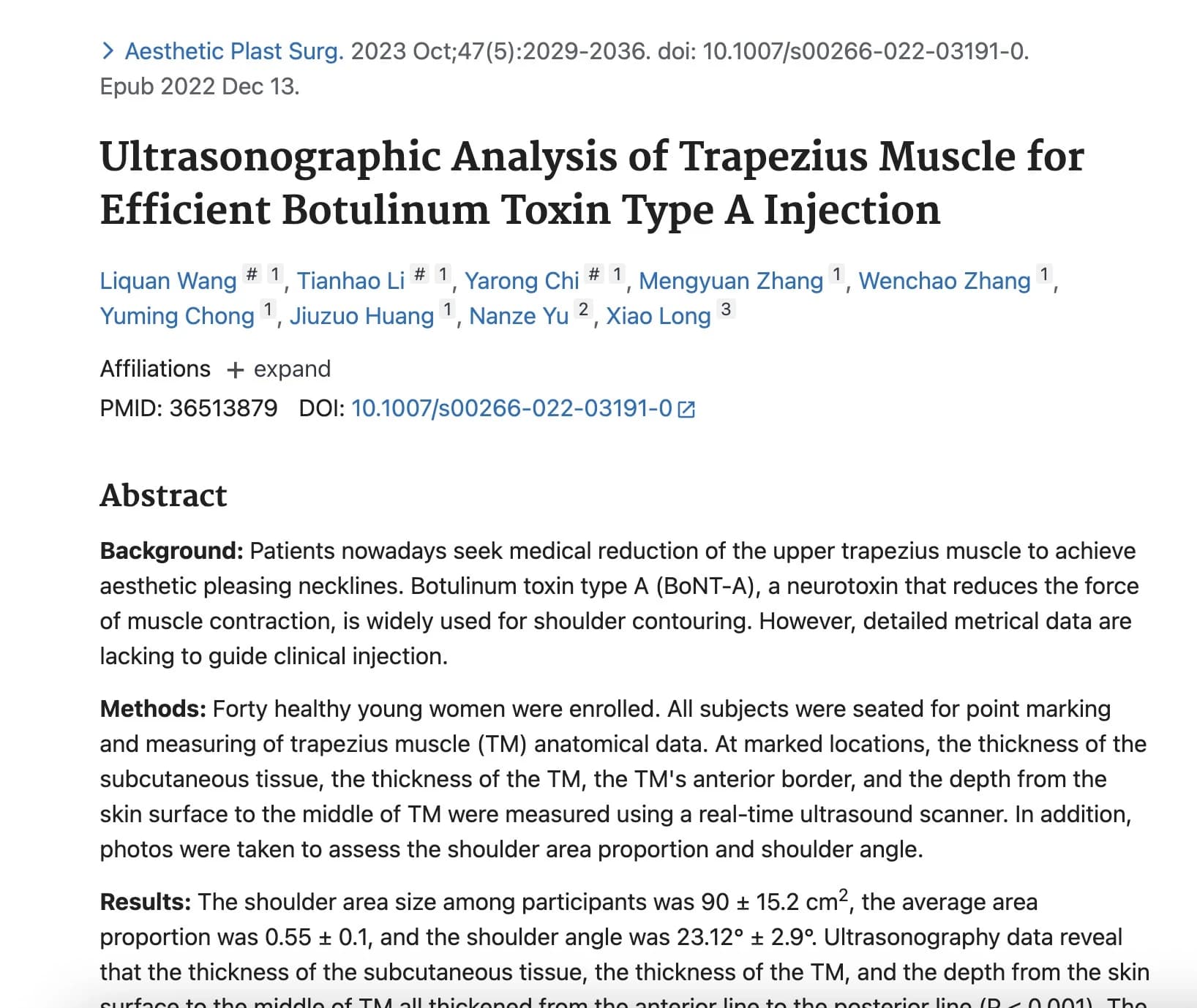
The researchers examined 40 healthy young women in a seated position, using real-time ultrasound to measure several shoulder sites individually:
- The thickness of subcutaneous fat
- The thickness of the trapezius muscle itself
- The depth from the skin surface to the middle of the trapezius
- The anterior border to which the trapezius extends
Their rationale was clear: although trapezius botulinum toxin injections are widely used, specific measurements to guide injections were lacking.
2. The key finding: the trapezius is not a “flat sheet”
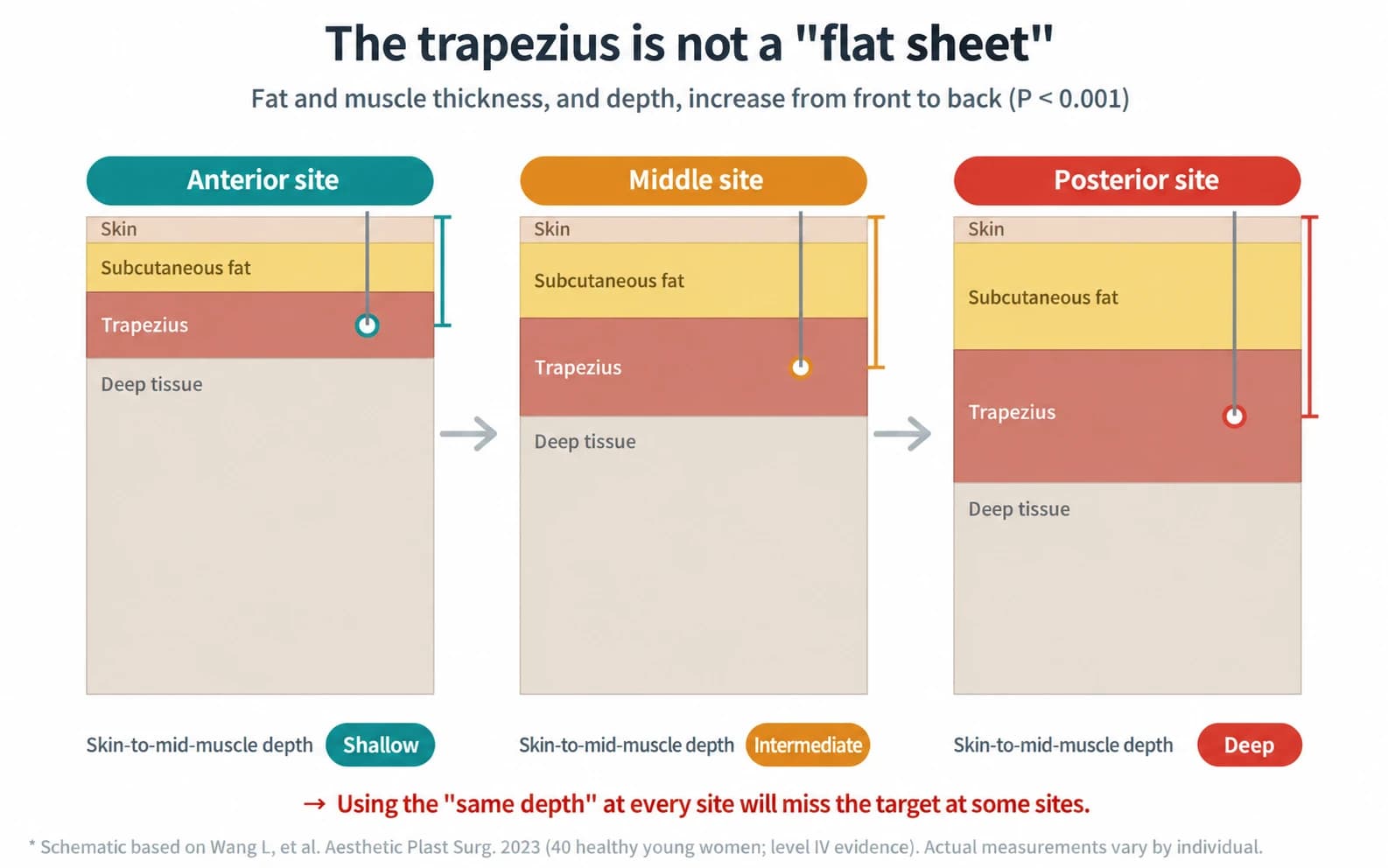
The study’s most important finding was this:
Subcutaneous fat thickness, trapezius thickness, and the depth from the skin to the middle of the muscle all increased from the anterior line toward the posterior line. All differences were statistically significant (P < 0.001).
What does that mean?
Think of a roof: thin near the eaves and thicker toward the ridge.
The trapezius is similarly thinner and shallower toward the front of the neck, and thicker and deeper toward the back.
Treatment, however, is distributed across several shoulder sites. In other words:
- At anterior sites, the muscle lies relatively shallow.
- At posterior sites, the muscle lies deeper.
If the same injection depth is used everywhere, it will not align with the target at every site.
- Using a posterior-site depth at an anterior site may pass through the muscle into the tissue beneath it.
- Using an anterior-site depth at a posterior site may stop in the fat layer before reaching the muscle.
These anatomical differences may help explain why the effect feels weaker or why results appear uneven between sides or sites.
3. The trapezius has an anterior border
Another measurement is particularly interesting.
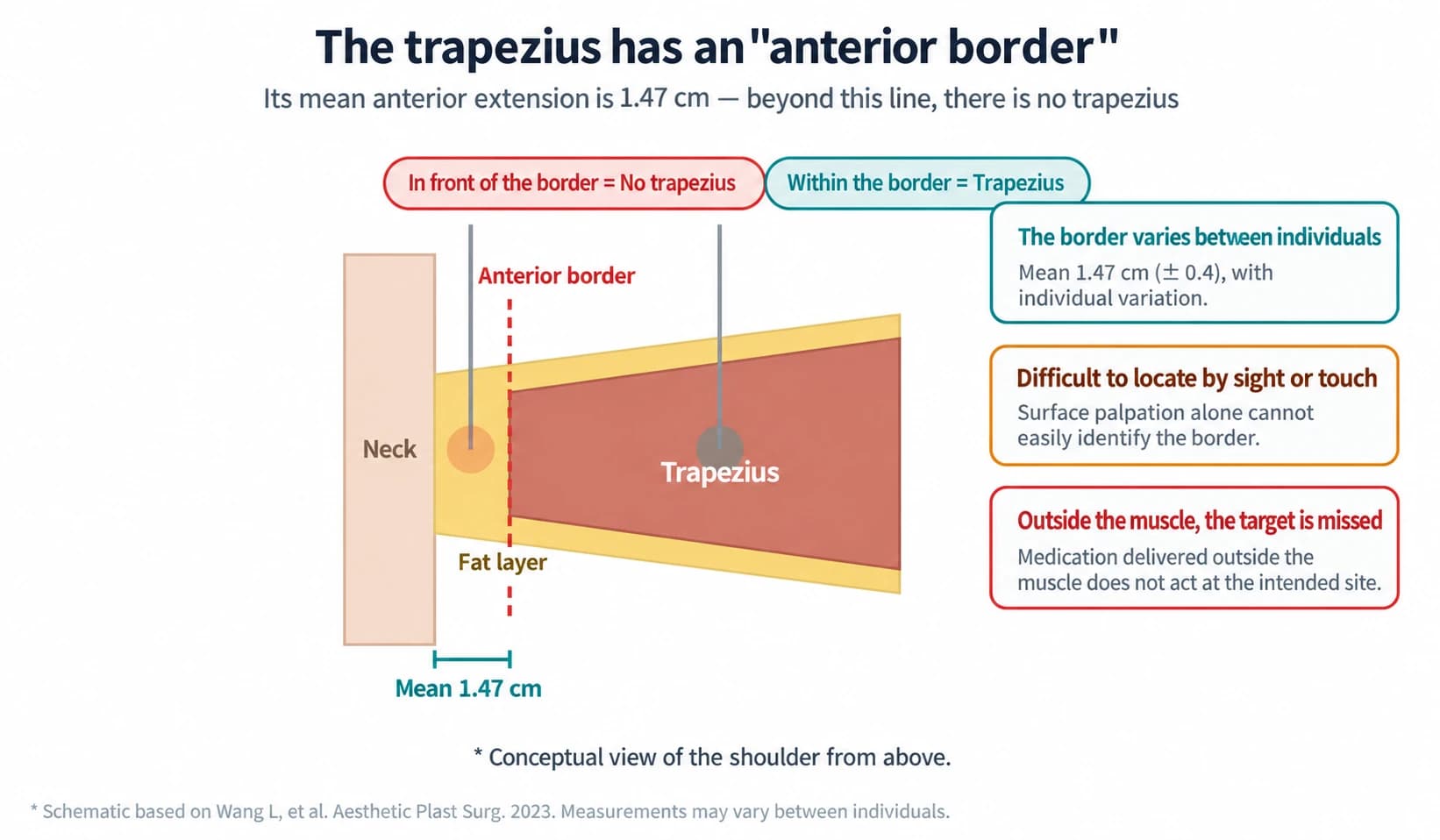
In the study, the mean anterior extension of the trapezius was 1.47 cm (± 0.4).
In other words, the trapezius has a distinct anterior border. Beyond that line, there is no trapezius muscle.
This border varies between individuals. Visual inspection and palpation alone cannot easily establish its exact location in a particular person.
Medication delivered outside the muscle may fail to act at the intended site and may reach an unintended location.
4. The researchers also graded shoulder shape
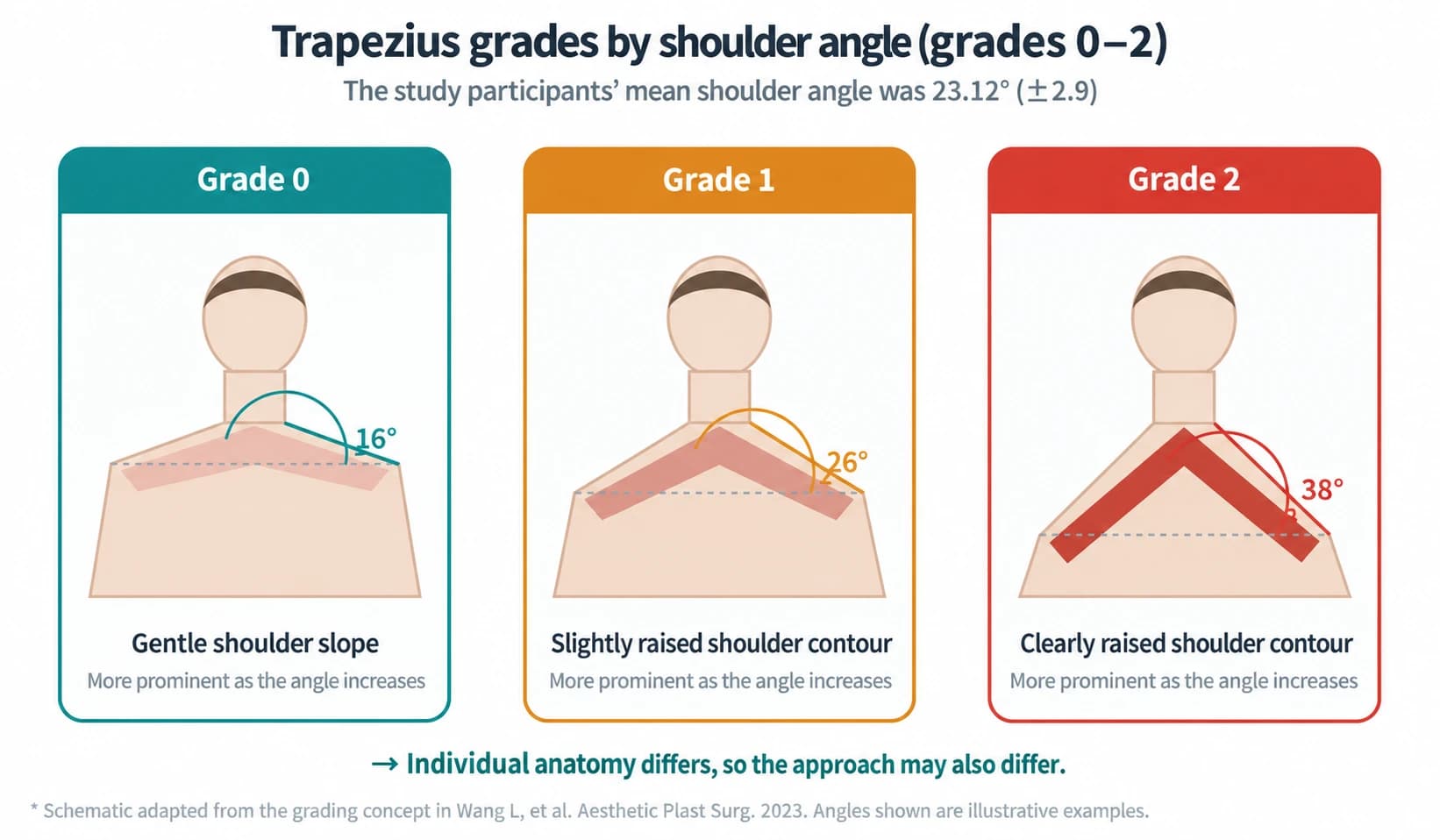
The researchers also analyzed photographs of the participants’ shoulders.
- Mean shoulder area: approximately 90 cm²
- Mean shoulder angle: 23.12° (± 2.9)
They used shoulder angle to create a grading system for trapezius hypertrophy from grade 0 to grade 2. The intention was to recognize that the state of the trapezius differs between individuals and that the approach should reflect those differences.
The study’s findings come together in one message:
“The trapezius differs between people, and between sites within the same person.”
Just as it is difficult to cut only a particular layer of a cake without knowing its thickness, it is difficult to place an injection precisely within the intended layer without understanding the tissue layers.
Ultrasound makes those layers visible.
5. This study also has limitations
When presenting evidence, I believe it is important to present its limitations as well.
The participants were 40 healthy young women. The results should not be assumed to apply unchanged to men, middle-aged or older adults, or people with different body types.
The paper identifies its evidence as level IV, corresponding to an observational study.
It provides anatomical measurements. It does not demonstrate that a particular treatment technique is superior.
This article therefore does not claim or guarantee that using ultrasound will necessarily produce better results. Its purpose is to explain that differences in depth between individuals have been measured, and that a method exists for assessing those differences.
Important adverse effects and precautions
The following adverse effects are foreseeable with trapezius botulinum toxin treatment. The original article lists them with reference to Article 56(2)(7) of Korea’s Medical Service Act.
- Pain, swelling, bruising, bleeding, or infection at the injection site
- Temporary muscle weakness, including difficulty raising the arms or shrugging the shoulders
- Changes in neck or shoulder movement and posture due to spread into adjacent muscles
- Headache, neck stiffness, or dizziness
- Rare systemic reactions, including dysphagia (difficulty swallowing) or breathing discomfort
- Possible reduced response due to immune reactions or resistance
- Possible compensatory changes in surrounding muscles with repeated treatment
Rare but serious adverse reactions can occur. If unusual symptoms develop, seek medical attention immediately.
The procedure may not be suitable during pregnancy or breastfeeding, for people with neuromuscular conditions, or for those taking certain medications. Consult a medical professional before treatment.
When trapezius Botox does not produce the expected result, we often think first about the dose or product.
However, the 2023 ultrasound measurement study raised a more fundamental question:
“Did the medication actually reach the trapezius?”
The trapezius lies deeper from front to back, has an anterior border, and varies in all these measurements between individuals.
Without assessing this variation, the same procedure may lead to different results.
If the result differs from your expectations, consider checking depth before focusing only on dose.
This article provides medical information based on publicly available academic research. As stated in the Korean original, it was written to observe the restrictions in Article 56(2) of Korea’s Medical Service Act and Article 23 of its Enforcement Decree if classified as medical advertising, including restrictions concerning testimonials, guaranteed effects, false or exaggerated claims, comparisons or disparagement, depictions of procedures, omission of adverse-effect information, and advertisements for discounts on non-covered services. The cited research was an observational study of 40 healthy young women with level IV evidence. Treatment effects may vary between individuals. This article does not recommend a particular procedure or guarantee its results.
References
Wang L, Li T, Chi Y, Zhang M, Zhang W, Chong Y, Huang J, Yu N, Long X. Ultrasonographic Analysis of Trapezius Muscle for Efficient Botulinum Toxin Type A Injection. Aesthetic Plast Surg. 2023;47(5):2029–2036. (PMID 36513879)
Bae JH, et al. Accessory nerve distribution for aesthetic botulinum toxin injections into the upper trapezius muscle. Surg Radiol Anat. 2018. (PMID 29946827)
Li Z, et al. The "Visible" Muscles on Ultrasound Imaging Make Botulinum Toxin Injection More Precise: A Systematic Review. Aesthetic Plast Surg. 2022. (PMID 34341856)
Chen W, et al. Ultrasound-guided five-point injection of botulinum toxin for patients with trapezius hypertrophy. J Orthop Surg Res. 2021. (PMC8532279)
Park JY, et al. Efficacy and Safety of Incobotulinumtoxin-A for Trapezius Muscle Reduction. Plast Reconstr Surg Glob Open. 2025. (PMC12091602)
Source: Original post on Dr. Hyemi Yu’s Naver blog (Korean)
The original publication date and the website revision date are shown separately.