
JOURNAL
Pain After Trapezius Botox: Depth May Be Part of the Explanation
Anatomy, injection depth, and muscle compensation to consider when assessing pain after trapezius Botox.
This medical-information article draws on public anatomical material and research. As stated in the Korean original, it is written with medical-advertising restrictions in mind: no guaranteed effects or patient testimonials, foreseeable adverse effects presented alongside the body, objective evidence, no comparison or disparagement of other clinicians, no depiction of procedures being performed, and no discounts or promotional events for non-covered treatment. The original cites Article 56(2) of Korea’s Medical Service Act and Article 23 of its Enforcement Decree.
Symptoms and outcomes vary. Accurate diagnosis and treatment require consultation with a medical professional.
After trapezius Botox, you may wonder why your shoulder feels more tense or painful, why it appears thicker rather than slimmer, or why discomfort extends toward the clavicle or neck.
If symptoms have persisted, it can be difficult to know where to seek an explanation. This article discusses two possibilities: medication reaching a different layer than intended, and pain arising from compensation even when the intended muscle was treated.

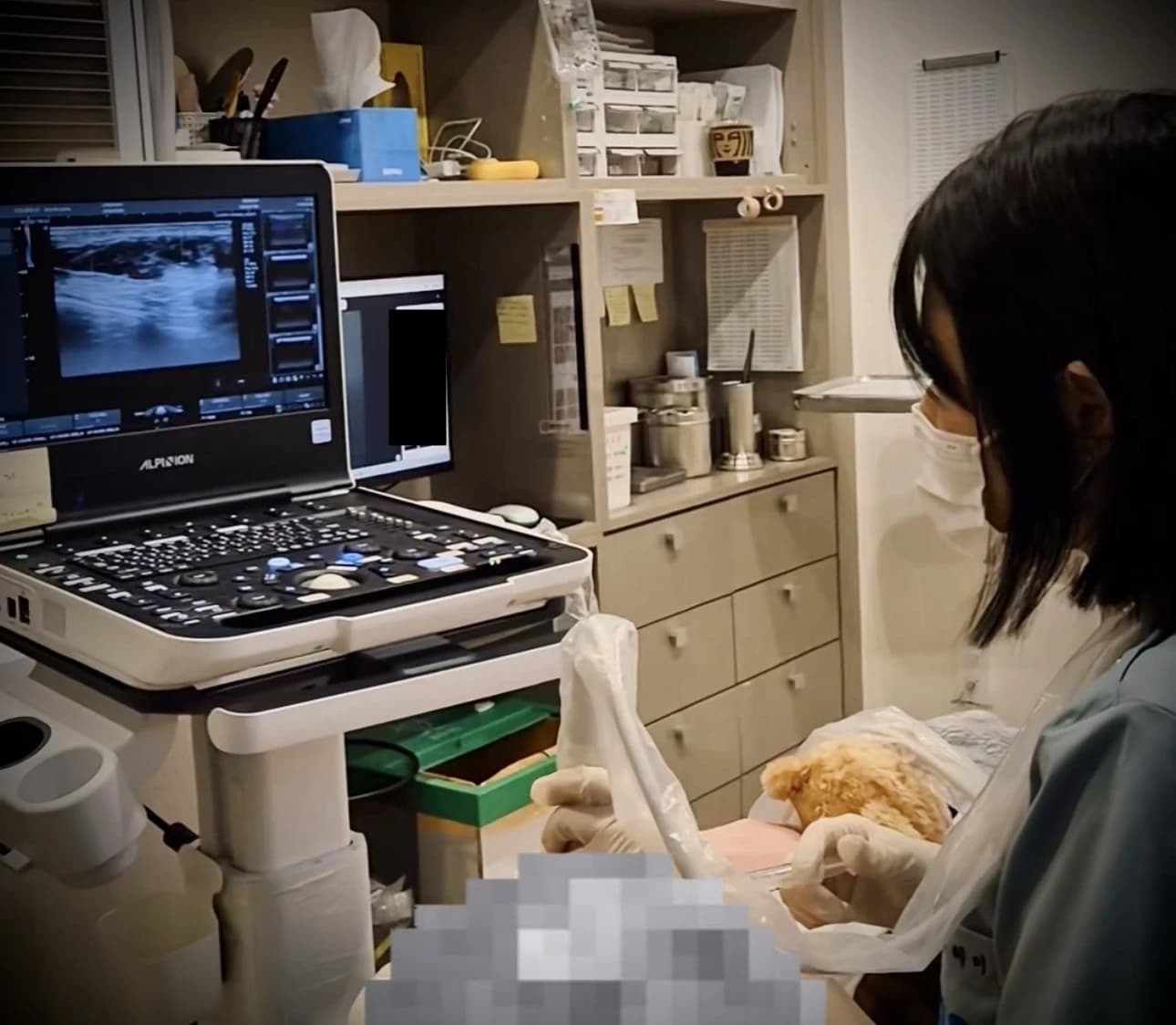
In practice, some people present with persistent pain after treatment elsewhere. Ultrasound assessment can sometimes point toward a deeper structure rather than the visibly prominent trapezius.
The following discussion uses anatomy and research to explain why depth may matter.
1. The levator scapulae lies beneath the trapezius
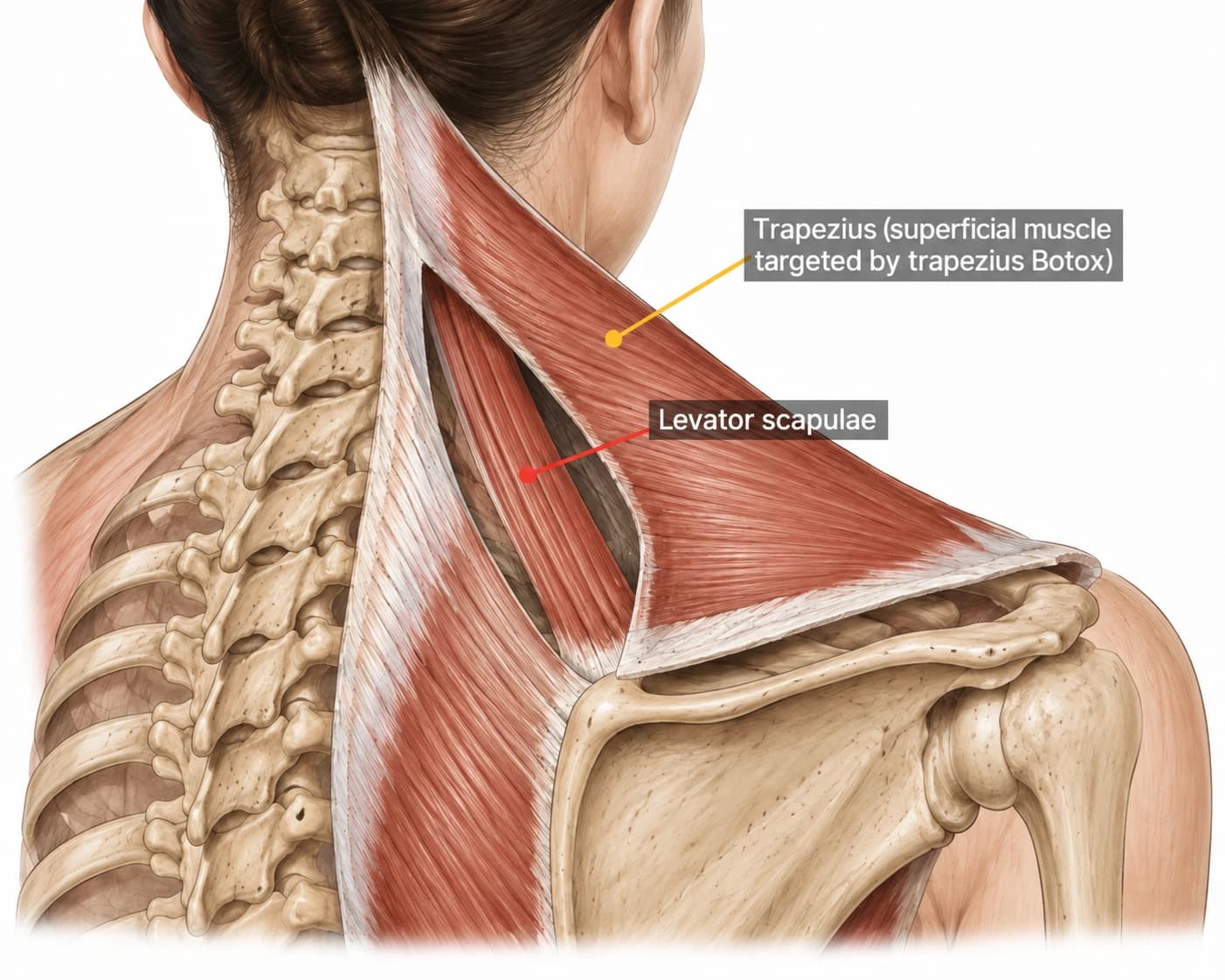
The trapezius is a broad superficial muscle covering the neck and shoulders. Immediately beneath it lies the levator scapulae.
The levator scapulae runs from cervical vertebrae C1–C4 to the upper corner of the scapula. It elevates the scapula and contributes to neck tilting, shoulder shrugging, and turning the head.
Like overlapping blankets, the muscles lie close together and cannot always be considered in isolation.
2. Injection depth matters
The thickness between skin and muscle varies. A slender person may have thinner subcutaneous fat and a thinner trapezius, with less distance to the levator scapulae.
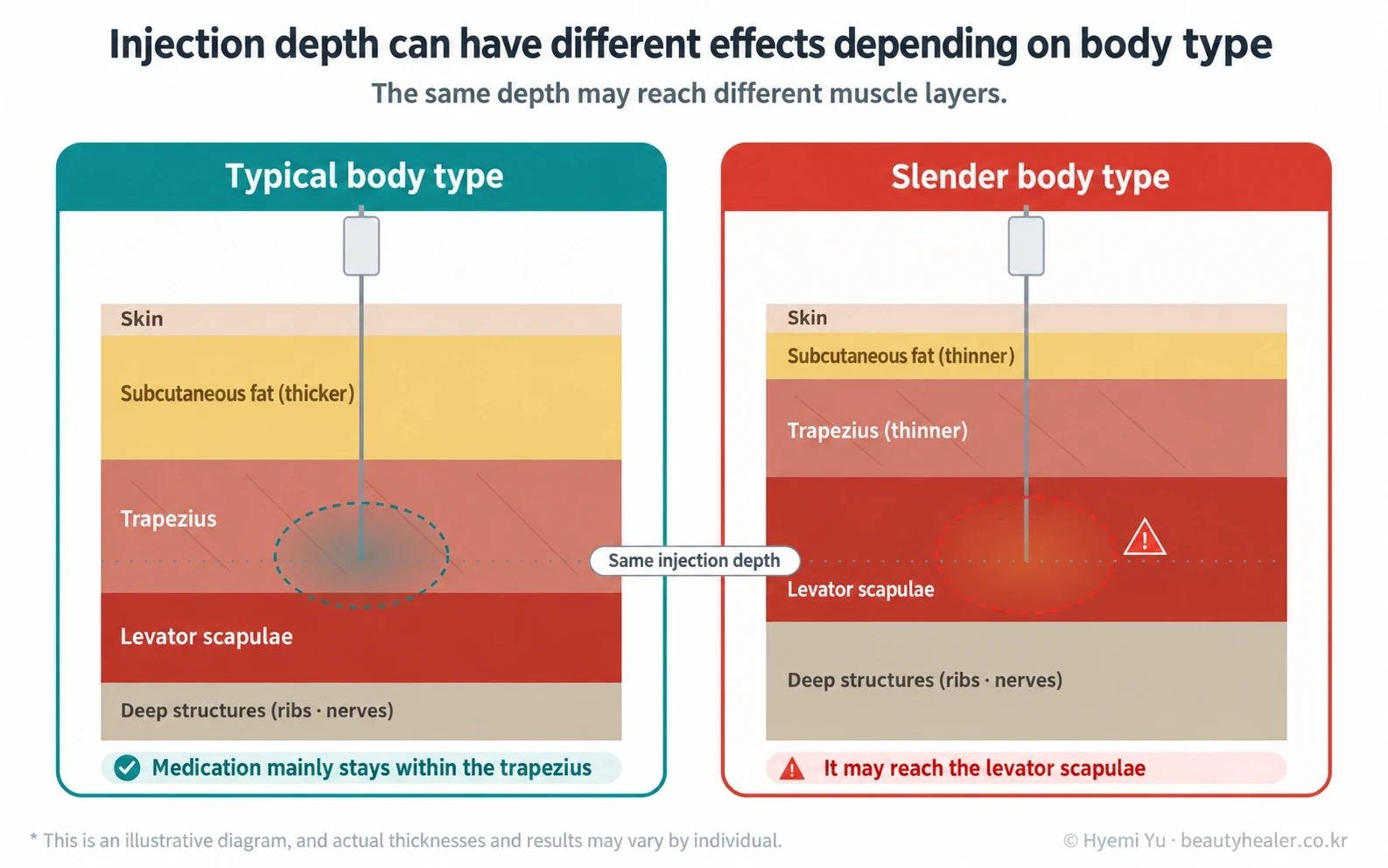
With more fat and muscle, there may be more space between the relevant layers. The same depth can therefore reach different tissues in different people.
A cadaveric ultrasound study reported higher accuracy for ultrasound-guided levator scapulae injection than unguided injection: 95.8% versus 54.2%.
Lee HJ et al. Ultrasound-guided Injection of the Levator Scapulae Muscle in a Cadaver Model. Pain Physician. 2023.
Surface anatomy and levator scapulae muscle injection: a cadaveric investigation. Medicine. 2024.
This is an anatomical finding, not a comparison of medical institutions. It demonstrates that estimating the target from surface anatomy alone can miss the intended layer.
Depth, direction, and body type may affect whether medication influences the deeper levator scapulae. This is a possible explanation, not an assertion that it necessarily occurs.
3. Why can a posterior muscle produce pain near the clavicle?
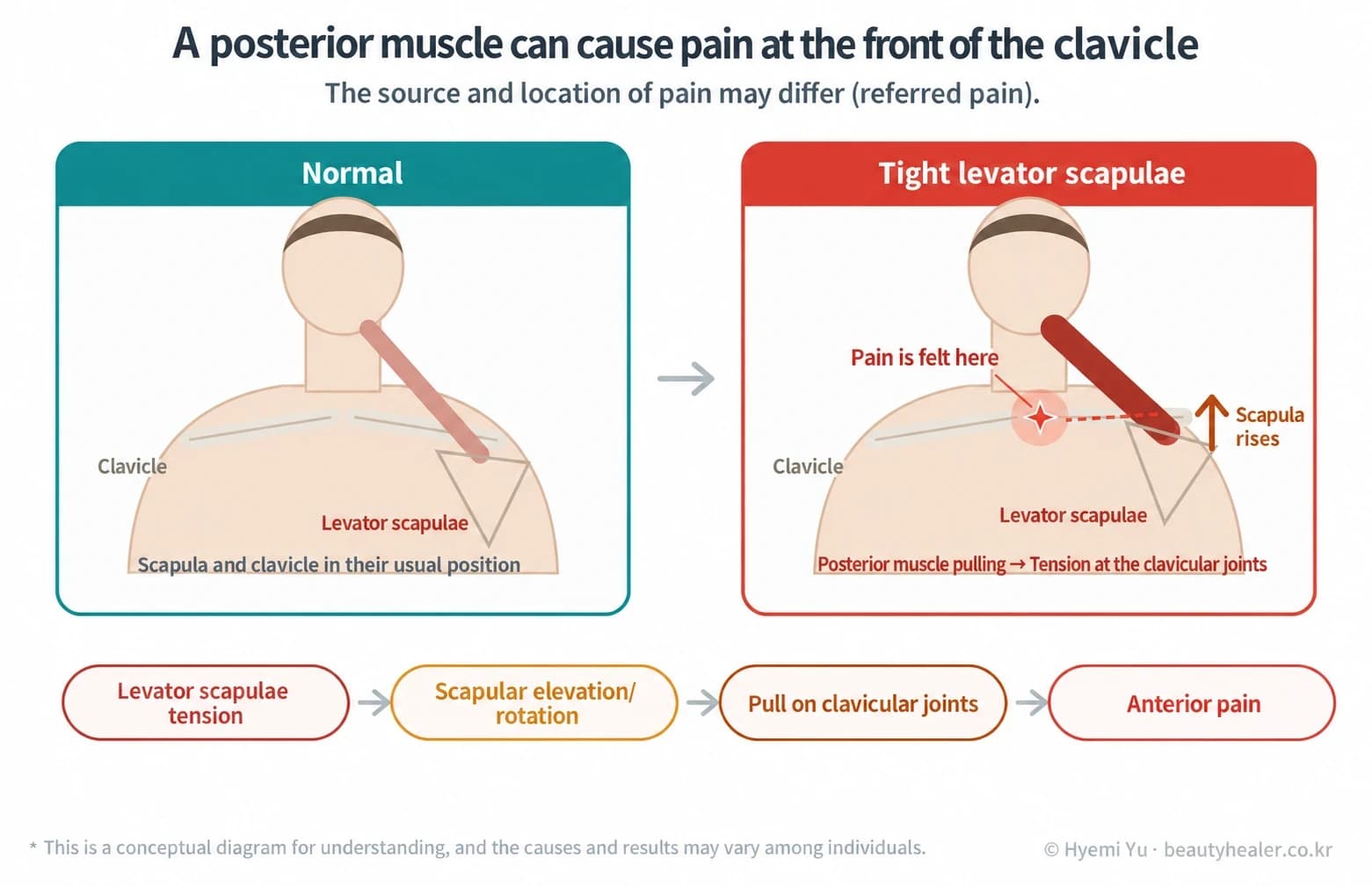
The original describes a possible sequence: trapezius weakening, increased levator scapulae tension, scapular elevation or downward rotation, and tension transmitted toward clavicular joints.
When the levator scapulae tightens, altered scapular movement may change clavicular movement and apply sustained tension to the sternoclavicular or acromioclavicular joints.
Pain may be felt at the clavicle or front of the neck even when its source is a posterior muscle. A difference between the source and location of discomfort is termed referred pain.
4. Correctly targeted treatment can still be followed by compensatory pain
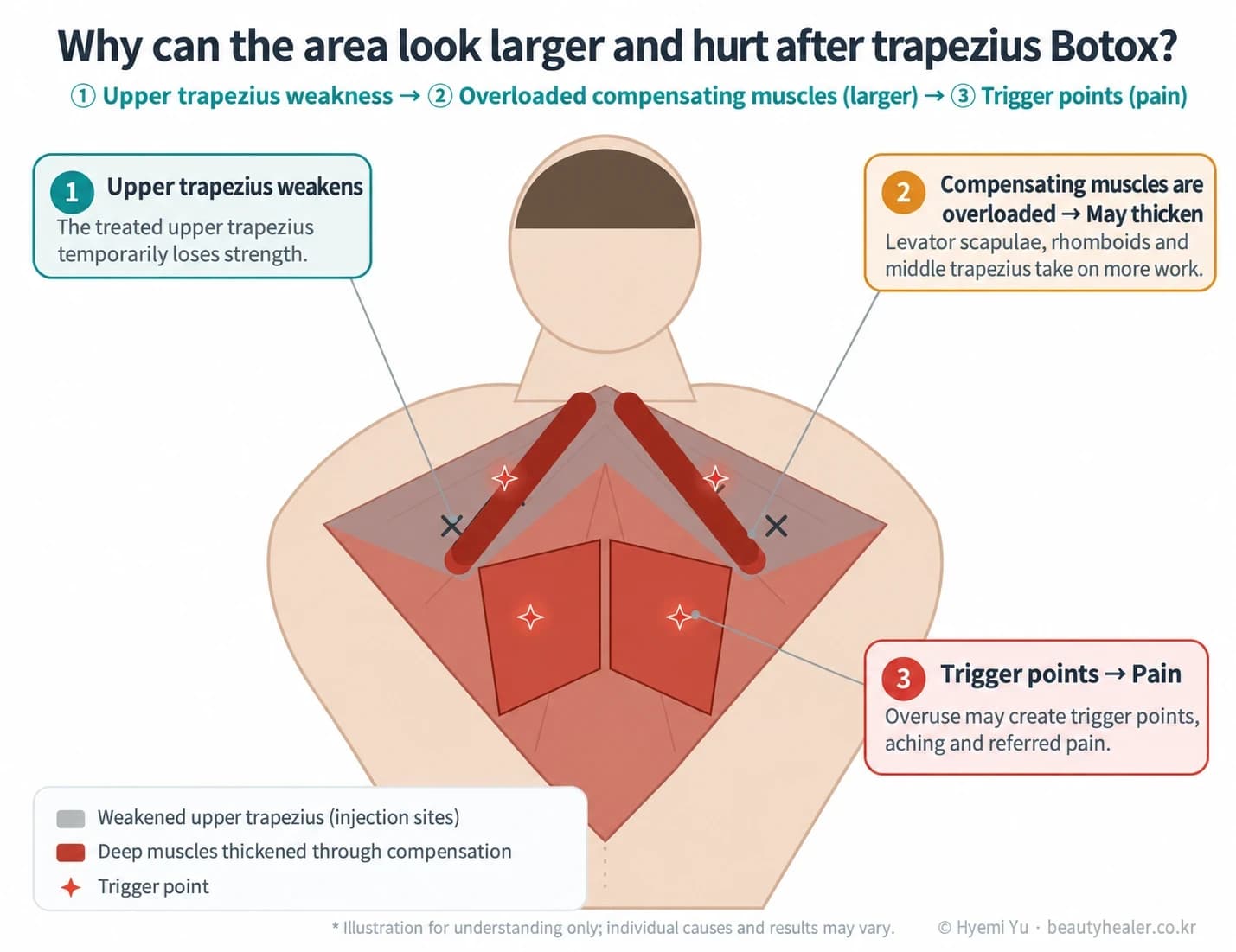
Botulinum toxin temporarily reduces strength in the treated muscle. Other muscles may take on more work and become more prominent, a process described as compensatory hypertrophy.
An imaging study found reduced upper-trapezius volume alongside increased middle-trapezius volume, interpreted as compensation. Compensatory bulging in untreated parts of the masseter after repeated injections has also been reported.
Why might this hurt? The analogy is a colleague working overtime when another team member is absent. Overloaded muscles may remain tense.
Sustained use beyond capacity can be associated with reduced local blood flow, less oxygen and energy, taut bands, and trigger points. Local changes in pain-related substances and acidity may contribute to tenderness and referred pain.
Thickening and discomfort can therefore reflect different aspects of the same overuse process.
Incobotulinumtoxin-A for Trapezius Muscle Reduction: Quantitative Evaluation With Imaging Studies. 2025.
Compensatory Masseteric Bulging and Its Implications for BoNT Injection Techniques. 2025.
Etiology of Myofascial Trigger Points. Curr Pain Headache Rep. 2012. / Myofascial Pain Syndrome. StatPearls. 2025.
5. Not every case of pain is caused by the levator scapulae
Muscle tension, joint problems, tendon injury, and nerve irritation are other possible causes. The levator scapulae is only one consideration.
The dorsal scapular nerve passes in a deeper region near this muscle. Reports describe associations between adhesions around this nerve and chronic pain near the medial scapula or neck.
Sharma GK, Botchu R. Dorsal scapular nerve entrapment neuropathy managed by ultrasound-guided hydrodissection. 2021.
Lam KHS, Yoon Y, et al. Ultrasound-Guided Hydrodissection for Dorsal Scapular Nerve Entrapment. Cureus. 2025.
6. The role of ultrasound assessment
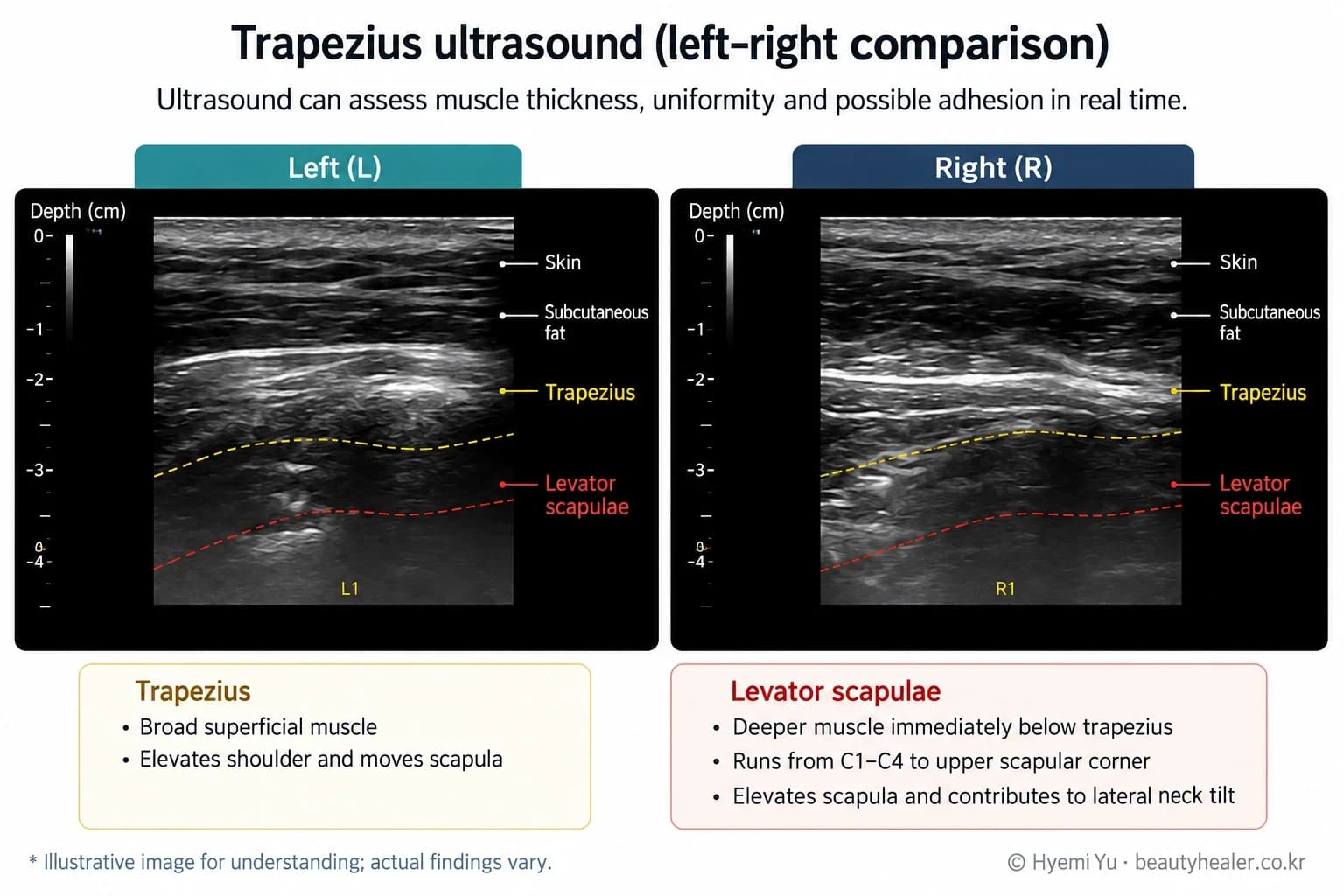
Although symptoms may all be described as shoulder pain, ultrasound can assess the trapezius, levator scapulae, fascia, and nearby nerves in real time. It may help identify changes in thickness, fascial adhesion, or surrounding tissue.
The approach depends on whether the cause involves tension, adhesions, or changes around nerves. Identifying the cause is therefore important.
Adverse effects and precautions
The original lists foreseeable adverse effects with reference to Article 56(2)(7) of Korea’s Medical Service Act:
- Injection-site pain, swelling, bruising, bleeding, or infection
- Temporary muscle weakness and difficulty raising the arms or shrugging
- Altered neck/shoulder movement or posture from spread to adjacent muscles
- Headache, neck stiffness, or dizziness
- Rare systemic reactions, including dysphagia or breathing discomfort
- Reduced response related to immune reactions or resistance
- Compensatory changes in surrounding muscles after repeated treatment
Rare serious reactions may occur. Unusual symptoms require prompt medical assessment.
Pregnancy, breastfeeding, neuromuscular disease, and certain medications may make the procedure unsuitable. Consult a clinician before treatment.
Pain after trapezius Botox is not described here as a common symptom, but anatomical mechanisms may explain some cases.
Depth can matter because the distance between trapezius and levator scapulae differs. Compensation can matter because muscles taking on extra work may thicken and hurt even after correctly targeted treatment.
Both require asking why the area hurts, rather than only where it hurts. If symptoms persist or affect daily life, assessment is preferable to simply waiting.
This medical-information article draws on publicly available anatomy and research. As stated in the original, it was written with Korean medical-advertising restrictions in mind, including restrictions on testimonials, guaranteed effects, false or exaggerated claims, comparison or disparagement, procedure depiction, omission of adverse effects, and non-covered fee discounts. Effects vary. It neither recommends a particular procedure nor guarantees outcomes. Diagnosis and treatment require professional medical consultation.
References
Lee HJ, et al. Ultrasound-guided Injection of the Levator Scapulae Muscle in a Cadaver Model. Pain Physician. 2023. (PubMed 37535786)
Surface anatomy and levator scapulae muscle injection: a cadaveric investigation. Medicine. 2024. (PubMed 38905373)
Efficacy and Safety of Incobotulinumtoxin-A for Trapezius Muscle Reduction: Quantitative Evaluation With Imaging Studies. 2025. (PMC12091602)
Compensatory Masseteric Bulging: Implications for Botulinum Neurotoxin Injection Techniques. 2025. (PMC11975157)
Etiology of Myofascial Trigger Points. Current Pain and Headache Reports. 2012. (PMC3440564)
Myofascial Pain Syndrome. StatPearls. 2025. (NBK499882)
Sharma GK, Botchu R. Dorsal scapular nerve entrapment neuropathy managed by ultrasound-guided hydrodissection. 2021. (PubMed 33791120)
Lam KHS, Yoon Y, et al. Ultrasound-Guided Hydrodissection for Dorsal Scapular Nerve Entrapment. Cureus. 2025. (PMC12767907)
Source: Original post on Dr. Hyemi Yu’s Naver blog (Korean)
The original publication date and the website revision date are shown separately.