
JOURNAL
Ultracol under-eye nodules and material-specific evidence
Ultracol under-eye nodules and material-specific evidence. Source observations, research context and limitations.
This article discusses the source author’s earlier literature, cases and experiences. Research populations and limitations matter; individual diagnosis and treatment require clinical assessment.
The source addresses concern about a persistent lump after Ultracol, particularly when a person has been told to wait or massage it. The material, timing and clinical signs need to be distinguished before predicting its course.
Historical graphic listing Dr. Hyemi Yu’s former BIO Plastic Surgery affiliation, specialty, publication, book and media appearances. These details are not current booking information.

The author recalls patients who still felt a lump months after treatment. The article discusses nodule types and research limitations rather than promising that early treatment changes every outcome.

Why might a nodule form?
The source uses unevenly scattered seeds as an analogy for focal accumulation. Local deposition and an inflammatory response are different possible processes, not diagnoses based on appearance alone.
Source caption: ultrasound-guided treatment of a PCL filler granuloma, Cerón Bohórquez and Desyatnikova, PRS Global Open, 2024. PCL is not the PDO material in Ultracol.
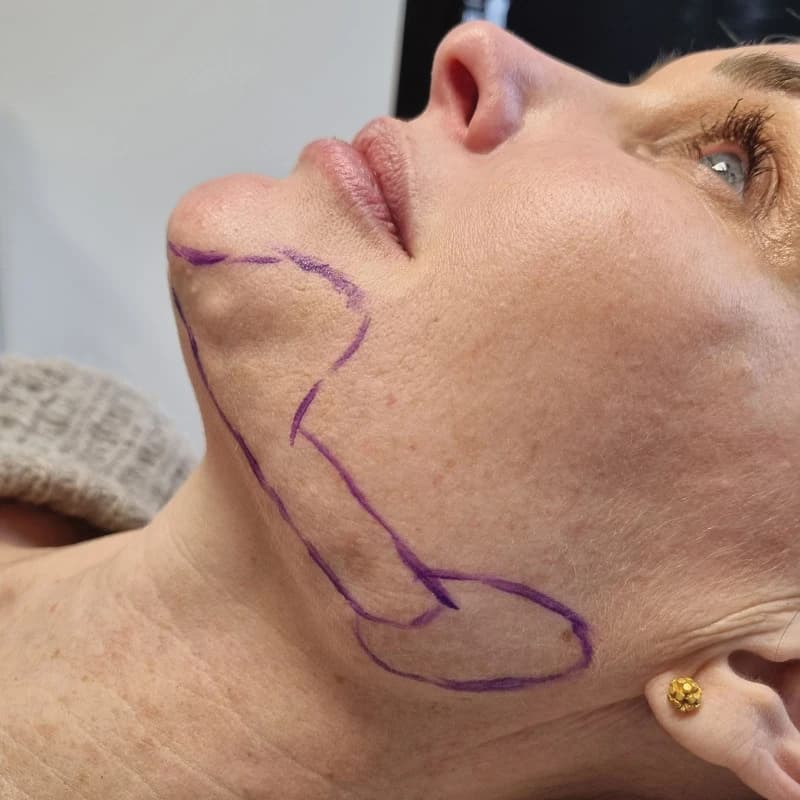
Ultracol is described in the source as a PDO, or polydioxanone, collagen-stimulating injectable. Early palpable deposits and delayed inflammatory reactions must be distinguished. Concentration, preparation and technique may be relevant, but timing alone cannot establish the mechanism.
Source caption: an individual delayed under-eye nodule reported as approximately one year old.
The source cites a 2025 systematic review of 117 patients with reported foreign-body granulomas related to collagen-stimulating fillers. It quotes nodules in 82.91% of the included cases, a mean onset of 20 months and a case as late as 15 years. These are selected published cases across materials, not rates or timelines for all Ultracol users.
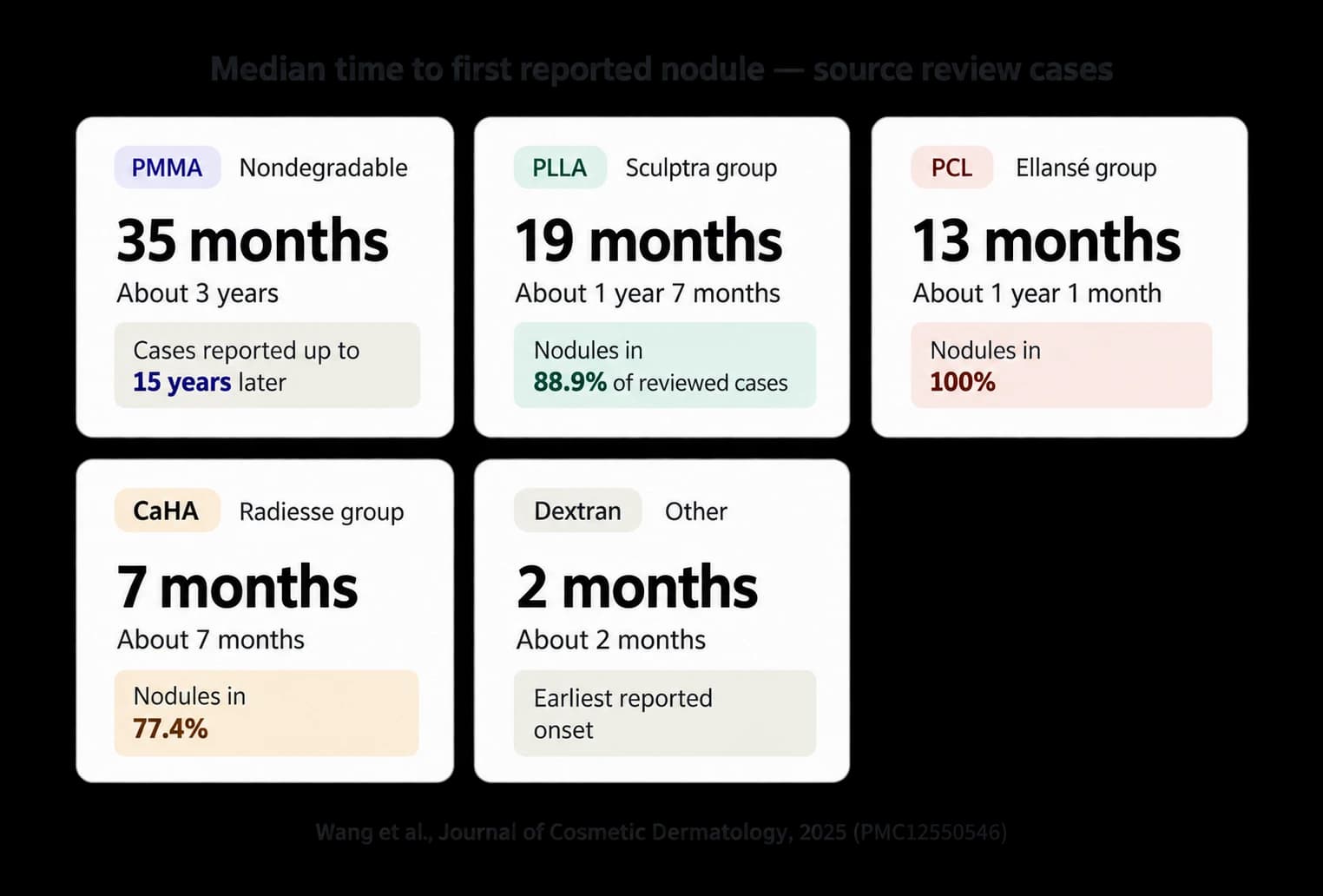
Reference cited: Wang et al. Foreign Body Granulomas Reaction Related to Collagen Stimulatory Cosmetic Fillers: A Systematic Review. Journal of Cosmetic Dermatology. 2025. https://pmc.ncbi.nlm.nih.gov/articles/PMC12550546/
Will a nodule disappear as the material degrades?
Some early deposits may improve, whereas inflammatory granulomas and associated fibrosis can persist. A granuloma is a chronic inflammatory tissue response and is not interchangeable with every palpable nodule.
The source quotes remission in 27.35% and complete resolution in 10.26% of the review’s cases. These pooled, selected reports cannot provide a general Ultracol prognosis or treatment success rate. Some difficult cases underwent surgery; that does not make surgery necessary for everyone.
A persistent, enlarging or visible lump deserves an assessment of its type and course rather than a universal instruction to wait.
What can ultrasound contribute?
Ultrasound can help locate a lesion and assess depth, size and adjacent structures. The cited 2024 case involved a PCL granuloma, not PDO Ultracol. After four earlier steroid injections had not resolved it, a combination including triamcinolone, hyaluronidase and 5-FU was delivered under ultrasound guidance; the source reports visible resolution at seven months. A case report is not a universal protocol.
Reference: Cerón Bohórquez JM, Desyatnikova S. Ultrasound-guided Treatment of Polycaprolactone Granuloma. PRS Global Open. 2024. https://pmc.ncbi.nlm.nih.gov/articles/PMC10860983/
Source caption: B-mode ultrasound of a PCL filler granuloma, with an irregular border and bright foci. It must be distinguished from PDO Ultracol evidence. Source: Cerón Bohórquez and Desyatnikova, 2024, PMC10860983.
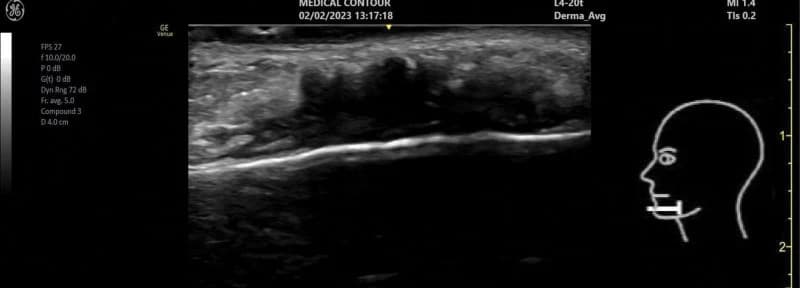
Ultrasound may support targeted assessment and treatment but does not remove the risk of injury to nearby tissue. Drug choice, amount and number of treatments depend on the diagnosis and individual condition. The key questions are the nodule type, duration and appropriate options, rather than a guarantee that waiting or a particular procedure will work.
Materials linked by the source
Source: Original post on Dr. Hyemi Yu’s Naver blog (Korean)
The original publication date and the website revision date are shown separately.