
JOURNAL
Assessing unevenness after liposuction
Assessing unevenness after liposuction. Source observations, research context and limitations.
This article discusses the source author’s earlier literature, cases and experiences. Research populations and limitations matter; individual diagnosis and treatment require clinical assessment.
After liposuction, some people notice persistent unevenness or firm areas despite waiting, massage or energy-based treatment. The cause needs assessment rather than an assumption that another session will resolve it.
Historical source caption: Dr. Hyemi Yu during her earlier BIO Plastic Surgery affiliation, with educational and media credentials listed in the original graphic.

In the source’s clinical accounts, patients describe trying massage or radiofrequency without a noticeable change and ask whether more time is needed. The article organizes the discussion around tissue changes and the limits of proposed treatments.
Unevenness and fibrosis: distinguish other causes, including swelling
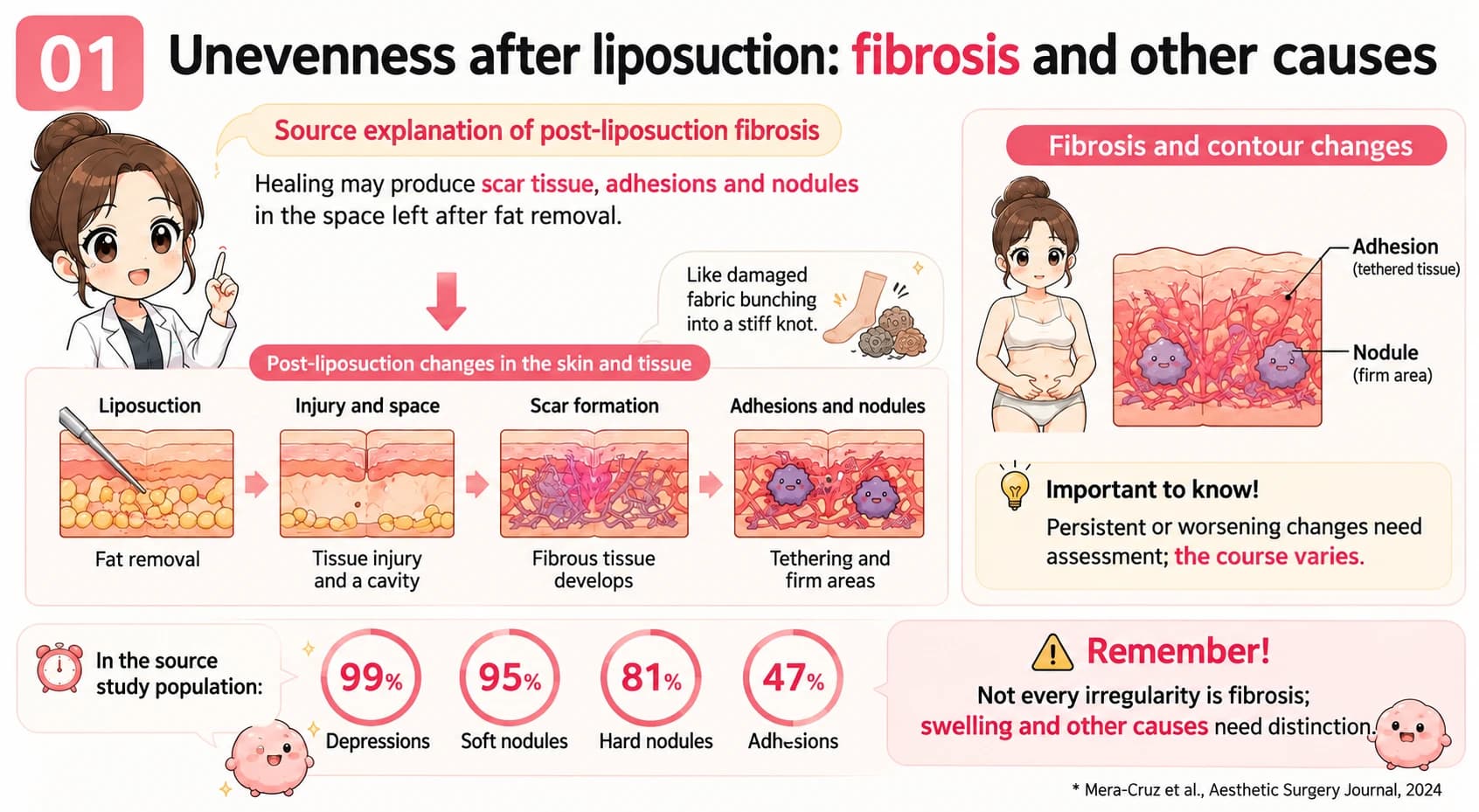
Liposuction removes subcutaneous fat and injures tissue. Healing may include fibrous scar tissue, adhesions or firm areas. These are possible explanations for contour changes, rather than a diagnosis of every irregularity.
The source uses the analogy of fabric bunching around a hole to describe firm, irregular healing.
Fibrosis can link tissue layers or form focal areas of firmness. It is one possible explanation for unevenness after liposuction; assessment must consider other causes.
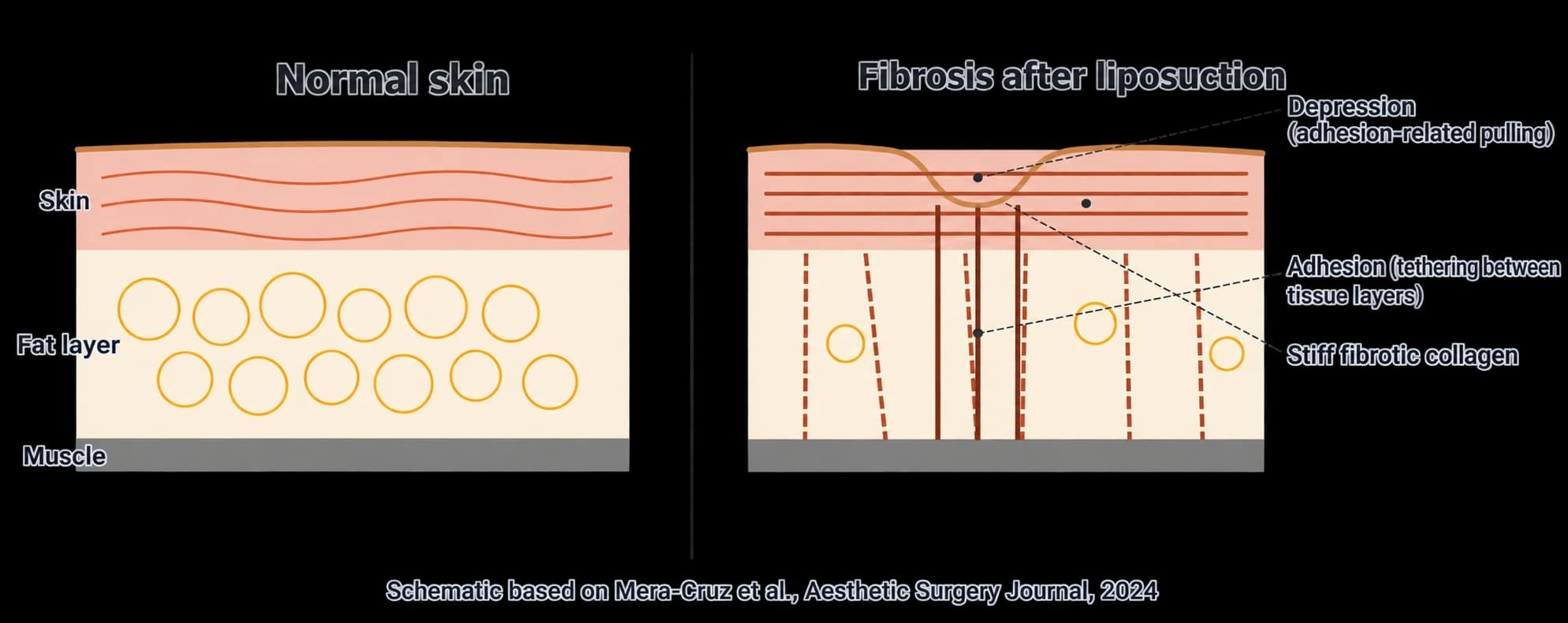
The source cites depressions in 99%, soft nodules in 95%, hard nodules in 81% and adhesions in 47% in Mera-Cruz et al., Aesthetic Surgery Journal, 2024. These figures concern the study population and should not be presented as rates among all liposuction patients.
Fibrosis follows different courses in different people. Persistent or worsening contour changes warrant evaluation.
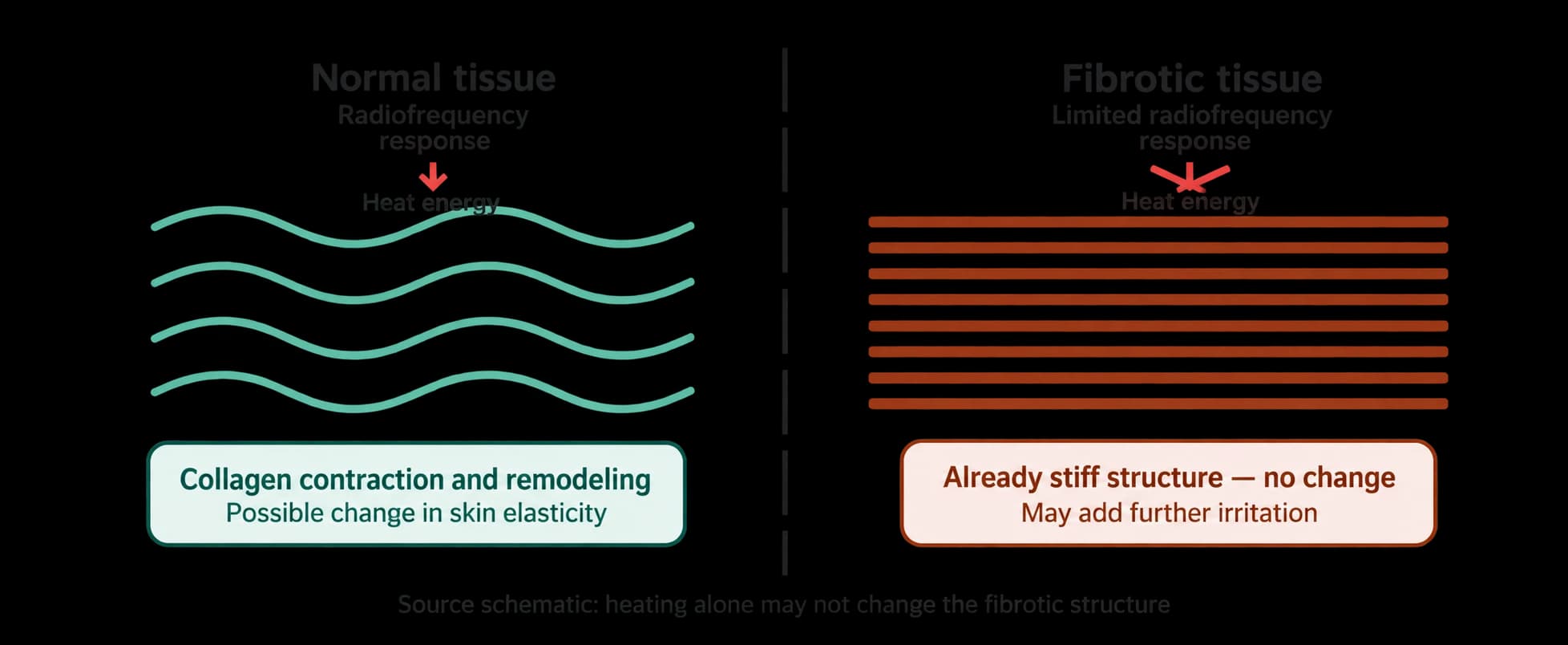
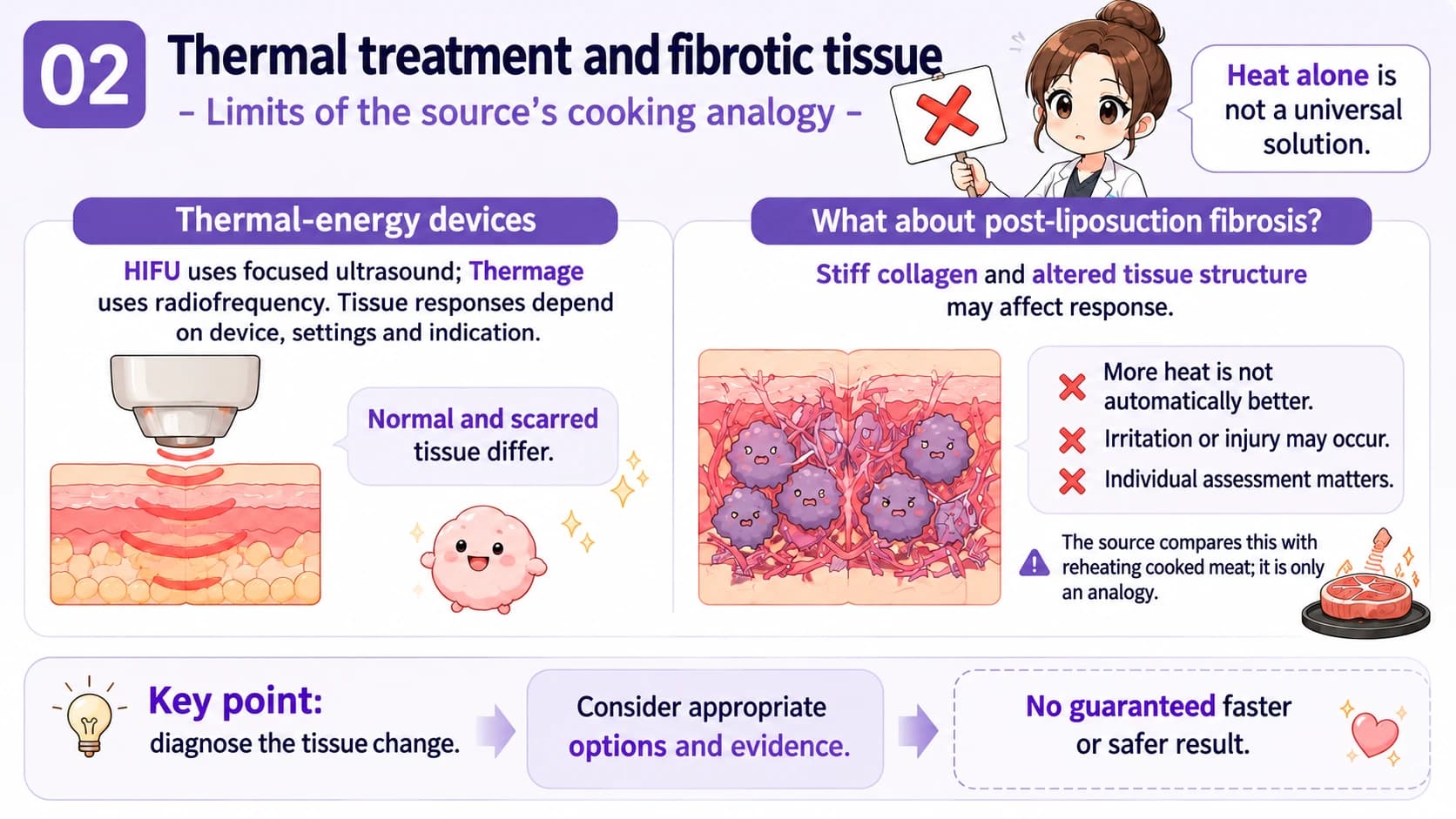
Energy-based treatment and fibrotic tissue
HIFU uses focused ultrasound, whereas Thermage uses radiofrequency. The source compares repeatedly heating fibrotic tissue to cooking meat again. An analogy cannot establish that treatment is ineffective or always makes tissue harder. Applicability and risk depend on the device, settings, site and tissue condition.
Approaches discussed in the literature
The source considers three different approaches, each with a different proposed role and evidence base.
CaHA and skin support
Radiesse contains calcium hydroxylapatite microspheres and is discussed as a biostimulator. The source describes fibroblast responses and collagen- and elastin-related tissue changes.
A scaffold is used as an analogy for the relationship between particles and surrounding tissue; it should not be read as a guarantee of rebuilding damaged layers.
Source figure caption: a 27-year-old woman, before treatment and at 16 weeks after three treatments six weeks apart. The reported amount was 6.0mL of a 1:3 dilution per visit per side, comprising 1.5mL CaHA and 4.5mL saline, delivered using a 22G cannula. These are study details, not instructions for self-treatment.
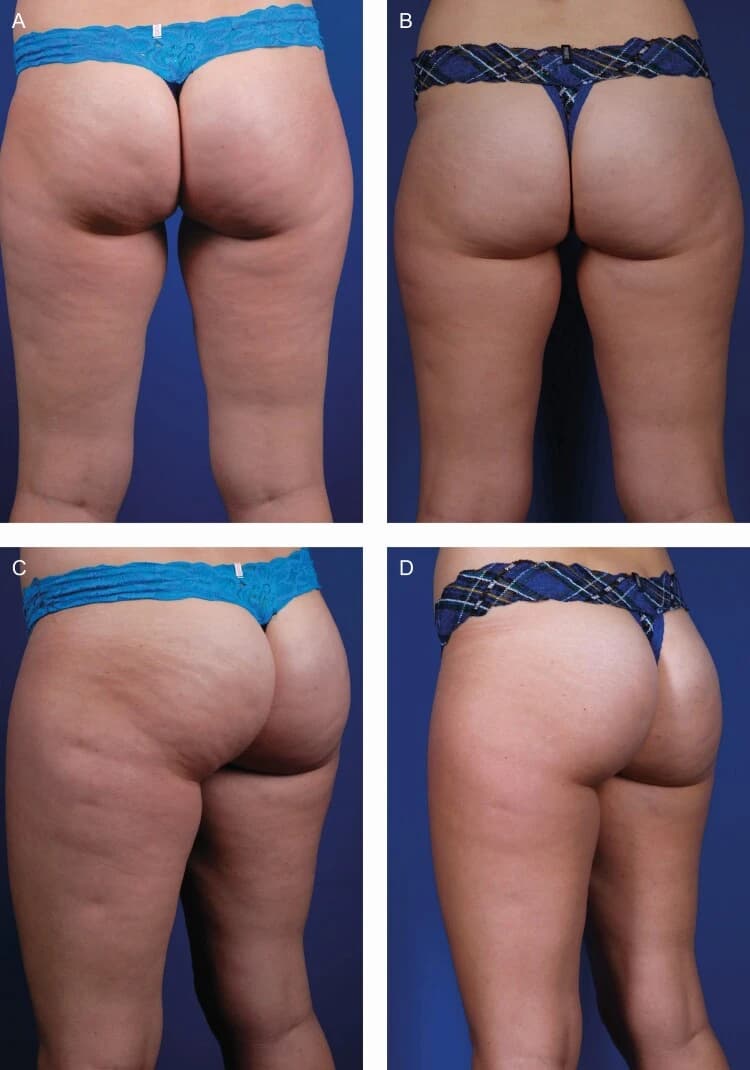
The source connects skin-support research with post-liposuction tissue changes and cites a clinical guidance paper.
The source cites Lorenc et al., Aesthetic Surgery Journal, 2022, PMC8849118, as discussing diluted CaHA for skin laxity and visible surface irregularities. The underlying population and recommendations need to be distinguished from a proven cure for fibrosis.
The author notes that severe, deep fibrosis may not be addressed by CaHA alone and emphasizes realistic expectations.
ESWT and tissue remodeling
Extracorporeal shock wave therapy delivers mechanical waves through the skin. Its established musculoskeletal uses and its investigated applications in skin fibrosis are different evidence questions.
The source compares the proposed mechanical effect to shaking a tightly clenched structure to loosen it.
The source discusses TGF-β1 and collagen remodeling. The 2024 paper PMC11452247 retrospectively observed 52 patients with dermal or subdermal fibrosis from various causes. Without a control group, it cannot establish efficacy for every post-liposuction contour problem or particular filler nodule; optimal protocols remain unsettled.
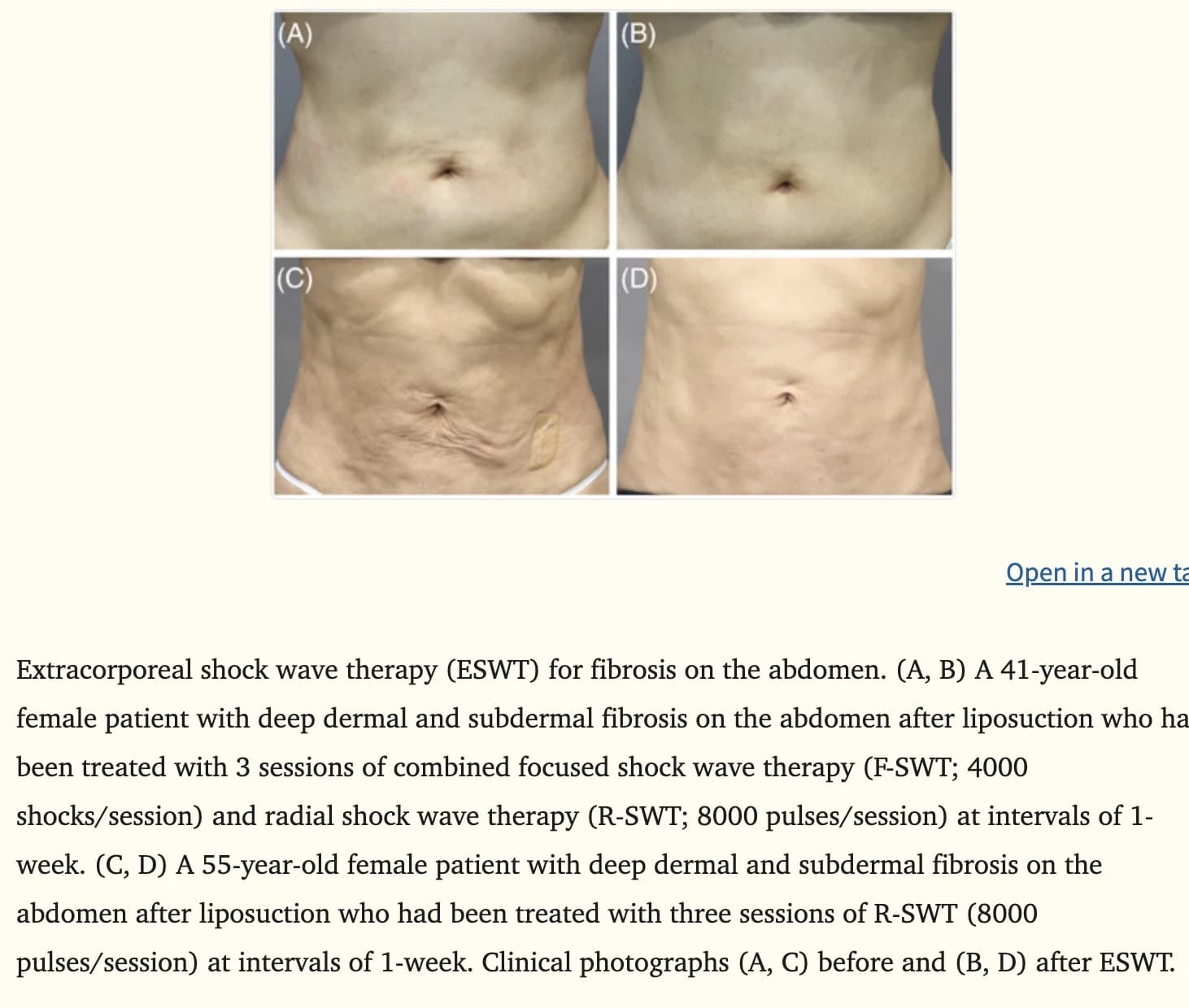
The original caption describes an individual abdominal contour change after three ESWT sessions. It is an observation, not a general expected result.
Botulinum toxin and fibrosis-related research
Research has examined botulinum toxin in scars as well as muscle relaxation. The source discusses possible fibroblast-related pathways.
Experimental effects on fibroblast proliferation and collagen production must be distinguished from clinical prevention of post-liposuction fibrosis.
The source links cellular hypotheses to scar care. PMC8249595 compares toxin doses in surgical scars and is not direct evidence that botulinum toxin stops post-liposuction fibrosis from progressing.
Considering the approaches together
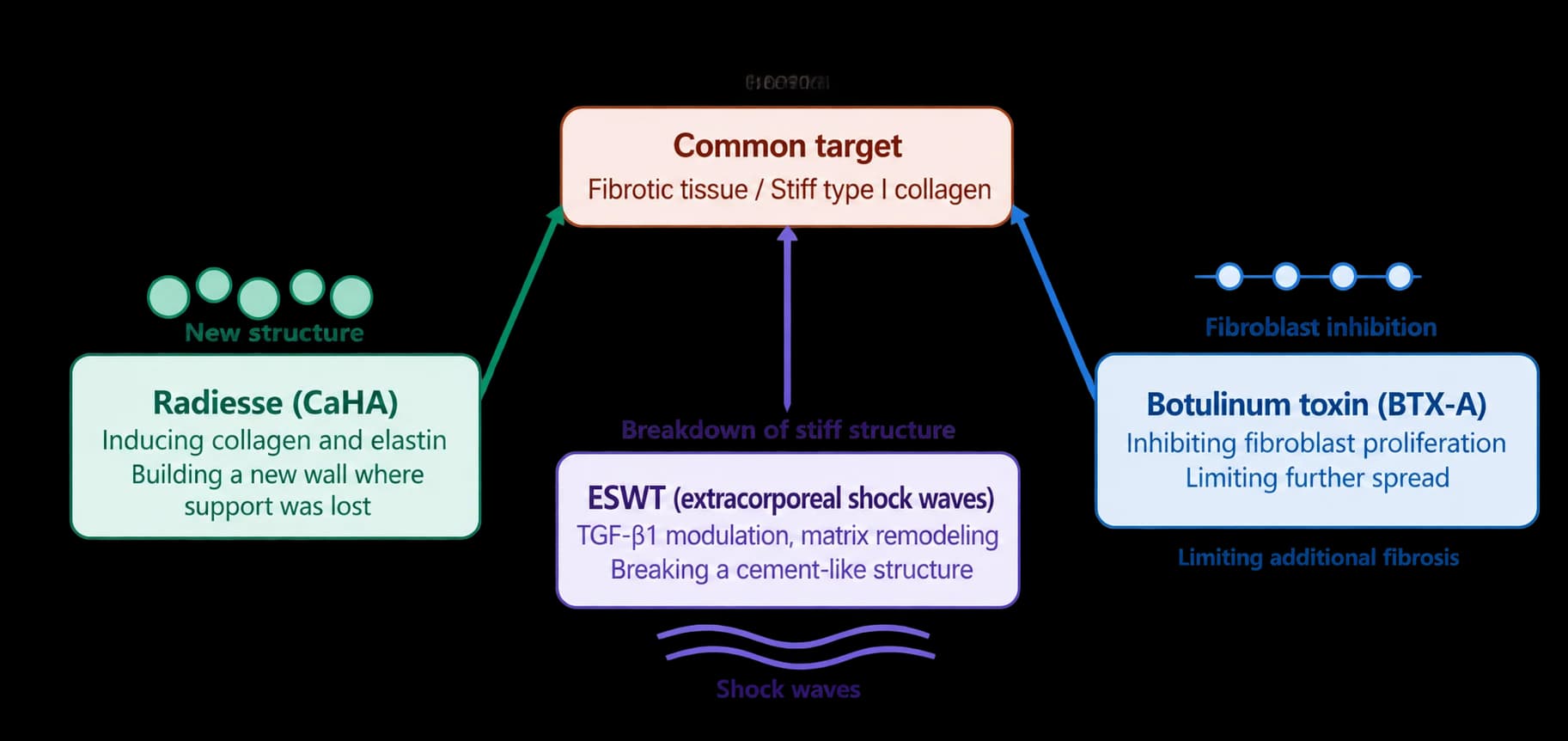
| Approach discussed | Topic in the source literature | | --- | --- | | CaHA | Skin laxity and tissue response | | ESWT | Remodeling of fibrotic tissue | | Botulinum toxin | Surgical scars and cellular hypotheses |
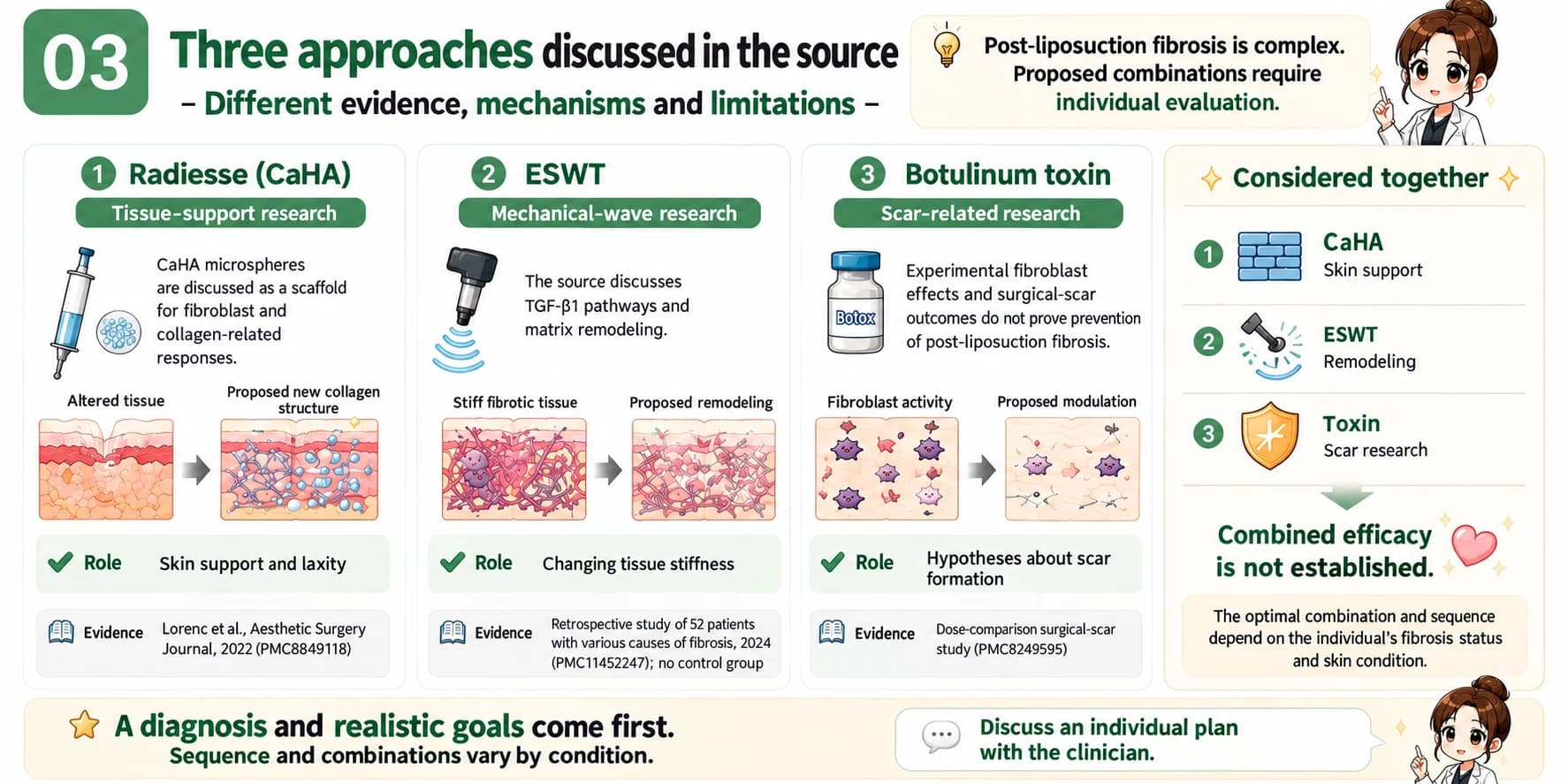
This table does not establish the efficacy or superiority of a combined treatment.
The source proposes considering different mechanisms together. Any combination or sequence requires individual assessment and should not be treated as an established protocol.
Closing reflection
Persistent symptoms after liposuction can lead people to repeat treatments without understanding the cause. A diagnosis and realistic goals are needed first.
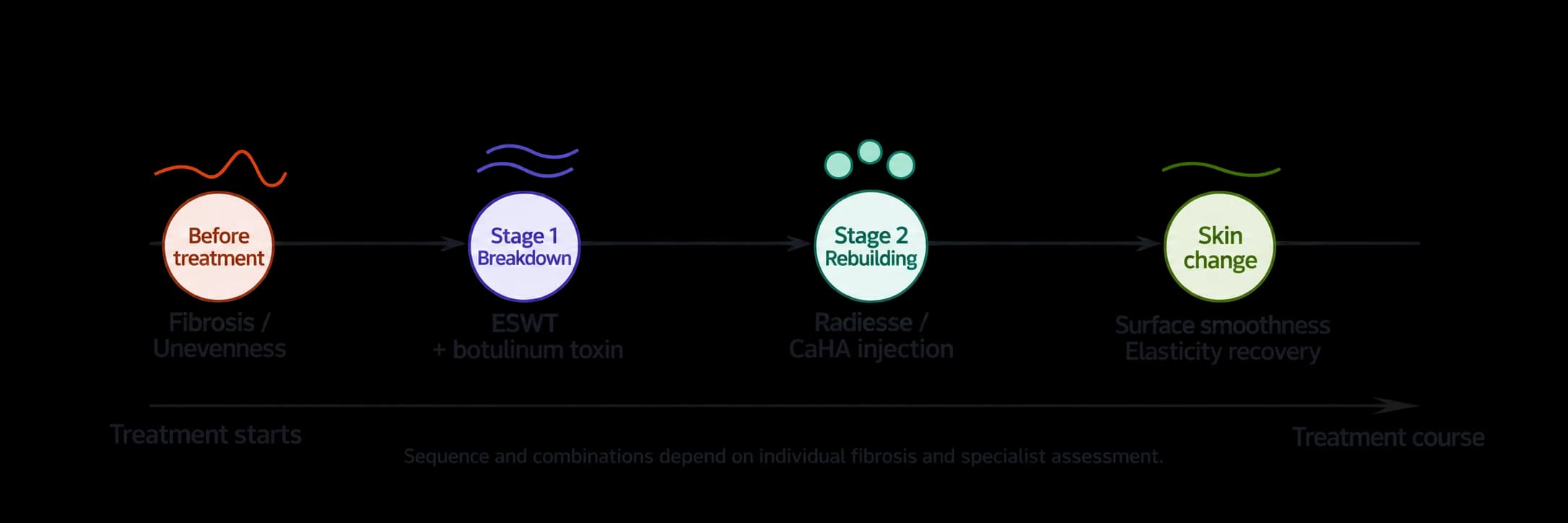
Persistent irregularities deserve assessment of the cause, course and need for treatment.
References cited in the source
Mera-Cruz G, et al. Fibrosis Management Algorithm in Secondary Liposculpture. Aesthetic Surgery Journal. 2024;44(8):859–868. https://pubmed.ncbi.nlm.nih.gov/38366902/
Lorenc ZP, et al. Skin Tightening With Hyperdilute CaHA. Aesthetic Surgery Journal. 2022;42(1):NP29–NP37. https://pmc.ncbi.nlm.nih.gov/articles/PMC8849118/
The source identifies the ESWT paper under a Kim et al. citation; the record and author details require reconciliation: https://pubmed.ncbi.nlm.nih.gov/39366905/
Fibrosis-related molecular research cited by the source: https://pmc.ncbi.nlm.nih.gov/articles/PMC5796073/
Botulinum toxin dose and surgical scar appearance: https://pmc.ncbi.nlm.nih.gov/articles/PMC8249595/
This article discusses published research and individual experiences, not guaranteed results or an individual diagnosis.
Materials linked by the source
Source: Original post on Dr. Hyemi Yu’s Naver blog (Korean)
The original publication date and the website revision date are shown separately.